DNA Now Stands For Data And Knowledge Accumulation

Technology frequently looks at nature to make improvements in efficiency, and we may be nearing a new breakthrough in copying how nature stores data. Maybe some day your thumb drive will be your actual thumb. The entire works of Shakespeare could be stored in an infinite number of monkeys. DNA could become a data storage mechanism! With all the sensationalism surrounding this frontier, it seems like a dose of reality is in order.

The Potential for Greatness

The human genome, with 3 billion base pairs can store up to 750MB of data. In reality every cell has two sets of chromosomes, so nearly every human cell has 1.5GB of data shoved inside. You could pack 165 billion cells into the volume of a microSD card, which equates to 165 exobytes, and that’s if you keep all the overhead of the rest of the cell and not just the DNA. That’s without any kind of optimizing for data storage, too.

This kind of data density is far beyond our current digital storage capabilities. Storing nearly infinite data onto extremely small cells could change everything. Beyond the volume, there’s also the promise of longevity and replication, maintaining a permanent record that can’t get lost and is easily transferred (like medical records), and even an element of subterfuge or data transportation, as well as the ability to design self-replicating machines whose purpose is to disseminate information broadly.

So, where is the state of the art in DNA data storage? There’s plenty of promise, but does it actually work?

Continue reading “DNA Now Stands For Data And Knowledge Accumulation”

Gravity-Defying Cosmetics Explained By Science!

There probably comes a point in every female technical journalist’s career at which she covers her first make-up story and wonders aloud whether this is what her life has come to. But this make-up story involves some physics, and follows a series of viral videos in the TikTok community in which specialist cosmetics vloggers were surprised to see lip gloss apparently levitating — defying gravity — from the ends of its applicators. This caught the attention of [Steve Mould], who followed up on his hunch that static electricity might be responsible. What follows in the video below the break are a variety of attempts to recreate and characterise the phenomenon.

The tried-and-trusted approach of rubbing feet on the carpet failing to cause any movement in the damp atmosphere of a British January, he’s off to try a Van de Graaff generator Even the hefty electrostatic charge from that failed to produce more than a tiny blip, but did at least give a suggestion that the effect might be electrostatic.

Finally he was able to replicate the beauty vloggers’ results using the FunFlyStick electrostatic toy, with satisfying threads of lip gloss heading off into the air. The FunFlyStick is an interesting device in its own right, being a Van de Graaff generator in toy form and capable of generating significant quantities of charge. The flying lip gloss is an interesting phenomenon, but speaks further about just how much electrostatic charge can accumulate on mundane objects in a dry climate. Those of in damper climes would do well to take note before we travel.

Continue reading “Gravity-Defying Cosmetics Explained By Science!”

Nuclear Fusion Power Without Regular Tokamaks Or Stellarators

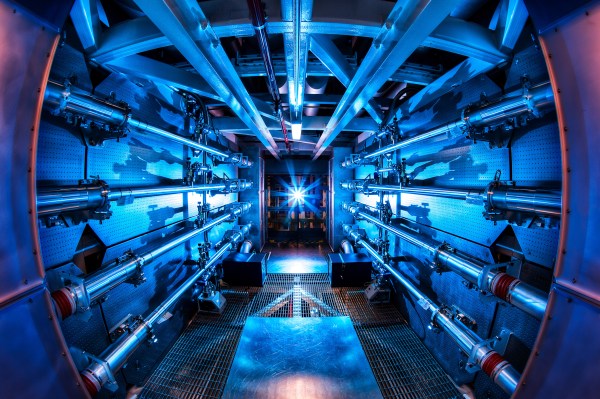
When it comes to nuclear fusion, the most well-known reactor type today is no doubt the tokamak, due to its relatively straight-forward concept of plasma containment. That’s not to say that there aren’t other ways to accomplish nuclear fusion in a way that could conceivably be used in a commercial power plant in the near future.

As we covered previously, another fairly well-known type of fusion reactor is the stellarator, which much like the tokamak, has been around since the 1950s. There are other reactor types from that era, like the Z-pinch, but they seem to have all fallen into obscurity. That is not to say that research on Z-pinch reactors has ceased, or that other reactor concepts — some involving massive lasers — haven’t been investigated or even built since then.

In this article we’ll take a look at a range of nuclear fusion reactor types that definitely deserve a bit more time in the limelight.

Continue reading “Nuclear Fusion Power Without Regular Tokamaks Or Stellarators”

Laser Etches Solar Absorbing Material

Having a laser cutter these days isn’t a big deal. But [Chunlei Guo], a professor at the University of Rochester, has a powerful femto-second pulse laser and used it to create what might be the perfect solar absorber. You can see a video about the work, below.

It stands to reason that white materials reflect most light and therefore absorb less energy than black materials — this is part of what makes a radiometer work. Tungsten, in particular, is a good metal for absorbing solar power, but this new laser treatment — which builds nanostructures on the surface of the metal — increases efficiency by 130% compared to untreated tungsten.

Continue reading “Laser Etches Solar Absorbing Material”

Tipping Points In The Climate System: The Worst Kind Of Positive Feedback

With global temperatures continuing to break records in recent years, it’s important to cast an eye towards the future. While efforts to reduce emissions remain in a political quagmire, time is running out to arrest the slide into catastrophe.

Further compounding the issue are a variety of positive feedback loops that promise to further compound the problem. In these cases, initial warming has flow-on effects that then serve to further increase global temperatures. Avoiding these feedback mechanisms is crucial if the Earth is to remain comfortably livable out to the end of the century.

A Multitude of Causes

The issue of climate change often appears as a simple one, with the goal being to reduce greenhouse gas emissions in order to prevent negative consequences for human civilization. Despite this, the effects of climate change are often diffuse and intermingled. The various climate systems of the Earth interact in incredibly complex ways, and there are many mechanisms at play in these feedback effects that could tip things over the edge.

Continue reading “Tipping Points In The Climate System: The Worst Kind Of Positive Feedback”

Growing Human Neurons Hooked Up To Electrodes

Philosophers have long mused about the concept of a “brain in a jar”, but thus far, it’s remained the preserve of science fiction rather than reality. However, after reading some scientific papers, [Justin] wanted to attempt the feat himself, so set out to grow some human neurons on an electrode array. 

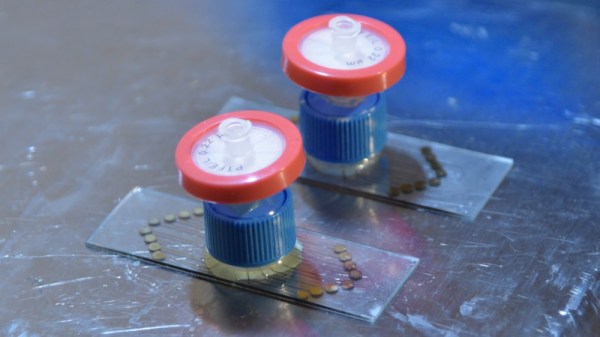
The project builds on [Justin]’s earlier work, using his DC sputtering rig to coat a glass microscope slide with electrodes. The first layer is silver for high conductivity, with an added gold layer for biocompatibility. The screw cap from a Falcon tube is then epoxied on to act as a reservoir for culture media for the neurons. Finally, an air filter is added to allow the biological mixture to breathe.

This was [Justin]’s first attempt at culturing neurons, and there were plenty of hurdles along the way. The custom culture assemblies had issues with the epoxy bonds leaking or failing entirely, leading to only one slide making it through the sterilization process. Additionally, the neurons were accidentally added in too high a quantity. While some growth was observed under the microscope, [Justin] was unable to detect any real signal from the system.

Despite a poor final result, plenty was learned along the way. [Justin] has already put plans into place to fix some of the pitfalls of the original experiment, and we look forward to seeing future updates from the project. Video after the break.

Continue reading “Growing Human Neurons Hooked Up To Electrodes”

Tricking The Brain Into Seeing Boosted Contrast In Stereo Imagery

Last year a team of researchers published a paper detailing a method of boosting visual contrast and image quality in stereoscopic displays. The method is called Dichoptic Contrast Enhancement (DiCE) and works by showing each eye a slightly different version of an image, tricking the brain into fusing the two views together in a way that boosts perceived image quality. This only works on stereoscopic displays like VR headsets, but it’s computationally simple and easily implemented. This trick could be used to offset some of the limitations of displays used in headsets, for example making them appear capable of deeper contrast levels than they can physically deliver. This is good, because higher contrasts are generally perceived as being more realistic and three-dimensional; important factors in VR headsets and other stereoscopic displays.

Stereoscopic vision works by having the brain fuse together what both eyes see, and this process is called binocular fusion. The small differences between what each eye sees mostly conveys a sense of depth to us, but DiCE uses some of the quirks of binocular fusion to trick the brain into perceiving enhanced contrast in the visuals. This perceived higher contrast in turn leads to a stronger sense of depth and overall image quality.

Example of DiCE-processed images, showing each eye a different dynamic contrast range. The result is greater perceived contrast and image quality when the brain fuses the two together.

To pull off this trick, DiCE displays a different contrast level to both eyes in a way designed to encourage the brain to fuse them together in a positive way. In short, using a separate and different dynamic contrast range for each eye yields an overall greater perceived contrast range in the fused image. That’s simple in theory, but in practice there were a number of problems to solve. Chief among them was the fact that if the difference between what each eyes sees is too great, the result is discomfort due to binocular rivalry. The hard scientific work behind DiCE came from experimentally determining sweet spots, and pre-computing filters independent of viewer and content so that it could be applied in real-time for a consistent result.

Things like this are reminders that we experience the world only through the filter of our senses, and our perception of reality has quirks that can be demonstrated by things like this project and other “sensory fusion” edge cases like the Thermal Grill Illusion, which we saw used as the basis for a replica of the Pain Box from Dune.

A short video overview of the method is embedded below, and a PDF of the publication can be downloaded for further reading. Want a more hands-on approach? The team even made a DiCE plugin (freely) available from the Unity asset store.

Continue reading “Tricking The Brain Into Seeing Boosted Contrast In Stereo Imagery”