Using Azo Photoisomerization To Alter Semiconductor Film Properties

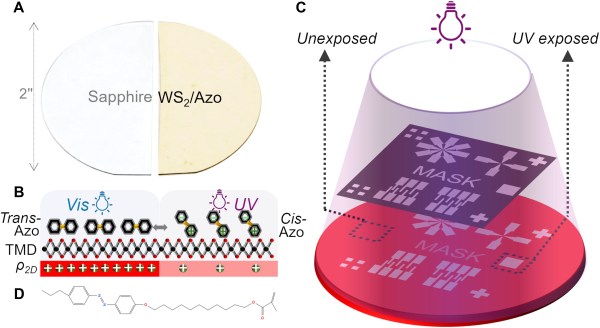
Generally semiconductor devices like transistors have fixed properties, but using an azobenzene (Azo) compound it’s possible to optically alter these properties by exposing them to UV light. This is demonstrated in a recent paper by [Jaehoon Ji] et al., as published in Science Advances, with accompanying coverage by Princeton University.

Building on previous research on e.g. flakes of MoS2 with photochromic Azo molecules, a functional semiconductor device was created. This uses a transition metal dichalcogenide (TMD) monolayer combined with the Azo compound, with the latter altering the electrical and optical properties of the structure.

In both n- and p-type FET semiconductors it was demonstrated using visible and UV light that this can alter the carrier densities in the material, effectively altering the FET’s behavior.

While this is of course just a proof of concept, it does show that by using (Azo) molecules that can respond to certain electromagnetic radiation frequencies, electric fields, temperature, etc. semiconductor devices can be created whose behavior dynamically changes with these factors. This could potentially provide new ways to make programmable circuits and sensors.
Heat Domes: Meet The Quiet And Oppressive Take On The Thunderdome

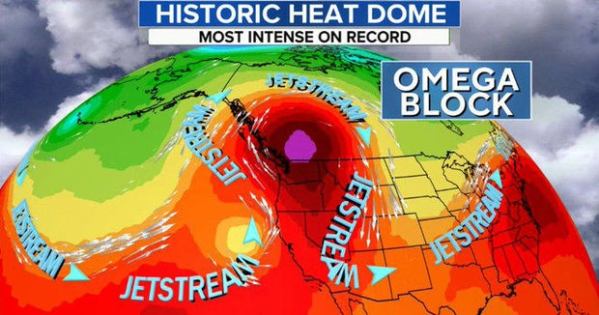
One of the nice things about the weather is that even if it’s bad right now, it’ll definitely be changing soon and maybe even for the better. There is one exception to this rule, however, and that comes in the form of heat domes, which are weather systems whereby a region of air becomes isolated from the surrounding systems. This creates effectively a greenhouse, with hot air remaining trapped and moisture unable to get in.

Although until recently not very common, this weather phenomenon poses a major challenge to any flora and fauna that finds itself trapped in a heat dome. With nights being about as hot and stifling as the days with their blue skies unbroken by any cloud cover and no rain for potentially weeks on end, it poses severe hydration, cardiovascular, and other challenges to any affected lifeforms.

Continue reading “Heat Domes: Meet The Quiet And Oppressive Take On The Thunderdome” →

Fly Brain Connectome Used To Trade Stocks And Play Games

Recently researchers finished mapping the central nervous system (CNS) connectome of not just the female Drosophila melanogaster (i.e. fruit fly) brain, but also that of the male D. melanogaster for a comparative analysis. Here the sexually dimorphic changes turned out to induce specific mating behavior that ensures that there will only be smooching between genetically fit D. melanogaster males and females, while the rest of the connectome remained effectively the same.

Of course, with this connectome in hand it led some people to ask themselves what else one can do with this connectome graph of about 160,000 neurons other than make a fruit fly into a fruit fly. So far we have seen [Nftechie] turn this connectome into a crypto stock trader with the Stonkfly project that uses the connectome’s reward circuits to potentially make profitable trades, though [Nftechie] says that they haven’t verified yet how good a fruit fly is at trading stocks, only that it does said stonks.

Over at [PC Gamer] they summarized a number of things that people have also done, including trying to make the connectome control a game of DOOM and Beat Saber. Each game frame stimulates sensory neurons, with the generated outputs then mapped to game controls, with dopamine-producing reward circuits wired in for reinforcement learning.

Although the D. melanogaster brain is only the merest fraction of the size of the human brain, it does provide us with a glimpse of what actual artificial intelligence research may lead to, as we unravel how even a 160,000 neuron connectome is enough to make these terrors of rotting plant matter do their wonderful things.

Re-creating NASA’s Heat Shield Problem

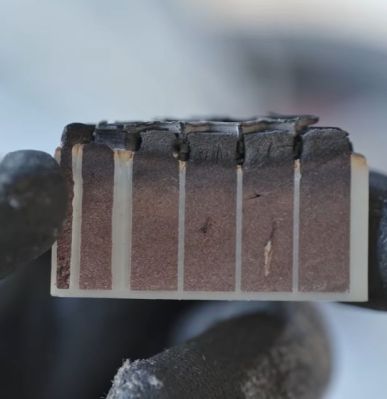
After the Orion capsule of the Artemis I lunar mission returned to Earth, it was found that massive chunks of its heatshield had been ripped off, posing a serious risk to any future missions. In a recent video in which [polymatt] takes a break from repairing old laptop shells and the like, he tries to recreate the Orion’s heatshield using a variety of methods and materials.

For this test a number of samples were created, each using the same kind of segmented structure as the larger Orion heatshield. The filler was created from the published materials for the heat shield by NASA, requiring just serious mixing.

The resulting samples were then cured with thermocouples inserted, before they got blasted with the heat from a propane torch, trying to simulate the various re-entry patterns.

Perhaps unsurprisingly, the results matched the findings by NASA for why the Orion’s heat shield had failed, being the build-up of gases due to the sustained pyrolysis processes that eventually fractured the material. Despite some experimental flaws that injected residual heat from the copper structure, this still seems to be a pretty good setup to test ablative heat shields in DIY lab conditions.

Continue reading “Re-creating NASA’s Heat Shield Problem” →

The Heavy Disco-Ball Satellite Designed To Do… Nothing

Launched in 1976, LAGEOS-1 (LAser GEOdynamic Satellite) is unusual in that it contains no instrumentation, no electronics, no power supply, and no means of propulsion. It’s spherical, weighs just under 407 kg, and looks a bit like a disco ball. It may not be accurate to say it does nothing, but unlike most satellites its role is entirely passive. It’s also one of the oldest scientific satellites still in service.

The lens-like objects covering the surface of LAGEOS-1 are corner cube retroreflectors, which have the nifty effect of always reflecting incident light right back towards its source.

Ground stations fire short laser pulses at it and measure the time it takes for the light to return, a form of time-of-flight ranging. Since LAGEOS-1’s orbit is highly stable, it provides a reliable reference point for measuring even tiny changes in the Earth itself. The size, shape, rotation, and more of our planet can be measured as a result. LAGEOS data (LAGEOS-2 was launched in 1992) has also been used in tests of general relativity.

Its orbit and construction were deliberately chosen so that atmospheric drag and other disturbances would be minimal. The simple, maintenance-free design combined with an extraordinarily stable orbit means LAGEOS is expected to circle our world for millions of years to come.

LAGEOS-1 also contains a message to the future in the form of two identical plaques prepared by Dr. Carl Sagan just in case there’s anyone around to find it some day. Check out the short 1975 video from NASA, embedded just below.

Continue reading “The Heavy Disco-Ball Satellite Designed To Do… Nothing” →

Hunting The Wild Vibrotruck

A few weeks ago, my wife was out walking the dog, and she sent me four or five photos of small orange boxes planted all around our neighborhood. (OK, I’ll bite!) They had little cards on them explaining that they were geophones, and a QR code on them that lead to a website with all the details. Munich was getting a large-scale seismic survey to map out our underground water, with the aim of using it for geothermal heat and power in the near future.

How do you map up to five kilometers under the earth? You pound the ground, sending shockwaves downward, and then listen for their reflections. At the boundaries between different layers, the change in the speed of sound in the different media cause reflections. Calculating the time it took for a given reflection to reach you lets you figure out how deep the layer boundary is.

The seismic survey procedure goes like this: geophones are set out at roughly 20 m intervals in lines spaced around 300 m apart that run roughly north-south, while “vibrotrucks” drive a roughly east-west course, creating mini-earthquakes every 20 meters along the way. Covering a surface of 1,000 km^2 with over 120,000 sample locations and exciting them 86,000 times is going to take a while. Lucky for me, they started in my part of town.

Continue reading “Hunting The Wild Vibrotruck” →

The Different Ways To Look At Negative Resistance

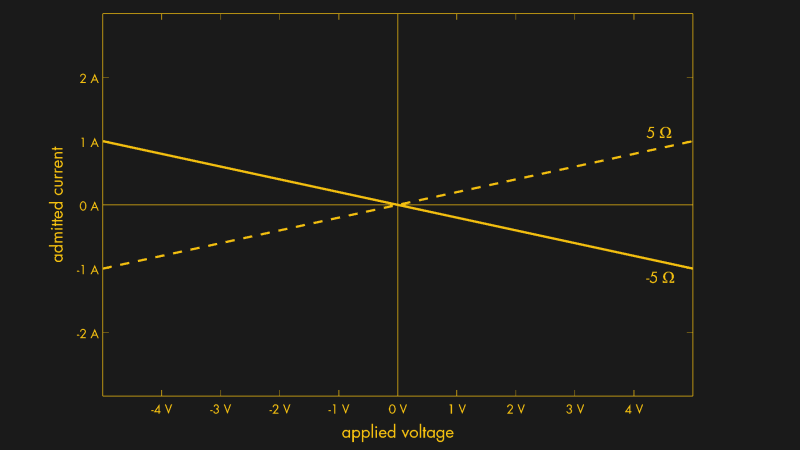
[lcamtuf] has an in-depth look at the concept of negative resistance that goes somewhat further than one might expect. Normally, as voltage across a resistance increases so too does the current. Negative resistance is the concept of current decreasing as voltage increases. But beyond the raw concept, there are a few other ways to look at this idea.

The usual way to think about it is negative differential resistance (NDR). Not everything has a linear relationship between voltage and current, and for a device to exhibit NDR means that in certain ranges the I–V curve actually slopes downward; increasing one of voltage or current decreases the other. This kind of thing occurs in neon lamps. Once they are glowing, increasing current can result in decreasing voltage.

True negative resistance, that of a literal -100 Ω resistor, does not exist. Not in the sense of a passive component, anyway. Such a device would supply power into a circuit rather than dissipating it, and would therefore require an external power source to do so. If that’s not a deal breaker, then it’s actually fairly simple to build one. [lcamtuf] provides a design for a device that uses an op-amp to exhibit ideal constant negative resistance. Naturally it only does so within its operating range; going beyond risks letting out the magic smoke.

Is making a literal negative resistor of practical use? Perhaps only in very specialized situations. But it is worth having a basic understanding if for no other reason than it rears its head in unusual places: the strange tunnel diode comes to mind.