Particle Physics On A Small, Affordable PCB

Experimenting in the world of particle physics probably brings to mind large, expensive pieces of equipment like particle accelerators, or at least exotic elements or isotopes that most of us can’t easily find. But plenty of common objects emit various particles, and it turns out that detecting these particles does not require government backing or acres of test equipment. In fact, you can get this job done with a few readily-available parts and [Tim] shows us how it’s done with his latest project.

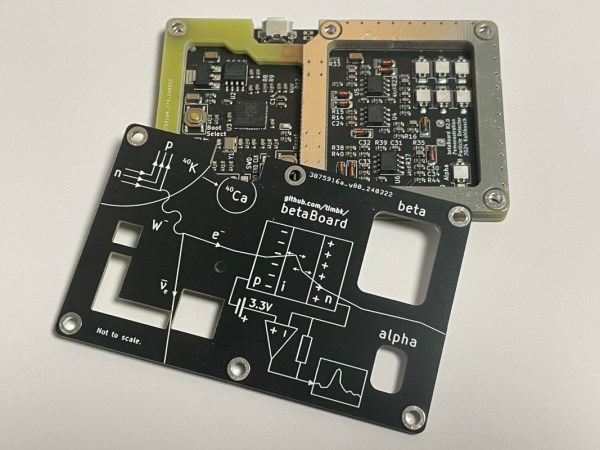
The goal of his build is to have a working particle detector for less than $10 per board, although he’s making them in bulk to be used in an educational setting. The board uses a set of photodiodes enclosed in a protective PCB sandwich to detect beta particles from a Potassium-40 source. The high-energy electron interacts with the semiconductor in the photodiode and creates a measurable voltage pulse, which can be detected and recorded by the microcontroller on the board. For this build an RP2040 chip is being used, with a number of layers of amplification between it and the photodetector array used to get signals that the microcontroller can read.

Getting particle physics equipment into the hands of citizen scientists is becoming a lot more common thanks to builds like this which leverage the quirks of semiconductors to do something slightly outside their normal use case, and of course the people building them releasing their projects’ documentation on GitHub. We’ve also seen an interesting muon detector with a price tag of around $100 and an alpha particle detector which uses a copper wire with a high voltage to do its work.

Amputation and wound care behavior in C. floridanus (A) Illustration of a worker providing wound care on a femur-injured individual. (B) A worker amputating (biting) the injured leg at the trochanter. (C) A worker providing wound care on the newly created trochanter wound after amputation. (D) Percentage of amputations performed on ants with an infected or sterile femur (red) or tibia (blue) injury after 24 h. Numbers above the bars represent the sample size for each treatment. (E) Percentage of time the injured ant received wound care behavior over 3 h, binned in 10 min intervals, with a local polynomial regression (loess) showing a 95% confidence interval for the first 3 h after the experimental femur injury (femur, red: n = 8) and the first 3 h after amputation on the trochanter wound (trochanter, brown: n = 7).

Surgery — Not Just For Humans Anymore

Sometimes, a limb is damaged so badly that the only way to save the patient is to amputate it. Researchers have now found that humans aren’t the only species to perform life-saving amputations. [via Live Science]

While some ants have a gland that secretes antimicrobial chemicals to treat wounds in their comrades, Florida carpenter ants have lost this ability over the course of evolution. Lacking this chemical means to treat wounds, these ants have developed the first observed surgery in an animal other than humans.

When an ant has a wounded leg, its fellow ants analyze the damage. If the femur is the site of the wound, the other ants removed the damaged limb in 76% of cases by biting it off, while tibial wounds were treated in other ways. Experimental amputations of the tibia by researchers showed no difference in survivability compared to leaving the limb intact unless the amputation was performed immediately, so it seems the ants know what they’re doing.

Maybe these ants could be helpful surgical aids with some cyborg additions since they’ve already got experience? Ants can help you with programming too if that’s more your speed.

Continue reading “Surgery — Not Just For Humans Anymore”

You Can Build A Little Car That Goes Farther Than You Push It

Can you build a car that travels farther than you push it? [Tom Stanton] shows us that you can, using a capacitor and some nifty design tricks.

[Tom]’s video shows us the construction of a small 3D printed trike with a curious drivetrain. There’s a simple generator on board, which charges a capacitor when the trike is pushed along the ground. When the trike is let go, however, this generator instead acts as a motor, using energy stored in the capacitor to drive the trike further.

When put to the test by [Tom], both a freewheeling car and the capacitor car are pushed up to a set speed. But the capacitor car goes farther. The trick is simple – the capacitor car can go further because it has more energy. But how?

It’s all because more work is being done to push the capacitor car up to speed. It stores energy in the capacitor while it’s being accelerated by the human pushing it. In contrast, after being pushed, the freewheeling car merely coasts to a stop as it loses kinetic energy. However, the capacitor car has similar kinetic energy plus the energy stored in its capacitor, which it can use to run its motor.

It’s a neat exploration of some basic physics, and useful learning if you’ve ever wondered about the prospects of perpetual motion machines.

Continue reading “You Can Build A Little Car That Goes Farther Than You Push It”

PeLEDs: Using Perovskites To Create LEDs Which Also Sense Light

With both of the dominant display technologies today – LCD and OLED – being far from perfect, there is still plenty of room in the market for the Next Big Thing. One of the technologies being worked on is called PeLED, for Perovskite LED. As a semiconductor material, it can both be induced to emit photons as well as respond rather strongly to incoming photons. That is a trick that today’s displays haven’t managed without integrating additional sensors. This technology could be used to create e.g. touch screens without additional hardware, as recently demonstrated by [Chunxiong Bao] and colleagues at Linköping University in Sweden and Nanjing University in China.

Their paper in Nature Electronics describes the construction of photo-responsive metal halide perovskite pixels, covering the typical red (CsPbI3−xBrx), green (FAPbBr3), and blue (CsPbBr3−xClx) wavelengths. The article also describes the display’s photo-sensing ability to determine where a finger is placed on the display. In addition, it can work as an ambient light sensor, a scanner, and a solar cell to charge a capacitor. In related research by [Yun Gao] et al. in Nature Electronics, PeLEDs are demonstrated with 1 microsecond response time.

As usual with perovskites, their lack of stability remains their primary obstacle. In the article by [Chunxiong Bao] et al. the manufactured device with red pixels was reduced to 80% of initial brightness after 18.5 hours. While protecting the perovskites from oxygen, moisture, etc. helps, this inherent instability may prevent PeLEDs from ever becoming commercialized in display technology. Sounds like a great challenge for the next Hackaday Prize!

Repeatable “One-Click” Fusion, From Your Cellphone

Sometimes you spend so much time building and operating your nuclear fusor that you neglect the creature comforts, like a simple fusion control profile or a cellphone app to remote control the whole setup. No worries, [Nate Sales] has your back with his openreactor project, your one-click fusion solution!

An inertial electrostatic confinement (IEC) fusor is perhaps the easiest type of fusion for the home gamer, but that’s not the same thing as saying that building and running one is easy. It requires high vacuum, high voltage, and the controlled introduction of deuterium into the chamber. And because it’s real-deal fusion, it’s giving off neutrons, which means that you don’t want to be standing on the wrong side of the lead shielding. This is where remote control is paramount.

While this isn’t an automation problem that many people will be having, to put it lightly, it’s awesome that [Nate] shared his solution with us all. Sure, if you’re running a different turbo pump or flow controller, you might have some hacking to do, but at least you’ve got a start. And if you’re simply curious about fusion on a hobby scale, his repo is full of interesting details, from the inside.

And while this sounds far out, fusion at home is surprisingly attainable. Heck, if a 12-year old or even a YouTuber can do it, so can you! And now the software shouldn’t stand in your way.

Thanks [Anon] for the tip!

Putting Some Numbers On Your NEMAs

It’s official: [Engineer Bo] wins the internet with a video titled “Finding NEMA 17,” wherein he builds a dynamometer to find the best stepper motor in the popular NEMA 17 frame size.

Like a lot of subjective questions, the only correct answer to which stepper is best is, “It depends,” and [Bo] certainly has that in mind while gathering the data needed to construct torque-speed curves for five samples of NEMA 17 motors using his homebrew dyno. The dyno itself is pretty cool, with a bicycle disc brake to provide drag, a load cell to measure braking force, and an optical encoder to measure the rotation of the motor under test. The selected motors represent a cross-section of what’s commonly available today, some of which appear in big-name 3D printers and other common applications.

[Bo] tested each motor with two different drivers: the TMC2209 silent driver to start with, and because he released the Magic Smoke from those, the higher current TB6600 module. The difference between the two drivers was striking, with lower torque and top speeds for the same settings on each motor using the TB6600, as well as more variability in the data. Motors did better across the board with the TBC6600 at 24 volts, showing improved torque at higher speeds, and slightly higher top speeds. He also tested the effect of microstepping on torque using the TBC6600 and found that using full steps resulted in higher torque across a greater speed range.

At the end of the day, it seems as if these tests say more about the driver than they do about any of the motors tested. Perhaps the lesson here is to match the motor to the driver in light of what the application will be. Regardless, it’s a nice piece of work, and we really appreciate the dyno design to boot — reminds us of a scaled-down version of the one [Jeremey Fielding] demonstrated a few years back.

Continue reading “Putting Some Numbers On Your NEMAs”

A Brief History Of Perpetual Motion

Conservation of energy isn’t just a good idea: It is the law. In particular, it is the first law of thermodynamics. But, apparently, a lot of people don’t really get that because history is replete with inventions that purport to run forever or produce more energy than they consume. Sometimes these are hoaxes, and sometimes they are frauds. We expect sometimes they are also simple misunderstandings.

We thought about this when we ran across the viral photo of an EV with a generator connected to the back wheel. Of course, EVs and hybrids do try to reclaim power through regenerative braking, but that’s recovering a fraction of the energy already spent. You can never pull more power out than you put in, and, in fact, you’ll pull out substantially less.

Not a New Problem

If you think this is a scourge of social media and modern vehicles, you’d be wrong. Leonardo da Vinci, back in 1494, said:

Oh ye seekers after perpetual motion, how many vain chimeras have you pursued? Go and take your place with the alchemists.

There was a rumor in the 8th century that someone built a “magic wheel,” but this appears to be little more than a myth. An Indian mathematician also claimed to have a wheel that would run forever, but there’s little proof of that, either. It was probably an overbalanced wheel where the wheel spins due to weight and gravity with enough force to keep the wheel spinning.

Continue reading “A Brief History Of Perpetual Motion”