In the fast-moving world of battery research, scientists are constantly on the lookout for innovative materials with the right properties to help improve energy storage. Meanwhile, batteries are in greater demand than ever as production of EVs and renewable energy projects ramp up to new heights.
Water is heavy, so if you think about it, a moving ocean wave has quite a bit of energy. Scientists have a new way to use triboelectric generators to harvest that power for oceangoing systems. (PDF) Triboelectric nanogenerators (TENGs) are nothing new, but this new approach allows for operation where the waves have lower amplitude and frequency, making traditional systems useless.
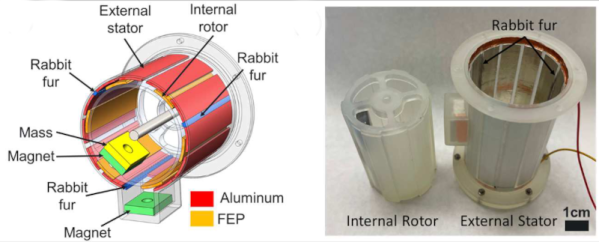
The new approach uses a rotor and a stator, along with some aluminum, magnets, and — no kidding — rabbit fur. The stator is 3D printed in resin. The idea is to mechanically accumulate and amplify small low-frequency waves into high-frequency motion suitable for triboelectric generation.
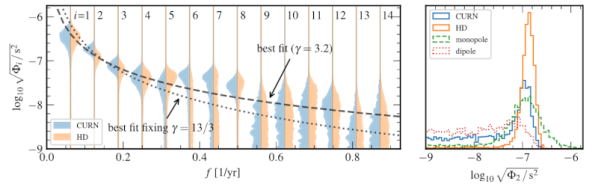
Detecting gravity waves isn’t easy. But what if you had a really big detector for a long time? That’s what researchers did when they crunched 15 years’ worth of data from the NANOGrav data set. The data was collected from over 170 radio astronomers measuring millisecond pulsars as a way to potentially detect low-frequency gravity waves.
Millisecond pulsars spin fast and make them ideal for the detection of low-frequency gravity waves, which are difficult to detect. The bulk of the paper is about the high-powered data analysis for a very large data set.
Steam generators in thermal (steam-cycle) power plants require a constant influx of cool water to maximize the transfer of thermal energy. How this water is cooled again in the condensor after much of the steam’s thermal energy has been spent in the steam turbines or heat exchangers is a very important consideration in the design and construction of these plants. The most obvious and straightforward system is direct “once-through” cooling, where the water is drawn straight from a nearby river or other body of water and released after passing through the condenser. This type of system is by far the cheapest, but is also impacted by both the seasons and environmental considerations.
Where cool surface water is less abundantly available, evaporative cooling in a recirculating system such as with spray ponds and cooling towers is a good alternative. Although slightly more costly, a big benefit of these is that they require far less water and have much more control over the intake water temperature, which can raise plant efficiency. Finally, dry cooling is essentially a closed-loop system, which is exceedingly useful in areas where water is scarce. This latter type of cooling is what allows thermal plants to operate even in desert regions.
As the global climate changes – with more extreme weather events – picking the right cooling solution is more important than ever, and has us looking at retrofitting existing thermal plants with more efficient solutions. If you were ever curious how power plants keep the cool side cool, read on!
According to [Charles Q. Choi], a new study indicates that grooves in the hydrogen fuel cells used to power vehicles can improve their performance by up to 50%. Fuel cells are like batteries because they use chemical reactions to create electricity. Where they are different is that a battery reacts a certain amount of material, and then it is done unless you recharge it somehow. A fuel cell will use as much fuel as you give it. That allows it to continue creating electricity until the fuel runs out.
Common hydrogen fuel cells use a proton exchange membrane — a polymer membrane that conducts protons to separate the fuel and the oxidizer. You can think of it as an electrolyte. Common fuel cells use an electrode design that hasn’t changed in decades. The new research has catalyst ridges separated by empty grooves. This enhances oxygen flow and proton transport.
Conventional electrodes use an ion-conducting polymer and a platinum catalyst. Adding more polymer improves proton transport but inhibits oxygen flow. The grooved design allows for dense polymer on the ridges but allows oxygen to flow in the grooves. In technical terms, the proton transport resistance goes down, and there is little change in the oxygen transport resistance.
The grooves are between one and two nanometers wide, so don’t pull out your CNC mill. The researchers admit they had the idea for this some time ago, but it has taken several years to figure out how to fabricate the special electrodes.
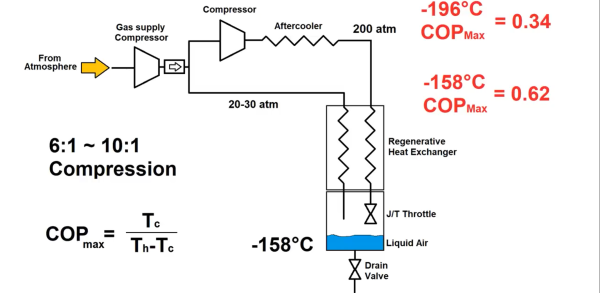
The fun part about crycoolers is that there are so many different and exciting ways to make stuff cold, based on a wide variety of physics. This is why after first exploring the Stirling/GM cycle and vapor-compression to create a cryocooler that he could liquefy nitrogen with, [Hyperspace Pirate] is exploring a Joule-Thomson cooler, which is also misspelled as ‘Joule-Thompson’ by those who don’t mind take some liberties with history. Either way, the advantage of the adiabatic Joule-Thomson effect is that it is significantly simpler than the other methods — having been invented in the 19th century and used for the earliest forms of refrigeration.
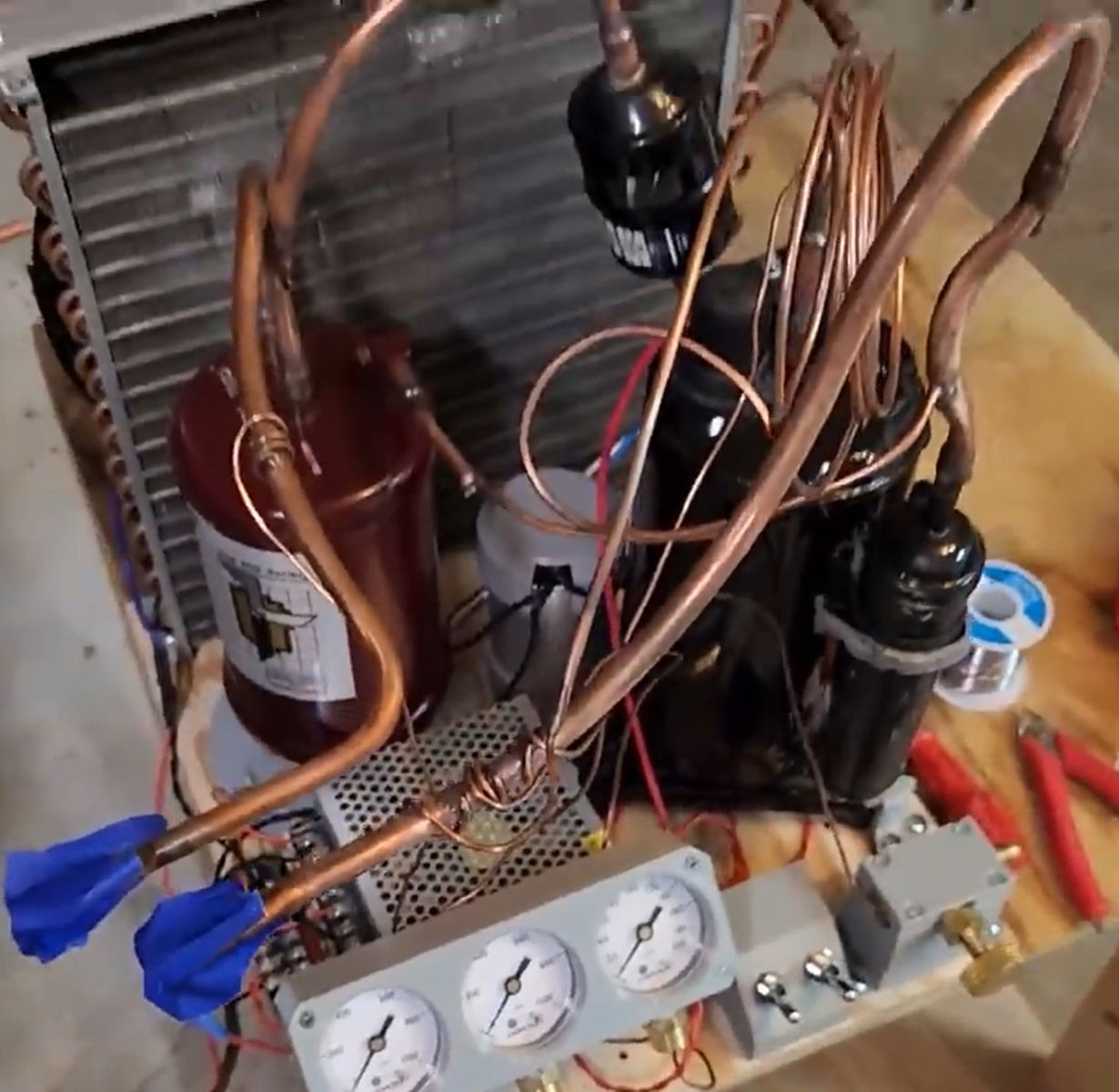
This is what peak Joule-Thomson prototype cooler performance looks like.
The big difference between it and other technologies is that the effect is based on throttling the flow of a gas as it seeks to expand, within specific temperature and pressure ranges to ensure that the temperature change effect is positive (i.e. the temperature of the gas decreases). The net result is that of a cooling effect, which as demonstrated in the video can be used with successive stages involving different gases, or a gas mixture, to reach a low enough temperature at which nitrogen (contained in the same gas mixture) liquefies and can be collected.
Although not a very efficient process, if your local electricity costs allow it, running the compressor in a closed loop version isn’t that expensive and worth it for the science alone. Naturally, as with any experimental setup involving a range of gases, a compressor and other components, getting it to run perfectly on the first try is basically impossible, which is why this is so far Part 1 of another series on cryocoolers at home (or in the garage).
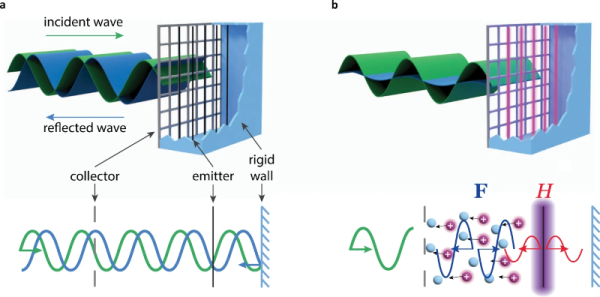
Most noise-blocking headphones fall into two categories: they use some kind of material to absorb or scatter noise, or they use active cancellation that creates a signal to oppose the noise signal. As you’ve probably noticed, both of these approaches have limitations. Now, Swiss scientists think they have a new method that will work better. In Nature Communications, they describe a noise cancellation system that moves air by using ionization instead of a conventional transducer.
With the cool name plasmaacoustic metalayers, the technique uses a controlled corona discharge to create very thin layers of plasma between a metal grid and thin wires. With no voltage, sound passes freely. Applying a voltage across the assembly produces ions and moves air with very low inertia, unlike a typical speaker. By controlling the reverse pressure of air, the system can cancel incoming noise picked up by a microphone.