Ask Hackaday: Vibe Coding

Vibe coding is the buzzword of the moment. What is it? The practice of writing software by describing the problem to an AI large language model and using the code it generates. It’s not quite as simple as just letting the AI do your work for you because the developer is supposed to spend time honing and testing the result, and its proponents claim it gives a much more interactive and less tedious coding experience. Here at Hackaday, we are pleased to see the rest of the world catch up, because back in 2023, we were the first mainstream hardware hacking news website to embrace it, to deal with a breakfast-related emergency.

Jokes aside, though, the fad for vibe coding is something which should be taken seriously, because it’s seemingly being used in enough places that vibe coded software will inevitably affect our lives.  So here’s the Ask Hackaday: is this a clever and useful tool for making better software more quickly, or a dangerous tool for creating software nobody quite understands, containing bugs which could cause a disaster?

Our approach to writing software has always been one of incrementally building something from the ground up, which satisfies the need. Readers will know that feeling of being in touch with how a project works at all levels, with a nose for immediately diagnosing any problems that might occur. If an AI writes the code for us, the feeling is that we might lose that connection, and inevitably this will lead to less experienced coders quickly getting out of their depth. Is this pessimism, or the grizzled voice of experience? We’d love to know your views in the comments. Are our new AI overlords the new senior developers? Or are they the worst summer interns ever?

In 2025, The Philly Maker Faire Finds Its Groove

The first Philadelphia Maker Faire was extremely impressive, and seemed poised to be one of the premier maker events on the East Coast. Unfortunately, it had the misfortune of happening just a few months before COVID-19 made such events impossible. Robbed of all its momentum, the event tried out different venues after the shadow of the pandemic was gone, but struggled to meet the high bar set by that inaugural outing.

But after attending the the 2025 Philadelphia Maker Faire this past weekend, I can confidently say the organizers have moved the needle forward. This year marks the second time the event has been held at the Cherry Street Pier, a mixed-use public space with an artistic bent that not only lends itself perfectly to the spirit of Maker Faire but offers room for expansion in the future. The pier was packed with fascinating exhibits and excited attendees, and when the dust settled, everyone I spoke to was thrilled with how the day went and felt extremely positive about the future of the Faire.

Providing coverage of an event like this is always difficult, as there’s simply no way I could adequately describe everything there was to see and do. The following represents just a few of the projects that caught my eye; to see all that the Philadelphia Maker Faire has to offer, I’d strongly suggest you make the trip out in 2026.

Continue reading “In 2025, The Philly Maker Faire Finds Its Groove”

Illustrated Kristina with an IBM Model M keyboard floating between her hands.

Keebin’ With Kristina: The One Where We Embrace The Jank

Yeah, yeah — not a keyboard. But one keyboard-adjacent topic I’m certainly interested in is that of finding a satisfying mouse. Why settle for ticky micro-switches when you could have full-on thock in both peripherals?

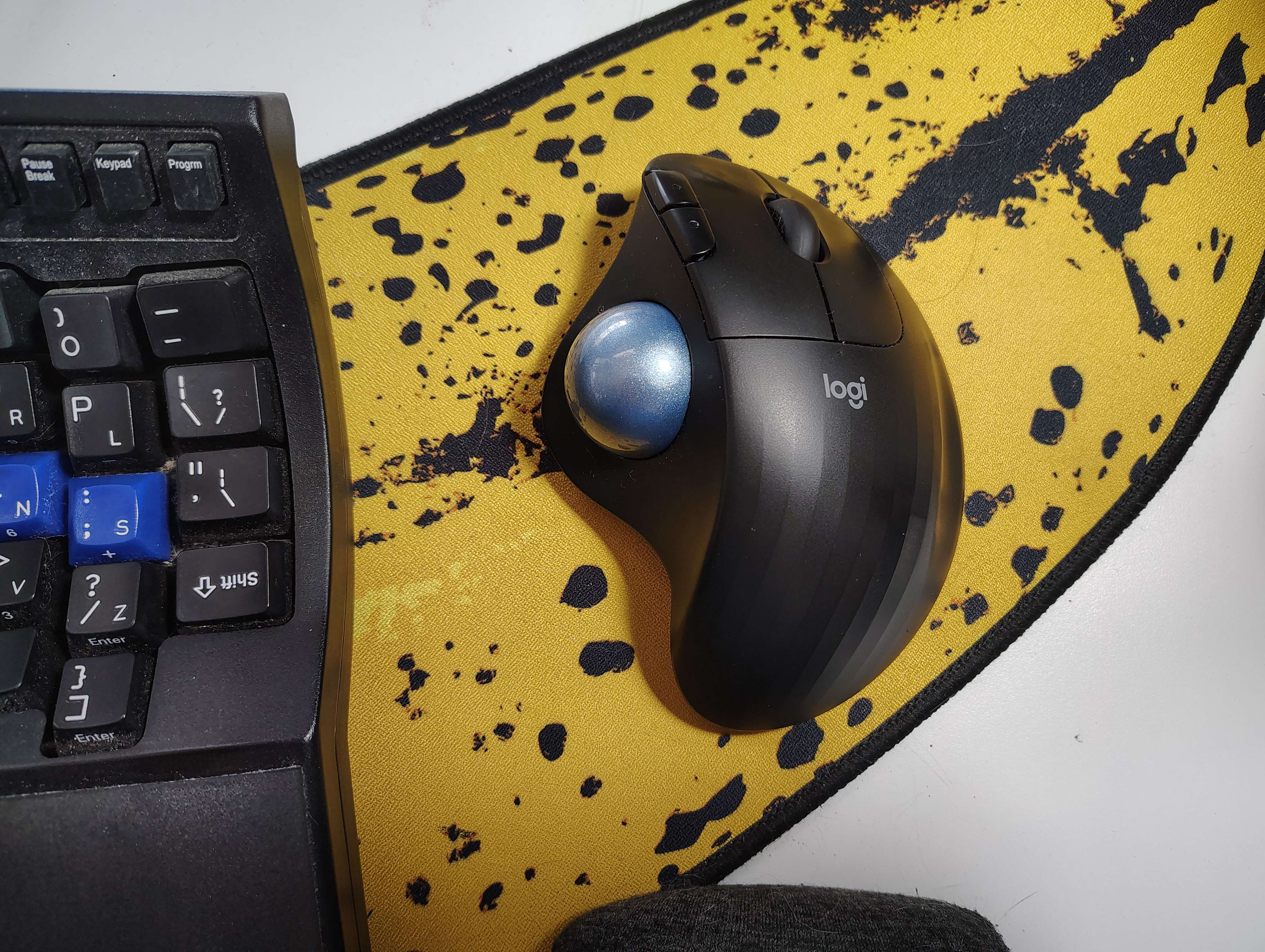
My own personal peripherals. Banana mat for scale.

I’ve been using a Logitech Ergo M575 for a couple of years now. As you can see, it’s a trackball with two extra buttons, which come programmed for forward and back. I find this next to useless, so I employed AutoHotKey and changed them to Ctrl+C on the up switch, and Ctrl+V on the down switch.

[Aknup] commented on the previous Keebin’ and brought up MMO mice, which, I didn’t know those things had a name other than maybe ‘multi-button mice’. And yes, there are a few trackball MMOs out there. I’ve got my eye on a couple already.

Does anyone have a trackball MMO? I hate to spend $100+ on something I won’t like. I’m intrigued that the one I found that’s the most attractive is less a thumb trackball and more a two-fingers-at-once kind of situation. That will take some getting used to, but the way my trackball moves sometimes, it could be a really positive change.

Continue reading “Keebin’ With Kristina: The One Where We Embrace The Jank”

Which Browser Should I Use In 2025?

Over the history of the Web, we have seen several major shifts in browsing software. If you’re old enough to have used NCSA Mosaic or any of the other early browsers, you probably welcomed the arrival of Netscape Navigator, and rued its decline in the face of Internet Explorer. As Mozilla and then Firefox rose from Netscape’s corpse the domination by Microsoft seemed inevitable, but then along came Safari and then Chrome.

For a glorious while there was genuine competition between browser heavyweights, but over the last decade we’ve arrived at a point where Chrome and its associated Google domination is the only game in town. Other players are small, and the people behind Firefox seem hell-bent on fleeing to the Dark Side, so where should we turn? Is there a privacy-centric open source browser that follows web standards and doesn’t come with any unfortunate baggage in the room? It’s time to find out. Continue reading “Which Browser Should I Use In 2025?”

Supercon 2024: Quick High-Feature Boards With The Circuit Graver

These days, if you want to build something with modern chips and components, you probably want a custom PCB. It lets you build a neat and compact project that has a certain level of tidiness and robustness that you can’t get with a breadboard or protoboard. The only problem is that ordering PCBs takes time, and it’s easy to grow tired of shipping delays when you don’t live in the shadow of the Shenzhen board houses.

[Zach Fredin] doesn’t suffer this problem, himself. He’s whipping up high-feature PCBs at home with speed and efficiency that any maker would envy. At the 2024 Hackaday Supercon, he was kind enough to give a talk to explain the great engineering value provided by the Circuit Graver.

Continue reading “Supercon 2024: Quick High-Feature Boards With The Circuit Graver”

Hackaday Podcast Episode 315: Conductive String Theory, Decloudified Music Players, And Wild Printing Tech

This week, Hackaday’s Elliot Williams and Kristina Panos met up across the (stupid, lousy) time zones to bring you the latest news, mystery sound, and of course, a big bunch of hacks from the previous week.

Again, no news is good news. On What’s That Sound, Kristina didn’t get close at all, but at least had a guess this time. If you think you can identify the sound amid all the talking, you could win a Hackaday Podcast t-shirt!

After that, it’s on to the hacks and such, beginning with a Dr. Jekyll and Mr. Hyde situation when it comes to a pair of formerly-cloud music players. We take a look at a crazy keyboard hack, some even crazier conductive string, and a perfectly cromulent list of 70 DIY synths on one wild webpage. Finally, we rethink body art with LEDs, and take a look at a couple of printing techniques that are a hundred years or so apart in their invention.

Check out the links below if you want to follow along, and as always, tell us what you think about this episode in the comments!

Download in DRM-free MP3 and savor at your leisure.

Continue reading “Hackaday Podcast Episode 315: Conductive String Theory, Decloudified Music Players, And Wild Printing Tech”