Impressive Pi System Controls Large Office

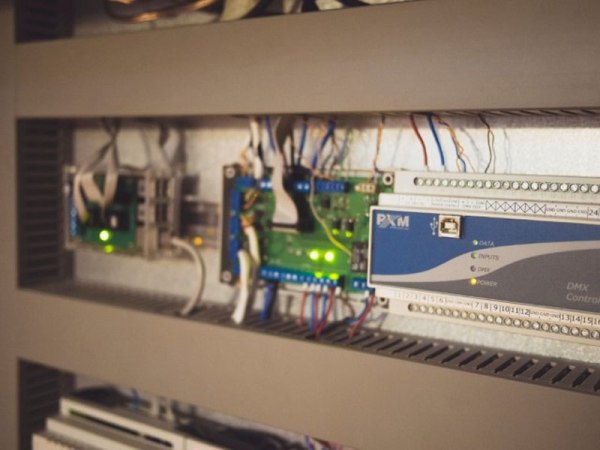
A pile of Raspberry Pis isn’t what would spring to mind for most people when building a system to control a large office, but most people aren’t [Kamil Górski]. He decided to use Pis to run the office of his company Monterail when they moved to a larger space. The system they built is one of the largest Pi installations we have seen, controlling the lights, TVs, speakers and door access. It can all be controlled through a web interface, so anyone on the network can turn the lights on or off, check if a room is occupied or send sound and video to the fancy AV system in the conference room. He even hacked a bunch of HDMI switches so that every TV can show the same image if everyone wants to watch the same event. Even the radio station that plays in the lounge is controlled remotely from an employee slack channel.

The system is run on five Pis, one of which acts as a master, while the others are connected to each of the TVs, running Chrome in console mode being remotely controlled through the Chrome Debugging Protocol.  That allows anyone on the network to control the display and send content to it. One interesting thing to note: [Kamil] freely admits that this is a bespoke system that couldn’t be easily sold as a product. Nothing wrong with that, but he decided to build in some backups: if the whole system fails, all of the lights, doors, and other devices can still be controlled through old-school switches, keys, and remote controls. Even a full system crash doesn’t render the office unusable. That’s a wide precaution that many people forget in systems like this.
You Might Not Be Able To Read This

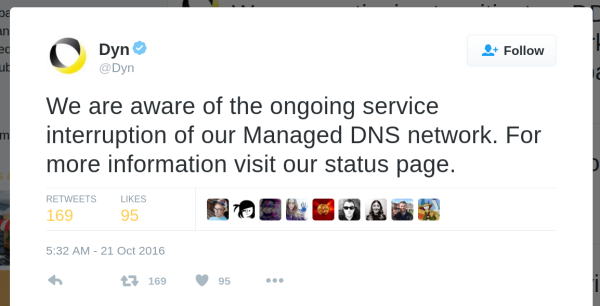
Early today, some party unleashed a massive DDoS attack against Dyn, a major DNS host. This led to a number of websites being completely inaccessible. DNS is the backbone of the Internet. It is the phone book that turns URLs into IP addresses. Without it, the Internet still works, but you won’t be able to find anything.

Over the past few months, security professionals have suggested — in as responsible terms as possible — that something big could happen. In early September [Bruce Schneier] wrote, Someone Is Learning How To Take Down The Internet. The implication of this very general warning is that someone — possibly a state actor, but don’t be too sure about that — was figuring out how to attack one of the core services of the web. The easiest way to effectively ‘turn off the Internet’ for everyone is a Distributed Denial of Service attack against root servers, DNS servers, or some other service that plays a key role in the web.

Dyn is responding well to the attack this morning, and the Internet is safe from attack for the time being. As for who is responsible for the attack, what the goal is, and if this will happen again, no one knows. An attack on this scale is most certainly someone with a very large pocketbook or a state actor (Russia, China, the US, UK, Germany, Israel, or the like) but that’s not a given. It’s also not given the DDoS attacks have stopped. You might not be able to read this, but if you can, it might be a good idea to find a shortwave radio.

Hajime, Yet Another IoT Botnet

Following on the heels of Mirai, a family of malware exploiting Internet of Things devices, [Sam Edwards] and [Ioannis Profetis] of Rapidity Networks have discovered a malicious Internet worm dubbed Hajime which targets Internet of Things devices.

Around the beginning of October, news of an IoT botnet came forward, turning IP webcams around the world into a DDoS machine. Rapidity Networks took an interest in this worm, and set out a few honeypots in the hopes of discovering what makes it tick.

Looking closely at the data, there was evidence of a second botnet that was significantly more sophisticated. Right now, they’re calling this worm Hajime.

Continue reading “Hajime, Yet Another IoT Botnet”

Are Today’s Engineers Worse?

Today’s engineers are just as good as the ones that came before, but that should not be the case and there is massive room for improvement. Improvement that can be realized by looking for the best of the world to come and the one we left behind.

Hey kids! Let's learn why the CE certifications exist!
Hey kids! Let’s learn why the CE certifications exist!

Survivorship bias is real. When we look at the accomplishments of the engineers that came before us we are forced to only look at the best examples. It first really occurred to me that this was real when I saw what I still consider to be the most atrocious piece of consumer oriented engineering the world has yet seen: the Campbell’s soup warmer.

This soup warmer is a poor combination of aluminum and Bakelite forged into the lowest tier of value engineering during its age. Yet it comes from the same time that put us on the moon: we still remember and celebrate Apollo. It’s possible that the soup warmer is forgotten because those who owned it perished from home fires, electrocution, or a diet of Campbell’s soup, but it’s likely that it just wasn’t worth remembering. It was bad engineering.

In fact, there’s mountains of objects. Coffee pots whose handles fell off. Switches that burned or shocked us. Cars that were ugly and barely worked. Literal mountains of pure refuse that never should have seen the light of day. Now we are here.

The world of engineering has changed. My girlfriend and I once snuck into an old factory in Louisville, Kentucky. The place was a foundry and the only building that survived the fire that ended the business. It happened to be where they stored their professional correspondence and sand casting patterns. It was moldy, dangerous, and a little frightening but I saw something amazing when we cracked open one of the file cabinets. It was folders and folders of all the communication that went into a single product. It was an old enough factory that some of it was before the widespread adoption of telephony and all documents had to be mailed from place to place.

Continue reading “Are Today’s Engineers Worse?”

How To Find, Buy, And Renovate A Titan II Missile Silo

Why would you want to live in a missile silo is the wrong question. Why wouldn’t you want to live in a missile silo is the right question. You’ll have weird, antiquated machinery hanging above your head, a great reason to change your name to ‘Zephram’, and living underground is much more ecologically sound, in any event.

For a certain class of people, the benefits of living in a missile silo are self-evident, but no one has really gone through the process of documenting all those unanswered questions. How do you buy a missile silo? How do you re-commission it and turn it into livable space? Is it even possible to get a bank to sign onto this? All these questions and more are being answered by a relatively new YouTube channel, [Death Wears Bunny Slippers].

In 2010, the creator of this channel decided to buy a missile silo. He ended up with a Titan II missile silo that was decommissioned in spring of 1986. In its prime, this missile silo held a single Titan II, pointed at a target over the pole, a three-story access tunnel, and a hardened command and control pod capable of keeping a few airmen alive after the apocalypse.

[DWBS] has been working on this project for a half-decade now, and what’s been shown so far is impressive. When this missile silo was decommissioned, the Air Force dropped a bunch of broken concrete down the access shaft, tore down the top 10 or so feet of the access tunnel, and generally made a huge mess of the place. After renting an excavator, [DWBS] was able to turn this hole filled with crap into a blank canvas.

Already, [DWBS] has been working on his missile silo home for years, and video updates are coming in at a rate of about one per week. The project is great, and a perfect example of a rare, strange, yet unbelievably interesting genre of YouTube channels: the huge, multi-year build broken up into weekly segments. If you’re looking for projects similar in scope, check out SV Seeker, the project that’s building a Chinese junk in the middle of Oklahoma, or the Camberghini, an abortion of an MX-5 designed to make you irrationally angry. Buying and refitting a missile silo is a step above any of these projects, and over the next weeks and months will make for spectacular YouTubing.

Below, you can check out the two most interesting videos to date – opening the access tunnel to the silo and draining all the water.

Continue reading “How To Find, Buy, And Renovate A Titan II Missile Silo”

A Win For The Raspberry Pi Compute Module

News comes from the Raspberry Pi Foundation, of something of a coup for their Compute Module product. Support for it is to be integrated into NEC’s line of commercial displays, and the electronics giant has lined up a list of software partners to provide integrated signage solutions for the platform.

It is interesting to note how NEC have done this, while it’s being spun by the Foundation as a coup for them the compute module sits on a daughter board in a slot on the back of the display rather than on the display PCB itself. They are likely hedging their bets with this move, future daughter boards could be created to provide support for other platforms should the Compute Module board fail to gain traction.

Given that this relates to a high-end commercial product from just one manufacturer, what’s in it for us in the hardware community? After all, it’s not as if you’ll be seeing Compute Module slots in the back of domestic TVs or monitors from NEC or any other manufacturer in the near future. The answer is that such a high-profile customer lends the module platform a commercial credibility that it may not yet have achieved.  Until now, it has found a home mainly in more niche or boutique products, this appearance in something from a global manufacturer takes it to a new level. And as the module finds its way into more devices the chances of them coming within the reach of our community and providing us with opportunities for adapting them for our purposes through the Pi platform become ever greater.

The use of the Compute Module in displays made for public signage is oddly a continuation of an unseen tradition for ARM-based machines from Cambridge. Aside from British schools a significant market for the Acorn Archimedes platform that spawned ARM was the embedded signage market, and even today there are still plenty of signs concealing RiscOS machines out there in the wild.

We covered the launch of the Compute Module in 2014, but it’s fair to say it’s not appeared much since in the world of Raspberry Pi projects from hardware hackers. This is not because it’s not a good platform; more likely that the Raspberry Pi models A, B, and particularly the Zero are so much cheaper when you consider the significant cost of the Compute Module development board. At the Raspberry Pi 4th birthday party earlier this year, while covering the event as your Hackaday scribe but also wearing my metaphorical Pi kit supplier and Pi Jam organizer hats I stood up in the Q&A session and asked the Foundation CEO Phil Colligan to consider a hardware developer program for the platform. Perhaps a cut-down Compute Module developer board would be an asset to such a program, as well as driving more adoption of that particular board.

Germans React To UK’s Micro:bit

Getting kids interested in programming is all the rage right now, and the UK is certainly taking pole position with its BBC micro:bit, just recently distributed to every seventh-grader in the land. Germany, proud of its education system and technological prowess, is caught playing catch-up. Until now.

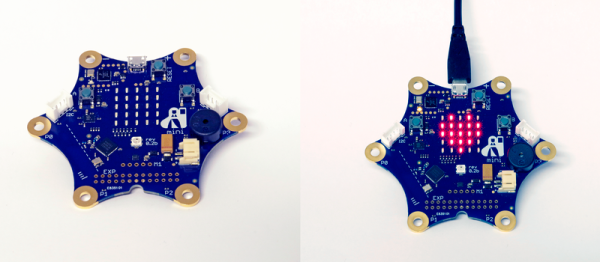
The Calliope Mini (translated here) is essentially a micro:bit clone, but one that has learned from the experience of its spiritual forefather — the connection points are spread around the outside of the board where the crocodile clips won’t accidentally touch each other.

Not content to simply copy, the Calliope also adds additional functionality. A microphone and speaker are integrated onboard, as is a Grove-style I2C connector. They’ve even added a TI DRV8837 H-bridge motor driver, so students could make a rolling robot straight out of the box.

Continue reading “Germans React To UK’s Micro:bit”