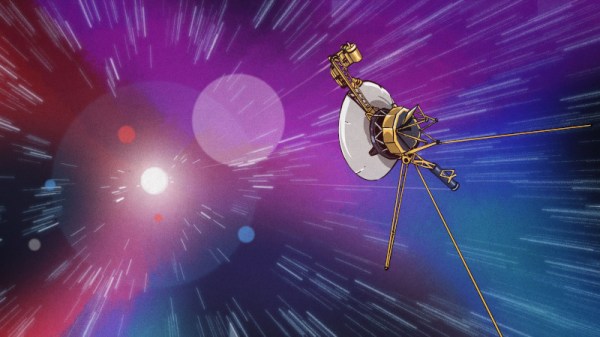
As humanity’s furthest reach into the Universe so far, the two Voyager spacecraft’s well-being is of utmost importance to many. Although we know that there will be an end to any science mission, the recent near-death experience by Voyager 1 was a shocking event for many. Now it seems that things may have more or less returned to normal, with all four remaining scientific instruments now back online and returning information.
Since the completion of Voyager 1’s primary mission over 43 years ago, five of its instruments (including the cameras) were disabled to cope with its diminishing power reserves, with two more instruments failing. This left the current magnetometer (MAG), charged particle (LECP) and cosmic ray (CRS) instruments, as well as the plasma wave subsystem (PWS). These are now all back in operation based on the returned science data after the Voyager team confirmed previously that they were receiving engineering data again.
With Voyager 1 now mostly back to normal, some housekeeping is necessary: resynchronizing the onboard time, as well as maintenance on the digital tape recorder. This will ensure that this venerable spacecraft will be all ready for its 47th anniversary this fall.
Reaching orbit around Earth is an incredibly difficult feat. It’s a common misconception that getting into orbit just involves getting very high above the ground — the real trick is going sideways very, very fast. Thus far, the most viable way we’ve found to do this is with big, complicated multi-stage rockets that shed bits of themselves as they roar out of the atmosphere.
Single-stage-to-orbit (SSTO) launch vehicles represent a revolutionary step in space travel. They promise a simpler, more cost-effective way to reach orbit compared to traditional multi-stage rockets. Today, we’ll explore the incredible potential offered by SSTO vehicles, and why building a practical example is all but impossible with our current technology.
A Balancing Act
The SSTO concept doesn’t describe any one single spacecraft design. Instead, it refers to any spacecraft that’s capable of achieving orbit using a single, unified propulsion system and without jettisoning any part of the vehicle.
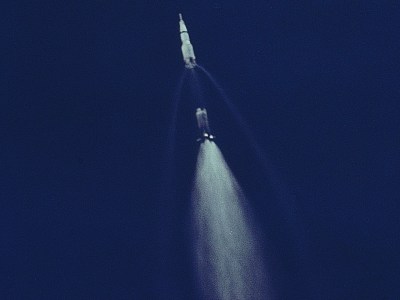
The Saturn V shed multiple stages on its way up to orbit. That way, less fuel was needed to propel the final stage up to orbital velocity. Credit: NASA
Today’s orbital rockets shed stages as they expend fuel. There’s one major reason for this, and it’s referred to as the tyranny of the rocket equation. Fundamentally, a spacecraft needs to reach a certain velocity to attain orbit. Reaching that velocity from zero — i.e. when the rocket is sitting on the launchpad — requires a change in velocity, or delta-V. The rocket equation can be used to figure out how much fuel is required for a certain delta-V, and thus a desired orbit.
The problem is that the mass of fuel required scales exponentially with delta-V. If you want to go faster, you need more fuel. But then you need even more fuel again to carry the weight of that fuel, and so on. Plus, all that fuel needs a tank and structure to hold it, which makes things more difficult again.
Work out the maths of a potential SSTO design, and the required fuel to reach orbit ends up taking up almost all of the launch vehicle’s weight. There’s precious mass left over for the vehicle’s own structure, let alone any useful payload. This all comes down to the “mass fraction” of the rocket. A SSTO powered by even our most efficient chemical rocket engines would require that the vast majority of its mass be dedicated to propellants, with its structure and payload being tiny in comparison. Much of that is due to Earth’s nature. Our planet has a strong gravitational pull, and the minimum orbital velocity is quite high at about 7.4 kilometers per second or so.
Stage Fright
Historically, we’ve cheated the rocket equation through smart engineering. The trick with staged rockets is simple. They shed structure as the fuel burns away. There’s no need to keep hauling empty fuel tanks into orbit. By dropping empty tanks during flight, the remaining fuel on the rocket has to accelerate a smaller mass, and thus less fuel is required to get the final rocket and payload into its intended orbit.
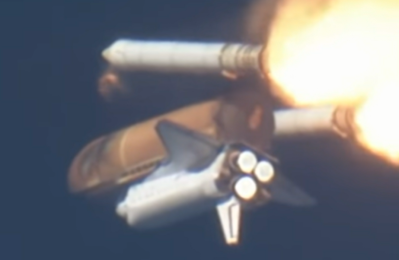
The Space Shuttle sheds its boosters and external fuel tank on its way up to orbit, too. Credit: NASA
So far, staged rockets have been the only way for humanity to reach orbit. Saturn V had five stages, more modern rockets tend to have two or three. Even the Space Shuttle was a staged design: it shed its two booster rockets when they were empty, and did the same with its external liquid fuel tank.
But while staged launch vehicles can get the job done, it’s a wasteful way to fly. Imagine if every commercial flight required you to throw away three quarters of the airplane. While we’re learning to reuse discarded parts of orbital rockets, it’s still a difficult and costly exercise.
The core benefit of a SSTO launch vehicle would be its efficiency. By eliminating the need to discard stages during ascent, SSTO vehicles would reduce launch costs, streamline operations, and potentially increase the frequency of space missions.
Pushing the Envelope
It’s currently believed that building a SSTO vehicle using conventional chemical rocket technology is marginally possible. You’d need efficient rocket engines burning the right fuel, and a light rocket with almost no payload, but theoretically it could be done.
Ideally, though, you’d want a single-stage launch vehicle that could actually reach orbit with some useful payload. Be that a satellite, human astronauts, or some kind of science package. To date there have been several projects and proposals for SSTO launch vehicles, none of which have succeeded so far.
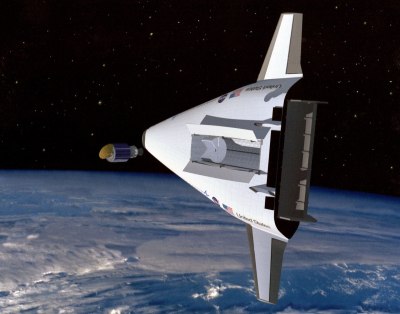
Lockheed explored a spaceplane concept called VentureStar, but it never came to fruition. Credit: NASA
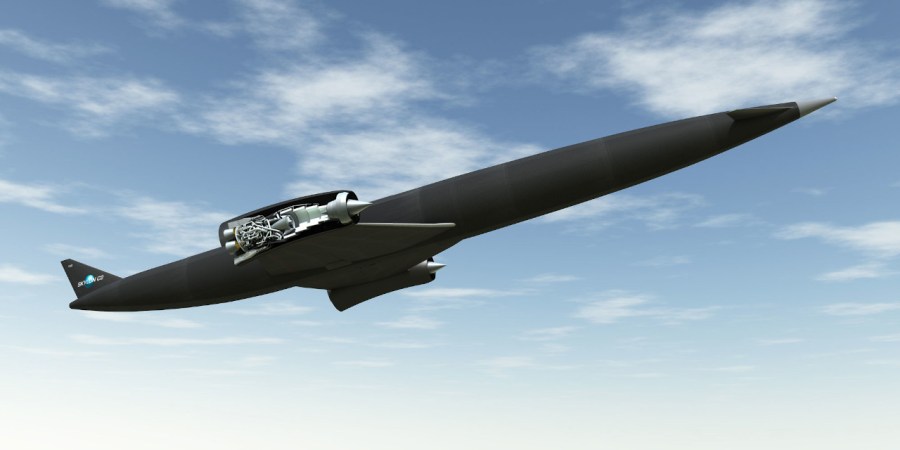
One notable design was the proposed Skylon spacecraft from British company Reaction Engines Limited. Skylon was intended to operate as a reusable spaceplane fueled by hydrogen. It would take off from a runway, using wings to generate lift to help it to ascend to 85,000 feet. This improves fuel efficiency versus just pointing the launch vehicle straight up and fighting gravity with pure thrust alone. Plus, it would burn oxygen from the atmosphere on its way to that altitude, negating the need to carry heavy supplies of oxygen onboard.
Once at the appropriate altitude, it would switch to internal liquid oxygen tanks for the final acceleration phase up to orbital velocity. The design stretches back decades, to the earlier British HOTOL spaceplane project. Work continues on the proposed SABRE engine (Syngergetic Air-Breathing Rocket Engine) that would theoretically propel Skylon, though no concrete plans to build the spaceplane itself exist.
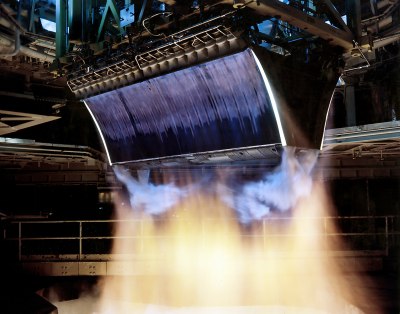
The hope was that efficient aerospike rocket engines would let the VentureStar reach orbit in a single stage.
Lockheed Martin also had the VentureStar spaceplane concept, which used an innovative “aerospike” rocket engine that maintained excellent efficiency across a wide altitude range. The company even built a scaled-down test craft called the X-33 to explore the ideas behind it. However, the program saw its funding slashed in the early 2000s, and development was halted.
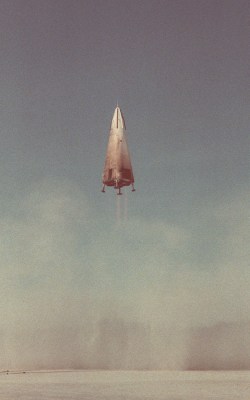
McDonnell Douglas also had a crack at the idea in the early 1990s. The DC-X, also known as the Delta Clipper, was a prototype vertical takeoff and landing vehicle. At just 12 meters high and 4.1 meters in diameter, it was a one-third scale prototype for exploring SSTO-related technologies
It would take off vertically like a traditional rocket, and return to Earth nose-first before landing on its tail. The hope was that the combination of single-stage operation and this mission profile would provide extremely quick turnaround times for repeat launches, which was seen as a boon for potential military applications. While its technologies showed some promise, the project was eventually discontinued when a test vehicle caught fire after NASA took over the project.
McDonnell Douglas explored SSTO technologies with the Delta Clipper. Credit: Public domain
Ultimately, a viable SSTO launch vehicle that can carry a payload will likely be very different from the rockets we use today. Relying on wings to generate lift could help save fuel, and relying on air in the atmosphere would slash the weight of oxidizer that would have to be carried onboard.
However, it’s not as simple as just penning a spaceplane with an air-breathing engine and calling it done. No air breathing engine that exists can reach orbital velocity, so such a craft would need an additional rocket engine too, adding weight. Plus, it’s worth noting a reusable launch vehicle would also still require plenty of heat shielding to survive reentry. One could potentially build a non-reusable single-stage to orbit vehicle that simply stays in space, of course, but that would negate many of the tantalizing benefits of the whole concept.
Single-stage-to-orbit vehicles hold the promise of transforming how we access space by simplifying the architecture of launch vehicles and potentially reducing costs. While there are formidable technical hurdles to overcome, the ongoing advances in aerospace technology provide hope that SSTO could become a practical reality in the future. As technology marches forward in materials, rocketry, and aerospace engineering in general, the dream of a single-stage path to orbit remains a tantalizing future goal.
For many decades, the USA has been at the forefront of astronomy, whether with ground-based telescopes or space-based observatories like Hubble and the JWST. Yet this is now at risk as US astronomers are forced to choose between funding either the Giant Magellan Telescope (GMT) or the Thirty Meter Telescope (TMT) as part of the US Extremely Large Telescope (USELT) program. This rightfully has the presidents of Carnegie Science and Caltech – [Eric D. Isaacs] and [Thomas F. Rosenbaum] respectively – upset, with their opinion piece in the Los Angeles Times going over all the reasons why this funding cut is a terrible idea.
The slow death of US astronomy is perhaps best exemplified by the slow death and eventual collapse of the Arecibo radio telescope. Originally constructed as a Cold War era ICBM detector, it found grateful use by radio astronomers, but saw constant budget cuts and decommissioning threats. After Arecibo’s collapse, it’s now China with its FAST telescope that has mostly taken the limelight. In the case of optical telescopes, the EU’s own ELT is expected to be online in 2028, sited close to the GMT in the Atacama desert. The TMT would be sited in Hawai’i.
When the United States launched the KH-9 Hexagon spy satellite into orbit atop a Titan IIID rocket in 1974, it brought a calibration target along for the ride: the Infra-Red Calibration Balloon (IRCB) S73-7. This 66 cm (26 inch) diameter inflatable satellite was ejected by the KH-9, but failed to inflate into its intended configuration and became yet another piece of space junk. Initially it was being tracked in the 1970s, but vanished until briefly reappearing in the 1990s. Now it’s popped up again, twenty-five years later.
As noted by [Jonathan McDowell] who tripped over S73-7 in recent debris tracking data, it’s quite possible that it had been tracked before, but hidden in the noise as it is not an easy target to track. Since it’s not a big metallic object with a large radar cross-section, it’s among the more difficult signals to reliably pick out of the noise. As can be seen in [Jonathan]’s debris tracking table, this is hardly a unique situation, with many lost (XO) entries. This always raises the exciting question of whether a piece of debris has had its orbit decayed to where it burned up, ended up colliding with other debris/working satellite or simply has gone dark.
For now we know where S73-7 is, and as long as its orbit remains stable we can predict where it’ll be, but it highlights the difficulty of keeping track of the around 20,000 objects in Earth orbit, with disastrous consequences if we get it wrong.
Our own Dan Maloney has been on a Voyager kick for the past couple of years. Voyager, the space probe. As a long-term project, he has been trying to figure out the computer systems on board. He got far enough to write up a great overview piece, and it’s a pretty good summary of what we know these days. But along the way, he stumbled on a couple old documents that would answer a lot of questions.
Dan asked JPL if they had them, and the answer was “no”. Oddly enough, the very people who are involved in the epic save a couple weeks ago would also like a copy. So when Dan tracked the document down to a paper-only collection at Wichita State University, he thought he had won, but the whole box is stashed away as the library undergoes construction.
That box, and a couple of its neighbors, appear to have a treasure trove of documentation about the Voyagers, and it may even be one-of-a-kind. So in the comments, a number of people have volunteered to help the effort, but I think we’re all just going to have to wait until the library is open for business again. In this age of everything-online, everything-scanned-in, it’s amazing to believe that documents about the world’s furthest-flown space probe wouldn’t be available, but so it is!
It makes you wonder how many other similar documents – products of serious work by the people responsible for designing the systems and machines that shaped our world – are out there in the dark somewhere. History can’t capture everything, and it’s down to our collective good judgement in the end. So if you find yourself in a position to shed light on, or scan, such old papers, please do! And then contact some nerd institution like the Internet Archive or the Computer History Museum.
This article is part of the Hackaday.com newsletter, delivered every seven days for each of the last 200+ weeks. It also includes our favorite articles from the last seven days that you can see on the web version of the newsletter.
Want this type of article to hit your inbox every Friday morning? You should sign up!
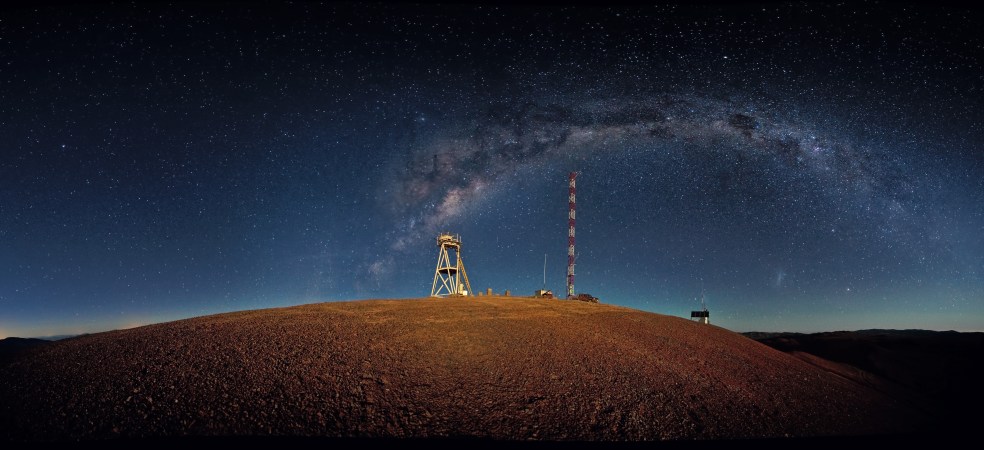
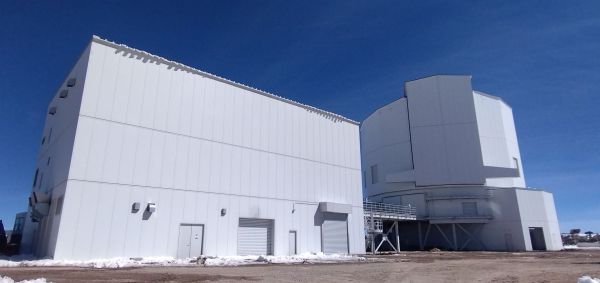
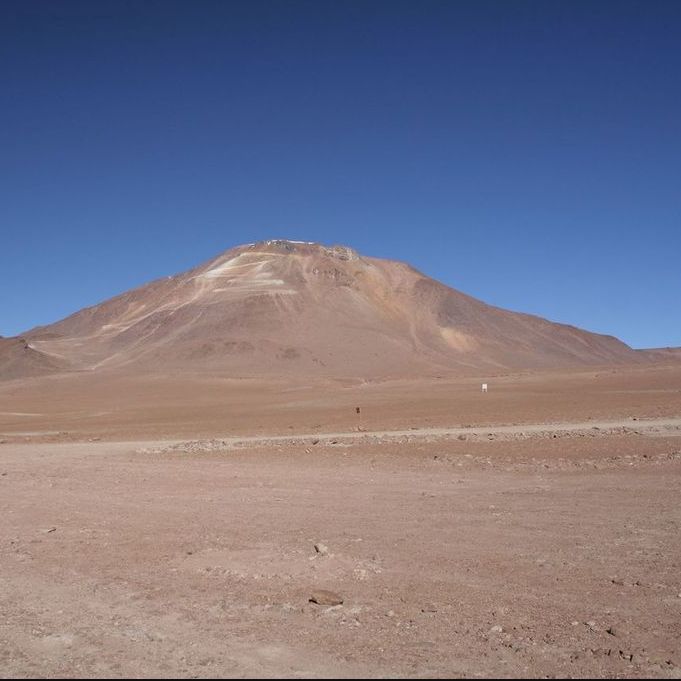
Although we have a gaggle of space telescopes floating around these days, there is still a lot of value in ground-based telescopes. These generally operate in the visible light spectrum, but infrared ground-based telescopes can also work on Earth, assuming that you put them somewhere high in an area where the atmosphere is short on infrared-radiation absorbing moisture. The newly opened Universe of Tokyo Atacama Observatory (TAO) with its 6.5 meter silver-coated primary mirror is therefore placed on the summit of Cerro Chajnantor at 5,640 meters, in the Atacama desert in Chile.
This puts it only a few kilometers away from the Atacama Large Millimeter Array (ALMA), but at a higher altitude by about 580 meters. As noted on the University of Tokyo project site (in Japanese), the project began in 1998, with a miniTAO 1 meter mirror version being constructed in 2009 to provide data for the 6.5 meter version. TAO features two instruments (SWIMS and MIMIZUKU), each with a specific mission profile, but both focused on deciphering the clues about the Universe’s early history, a task for which infrared is significantly more suitable due to redshift.
After more than four decades in space and having traveled a combined 44 billion kilometers, it’s no secret that the Voyager spacecraft are closing in on the end of their extended interstellar mission. Battered and worn, the twin spacecraft are speeding along through the void, far outside the Sun’s influence now, their radioactive fuel decaying, their signals becoming ever fainter as the time needed to cross the chasm of space gets longer by the day.
But still, they soldier on, humanity’s furthest-flung outposts and testaments to the power of good engineering. And no small measure of good luck, too, given the number of nearly mission-ending events which have accumulated in almost half a century of travel. The number of “glitches” and “anomalies” suffered by both Voyagers seems to be on the uptick, too, contributing to the sense that someday, soon perhaps, we’ll hear no more from them.
That day has thankfully not come yet, in no small part due to the computers that the Voyager spacecraft were, in a way, designed around. Voyager was to be a mission unlike any ever undertaken, a Grand Tour of the outer planets that offered a once-in-a-lifetime chance to push science far out into the solar system. Getting the computers right was absolutely essential to delivering on that promise, a task made all the more challenging by the conditions under which they’d be required to operate, the complexity of the spacecraft they’d be running, and the torrent of data streaming through them. Forty-six years later, it’s safe to say that the designers nailed it, and it’s worth taking a look at how they pulled it off.