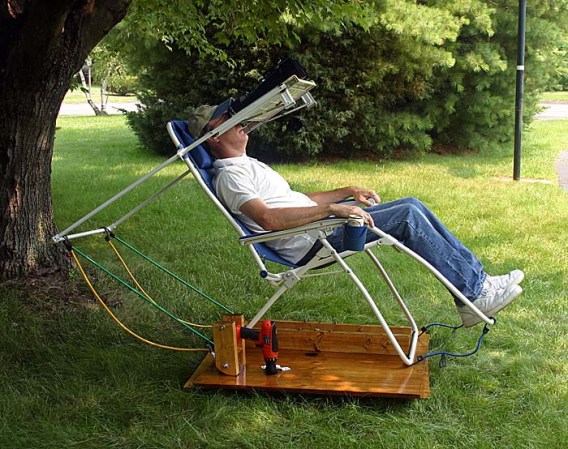
It seems like something out of The Red Green Show but this motorized stargazing chair is a serious piece of astronomical hardware. It has a shelf that places a set of high-power binoculars directly in the user’s line of sight. The elevation is easy to adjust. And a power drill lets you take the whole thing for a spin.
The base has been outfitted with cogs and a chain from an old bicycle. The gear reduction lets a power drill rotate the platform. This worked well enough but [Gary] found that making fine adjustments was rather difficult and more often than not he ended up moving the binoculars to avoid overshooting when adjusting the platform with the drill. Luckily he didn’t give up on the idea. On the eighth and final page of his build log he refines the rotating setup with the help of an ice cream maker. It’s gear box is used as a speed reducer so that a very slow drill speed results in an extremely small heading correction. Now he can view the stars in peace, freed from frustration by a well-refined hack.