WISP Needs No Battery Or Cable

One of the problems with the Internet of Things, or any embedded device, is how to get power. Batteries are better than ever and circuits are low power. But you still have to eventually replace or recharge a battery. Not everything can plug into a wall, and fuel cells need consumables.

University of Washington researchers are turning to a harvesting approach. Their open source WISP board has a sensor and a CPU that draws power from an RFID reader. To save power during communication, the device backscatters incoming radio waves, which means it doesn’t consume a lot of its own power during transmissions.

The big  news is that TU Delft has contributed code to allow WISP to reprogram wirelessly. You can see a video about the innovation below. The source code is on GitHub. Previously, a WISP had to connect to a PC to receive a new software load.

Continue reading “WISP Needs No Battery Or Cable”

1btn – An Open Source Dash

The availability of cheap radios, omni-present WiFi and powerful web services means the IoT wave is here to stay. Amazon got into the act with its “do only one thing” Dash button. But a more interesting solution would be an IoT “do it all” button.

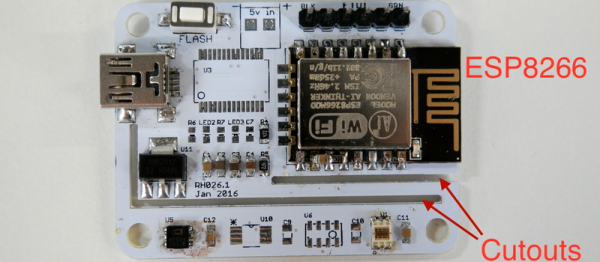
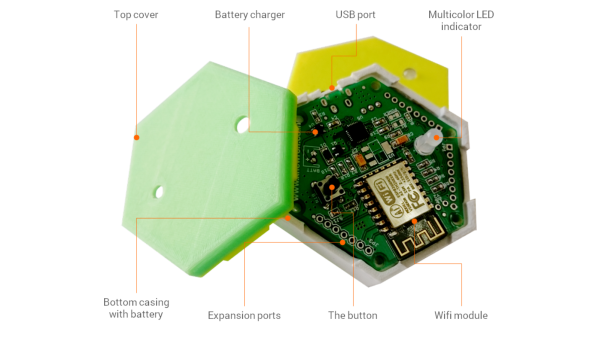
[Anand] has been working on his 1btn Open Source WiFi connected IoT button for a while. It connects to the Internet over WiFi to trigger whatever action you have assigned to it using a simple, online interface. It’s reconfigurable and open source. Which means it can be used in pretty imaginative ways, and if needed, can be re-flashed with your own custom firmware should you decide to really get under its hood.

The 1btn’s ESP8266 module is usually in sleep mode, waking up when the button is pressed, making the connection, performing the task and then going back to sleep once confirmation is received. A Red/Green LED indicates if the action was successful or not. You can set it up to send e-mails, messages, tweets or perform actions via a custom script, API or the IFTTT – maker channel. To make it hacker friendly, all of the ESP8266 GPIO pins are accessible via headers. This makes it convenient to add external sensors, for example. There’s also a (unpopulated) QFN footprint to allow adding an ATmega device (168P/328P) whose GPIO pins are also accessible via headers. This opens up a large number of additional applications for the device such as home automation.

On the software side, the 1btn connects to a web console, where you can set up an account, configure the device, register its MAC ID, assign it an alias and set up its actions. All of the source files for the 1btn – firmware, enclosure, schematic, BOM, PCB layout and example use cases – are posted on his Github repository.

The HackadayPrize2016 is Sponsored by:

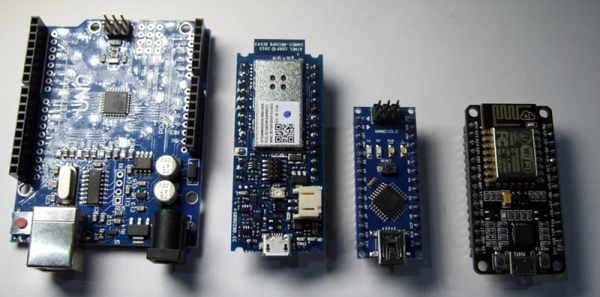
ESP8266 Or MKR1000?

If you are a regular Hackaday reader, you’ve probably seen plenty of ESP8266 projects. After all, the inexpensive device is a workhorse for putting a project on WiFi, and it works well. There is a processor onboard, but, most often, the onboard CPU runs a stock firmware that exposes an AT command set or Lua or even BASIC. That means most projects have a separate CPU and that CPU is often–surprise–an Arduino.

It isn’t a big leap of logic to imagine an Arduino with an integrated WiFi subsystem. That’s the idea behind the MKR1000. But the real question you have to ask is: is it better to use an integrated component or just put an Arduino and ESP8266 together?

[Andreas Spiess] not only asked the question, but he answered it in a YouTube video (see below). He examines several factors on the MKR1000, the Arduino Due and Uno, and several other common boards. The examination covers performance, features, and power consumption.

Continue reading “ESP8266 Or MKR1000?”

Make Your Own ESP8266 Breadboard Adapter

Want to play around with the ESP8266? You’ll need a breadboard adapter, which allows you to connect the ESP8266 to a breadboard as you refine your design. Sure, you could just buy one, but where’s the fun in that?

[Markus Ulsass] designed a simple breadboard adapter for his ESP8266 that can be easily etched and built at home, but which has most of the features of the commercial versions. His adapter features a voltage regulator that can handle anything up to 7 volts and which has reverse polarity protection and a reset switch that puts the ESP8266 into flash mode, where it can be reprogrammed.

It’s a neat, simple build that makes it easier to tap into the power of the ESP8266 , which can be used to do everything from running a webcam to automating your home.

Hackaday Dictionary: Ultrasonic Communications

Say you’ve got a neat gadget you are building. You need to send data to it, but you want to keep it simple. You could add a WiFi interface, but that sucks up power. Bluetooth Low Energy uses less power, but it can get complicated, and it’s overkill if you are just looking to send a small amount of data. If your device has a microphone, there is another way that you might not have considered: ultrasonic communications. Continue reading “Hackaday Dictionary: Ultrasonic Communications”

CarontePass: Open Access Control For Your Hackerspace

A problem faced by all collaborative working spaces as they grow is that of access control. How can you give your membership secure access to the space without the cost and inconvenience of having a keyholder on site at all times.

[Torehc] is working on solving this problem with his CarontePass RFID access system, at the Kreitek Makerspace (Spanish, Google Translate link) in Tenerife, Canary Islands.

Each door has a client with RFID readers, either a Raspberry Pi or an ESP8266, which  connects via WiFi to a Raspberry Pi 2 server running a Django-based REST API. This server has access to a database of paid-up members and their RFID keys, so can issue the command to the client to unlock the door. The system also supports the Telegram messaging service, and so can be queried as to whether the space is open and how many members are in at a particular time.

All the project’s resources are available on its GitHub repository, and there is a project blog (Spanish, Google Translate link) with more details.

This is a project that is still in active development, and [Torehc] admits that its security needs more work so is busy implementing HTTPS and better access security. As far as we can see through the fog of machine translation at the moment it relies on the security of its own encrypted WiFi network, so we’d be inclined to agree with him.

This isn’t the first hackerspace access system we’ve featured here. The MakerBarn in Texas has one using the Particle Photon, while the Lansing Makers Network in Michigan have an ingenious mechanism for their door, and the Nesit hackerspace in Connecticut has a very fancy system with video feedback. How does your space solve this problem?

The HackadayPrize2016 is Sponsored by:

Tiny BLE UART Makes Bluetooth Low Energy Simple

Last time I talked about the internals of how Bluetooth Low Energy (BLE) handles data. I mentioned that the way it is set up is meant to conserve power and also to support common BLE devices like heart rate monitors. On the other hand, I also mentioned that you often didn’t need to deal with that because you’d use an abstraction layer.

This time, I want to show you how I used the Hackaday special edition Tiny BLE (from Seeed Studios) and its mbed library to do a quick simple BLE project. If you didn’t read the first part, don’t worry. The abstraction is so good, you probably won’t have to unless you want to circle back around later and get a more detailed understanding of what’s happening under the covers.

I wanted something simple for an example so you could build on it without having to remove much code. For that reason, I decided to allow my phone to control the state of a three-color LED via BLE. To do that, I’m going to use a virtual UART and some off-the-shelf phone software. The whole thing won’t take much code, but that’s the point: the abstraction makes BLE relatively simple.

Continue reading “Tiny BLE UART Makes Bluetooth Low Energy Simple”