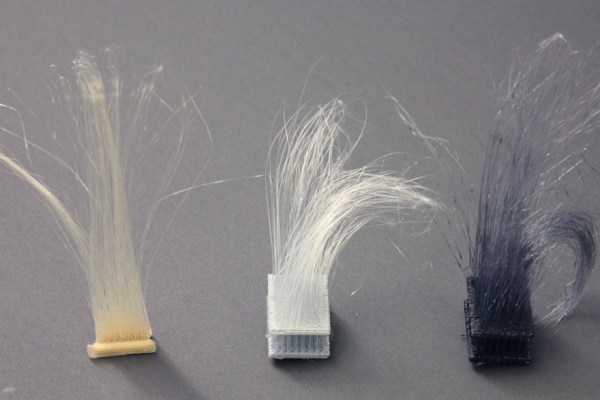
If you’ve been performing painstaking hair-plug procedures on your 3D-printed troll dolls, then prepare to have your world rocked! [Chris Harrison, Gierad Laput, and Xiang “Anthony” Chen] at Carnegie Mellon University have just released a paper outlining a technique they’ve developed for 3D printing fur and hair. Will the figurine section of Thingiverse ever be the same?
The technique takes advantage of a 3D printing effect that most hobbyists actively try to avoid: stringing. Stringing is what happens when the hot end of a 3D printer moves from one point to another quickly while leaking a small amount of molten filament. This results in a thin strand of plastic between the two points, and is generally perceived as a bad thing, because it negatively affects the surface quality of the print.
 To avoid this particular phenomenon, 3D printing slicers generally have options like retraction and wiping. But, instead of trying to stop the stringing, [Chris Harrison, Gierad Laput, and Xiang “Anthony” Chen] decided to embrace it. Through extensive experimentation, they figured out how to introduce stringing in a controlled manner. Instead of random strings here and there, they’re able to create strings exactly where they want them, and at specific lengths and thicknesses.
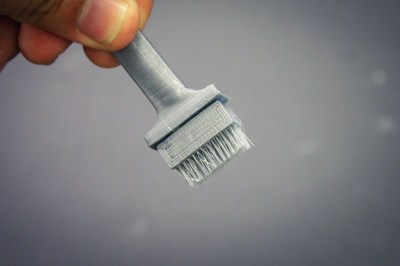
Examples of what this can be used for are shown in their video below, and include adding hair to figurines or bristles to brushes. Of course, once this technique becomes readily available to the masses, the 3D printing community is bound to find unexpected uses for it.
Continue reading “Hair Enthusiasts Rejoice! Synthetic Follicles Are Now 3D-Printable”