Google Is Building A New OS

Windows, macOS, and Linux are the three major desktop OSs in today’s world. However, there could soon be a new contender, with Google stepping up to the plate (via The Verge).

You’ve probably used Google’s operating systems before. Android holds a dominant market share in the smartphone space, and ChromeOS is readily available on a large range of notebooks intended for lightweight tasks. Going forward, it appears Google aims to leverage its experience with these products and merge them into something new under the working title of “Aluminium OS.”

The news comes to us via a job listing, which sought a Senior Product Manager to work on a “new Aluminium, Android-based, operating system.” The hint is in the name—with speculation that the -ium part of Aluminium indicates its relationship to Chromium, the open-source version of Chrome. The listing also indicated that the new OS would have “Artificial Intelligence (AI) at the core.” At this stage, it appears Google will target everything from cheaper entry level hardware to mid-market and premium machines.

It’s early days yet, and there’s no word as to when Google might speak more officiously on the topic of its new operating system. It’s a big move from one of the largest tech companies out there. Even still, it will be a tall order for Google to knock off the stalwart offerings from Microsoft and Apple in any meaningful way. Meanwhile, if you’ve got secret knowledge of the project and they forget to make you sign an NDA, don’t hesitate to reach out!

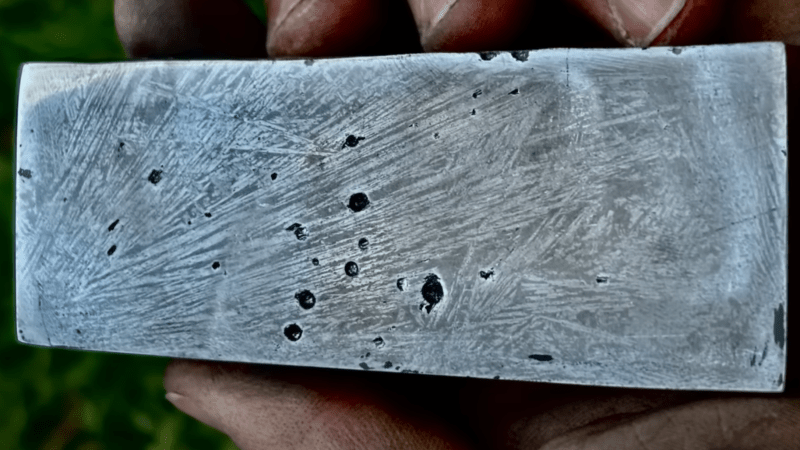
A man’s hand is shown holding a polished metal billet. The billet has a few voids in the surface, and the surface shows a pattern of lighter lines against the darker metal background.

Casting Meteorite-like Materials

From the outside, iron meteorites tend to look like formless, rusted lumps of metal, which is why museums often polish and etch sections to show their interior structure. This reveals their Widmanstätten patterns, a latticework structure of parallel iron-nickel intermetallic crystals which forms over millions of years of very slow solidification. Inspired by this, [Electron Impressions] created his own metal composition which forms similar patterns on a much-faster-than-geological time scale.

Witmanstätten patterns form when a meteorite colliding with a planet launches molten iron and nickel into space, where they very slowly solidify. As the mixture cools, it first forms a stable phase called Taenite, then begins to precipitate another phase called Kamacite. Kamacite forms needle-shaped crystals, which when polished show up against the Taenite background. However, such needle-shaped growth only becomes noticeable at a cooling rate of a few degrees per million years, so it’s not really a practical way to make the pattern. Continue reading “Casting Meteorite-like Materials”

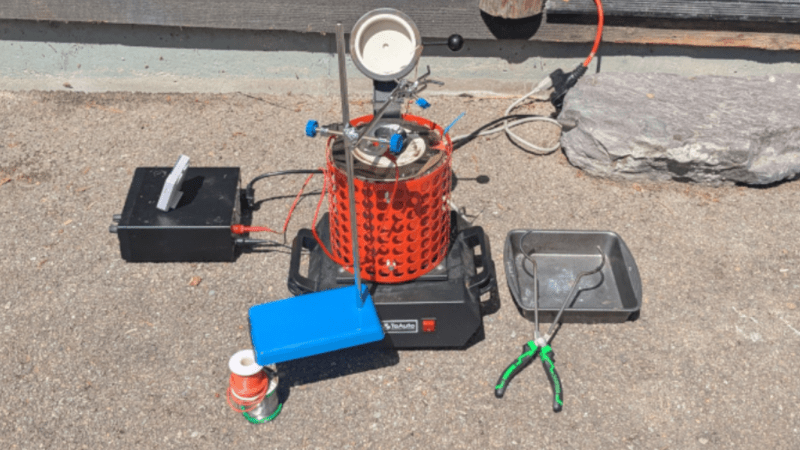
A cylindrical red furnace is in the center of the image. To the left of it is a black power supply. A stand is in front of the furnace, with an arm extending over the furnace. To the right of the furnace, a pair of green-handled crucible tongs sit on an aluminium pan.

The Hall-Héroult Process On A Home Scale

Although Charles Hall conducted his first successful run of the Hall-Héroult aluminium smelting process in the woodshed behind his house, it has ever since remained mostly out of reach of home chemists. It does involve electrolysis at temperatures above 1000 ℃, and can involve some frighteningly toxic chemicals, but as [Maurycy Z] demonstrates, an amateur can now perform it a bit more conveniently than Hall could.

[Maurycy] started by finding a natural source of aluminium, in this case aluminosilicate clay. He washed the clay and soaked it in warm hydrochloric acid for two days to extract the aluminium as a chloride. This also extracted quite a bit of iron, so [Maurycy] added sodium hydroxide to the solution until both aluminium and iron precipitated as hydroxides, added more sodium hydroxide until the aluminium hydroxide redissolved, filtered the solution to remove iron hydroxide, and finally added hydrochloric acid to the solution to precipitate aluminium hydroxide. He heated the aluminium hydroxide to about 800 ℃ to decompose it into the alumina, the starting material for electrolysis.

To turn this into aluminium metal, [Maurycy] used molten salt electrolysis. Alumina melts at a much higher temperature than [Maurycy]’s furnace could reach, so he used cryolite as a flux. He mixed this with his alumina and used an electric furnace to melt it in a graphite crucible. He used the crucible itself as the cathode, and a graphite rod as an anode. He does warn that this process can produce small amounts of hydrogen fluoride and fluorocarbons, so that “doing the electrolysis without ventilation is a great way to poison yourself in new and exciting ways.” The first run didn’t produce anything, but on a second attempt with a larger anode, 20 minutes of electrolysis produced 0.29 grams of aluminium metal.

[Maurycy]’s process follows the industrial Hall-Héroult process quite closely, though he does use a different procedure to purify his raw materials. If you aren’t interested in smelting aluminium, you can still cast it with a microwave oven.

Aluminum Business Cards Make Viable PCB Stencils

[Mikey Sklar] had a problem—namely, running low on the brass material typically used for making PCB stencils. Thankfully, a replacement material was not hard to find. It turns out you can use aluminum business card blanks to make viable PCB stencils.

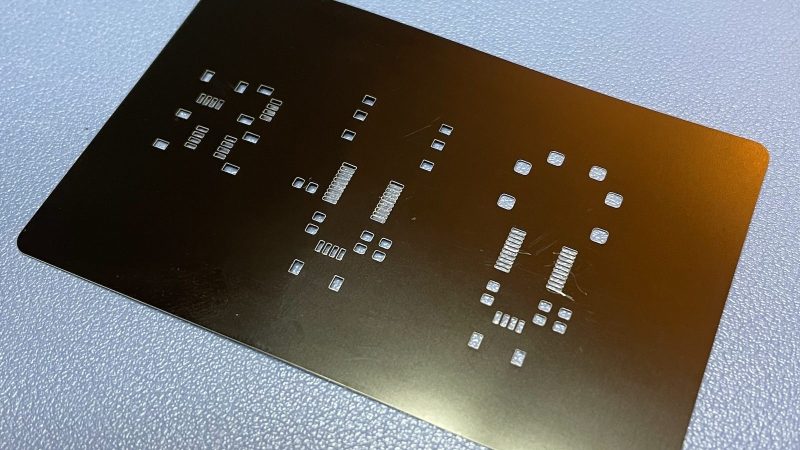
Why business card blanks? They’re cheap, for a start—maybe 15 cents each in quantity. They’re also the right thickness, at just 0.8 mm 0.18 mm, and they’re flat, unlike rolled materials that can tend to flip up when you’re trying to spread paste. They’re only good for small PCBs, of course, but for many applications, they’ll do just fine.

To cut these, you’ll probably want a laser cutter. [Mikey] was duly equipped in that regard already, which helped. Using a 20 watt fiber laser at a power of 80%, he was able to get nice accurate cuts for the stencils. Thanks to the small size of the PCBs in question, the stencils for three PCBs could be crammed on to a single card.

If you’re not happy with your existing PCB stencil material, you might like to try these aluminium blanks on for size. We’ve covered other stenciling topics before, too.

Continue reading “Aluminum Business Cards Make Viable PCB Stencils”

Curious Claim Of Conversion Of Aluminium Into Transparent Aluminium Oxide

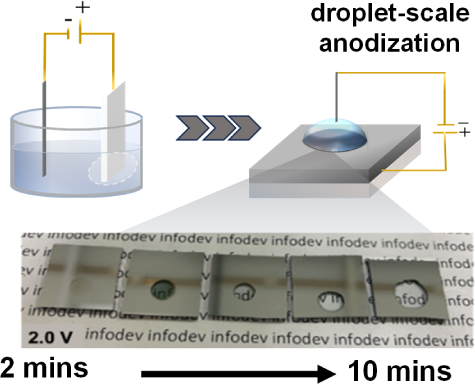
Sometimes you come across a purported scientific paper that makes you do a triple-check, just to be sure that you didn’t overlook something, as maybe the claims do make sense after all. Such is the case with a recent publication in the Langmuir journal by [Budlayan] and colleagues titled Droplet-Scale Conversion of Aluminum into Transparent Aluminum Oxide by Low-Voltage Anodization in an Electrowetting System.

Breaking down the claims made and putting them alongside the PR piece on the [Ateneo De Manila] university site, we start off with a material called ‘transparent aluminium oxide’ (TAlOx), which only brings to mind aluminium oxynitride, a material which we have covered previously. Aluminium oxynitride is a ceramic consisting of aluminium, oxygen and nitrogen that’s created in a rather elaborate process with high pressures.

In the paper, however, we are talking about a localized conversion of regular aluminium metal into ‘transparent aluminium oxide’ under the influence of the anodization process. The electrowetting element simply means overcoming the surface tension of the liquid acid and does not otherwise matter. Effectively this process would create local spots of more aluminium oxide, which is… probably good for something?

Combined with the rather suspicious artefacts in the summary image raising so many red flags that rather than the ‘cool breakthrough’ folder we’ll be filing this one under ‘spat out by ChatGPT’ instead, not unlike a certain rat-centric paper that made the rounds about a year ago.

Hack A Soda Can Into Jewelry

If you’ve ever needed some aluminum for a project, you might have noticed you have easy access to aluminum cans. If you need a cylinder, fine. But what if you don’t? [ThescientistformerlyknownasNaegeli] shows how to create an attractive necklace from two soda cans, and we think the techniques might be usable for other cases where you might need aluminum. If you care more about the necklace, it looks good. You only have to add a 3D-printed clasp or, if you prefer, you can buy a clasp and use that. For the Hackaday crowd, you can also use the resulting structure as an aluminum cable shield, which might better suit you.

The post gives more details and points to other posts for even deeper dives into many of the steps. But the basic idea is you strip the ink from the outside of the can and then cut the can into a strip. The mechanism for that looks a lot like a machine to cut plastic bottles into strips, but that method isn’t feasible without special blades.

Continue reading “Hack A Soda Can Into Jewelry”

Aluminum Battery Is Sustainable

If you think of metals in a battery, you probably think of lithium, mercury, lead, nickel, and cadmium. But researchers in Australia and China want you to think about aluminum. Unlike most battery metals, aluminum is abundant and not difficult to dispose of later.

Their battery design uses water-based electrolytes and is air-stable. It is also flame retardant. The battery can provide 1.25V at a capacity of 110 mAh/g over 800 charge cycles. The idea of using aluminum in a battery isn’t new. Aluminum is potentially more efficient since each aluminum ion is equivalent to three lithium ions. The batteries, in theory, have higher energy density compared to lithium-ion, but suffer from short shelf life and, so far, practical devices aren’t that close to the theoretical limits of the technology.

Continue reading “Aluminum Battery Is Sustainable”