You Can Now Run MS-DOS Applications On The Apple IIe

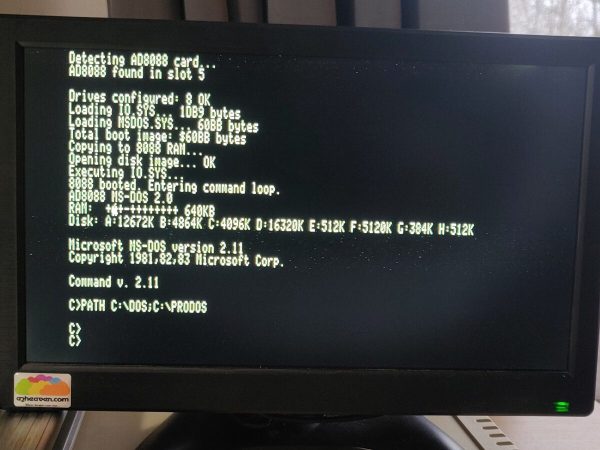
After a lot of debugging, [Seth Kushniryk] has managed to get the last issuess shaken out of his port of MS-DOS 2.0 to the Apple II, and has released the project to the public. If you have the requisite AD8088 or similar co-processor expansion card with onboard x86 CPU, this should be all you need to get started.

Although this co-processor card contains effectively a self-contained x86 system, its only I/O goes via the expansion bus, so it has to play nice with the 6502 CPU of the Apple II system. When we last reported on [Seth]’s efforts he had just managed to get MS-DOS 2.0 booting and basically in a barebones working state.

Since then he’s been working on the bridge program that provides communication between the 8088 on the card and the Apple II’s 6502, relocating it in RAM to enable high-resolution graphics, as well as other tweaks and optimizations. Also a lot of bug hunting, including an undocumented ProDOS constraint with a request count.

With all of this done it’s now possible to run basically any MS-DOS 2.0 compatible software, assuming it doesn’t try to write directly to video memory. This does limit the software selection somewhat, but back in the day it would probably have been amazing to have that 8 MHz 8088 purring along the 6502 to run both Apple and DOS software titles. Props to [Seth] for restoring this software functionality that had been lost to the ages.

Continue reading “You Can Now Run MS-DOS Applications On The Apple IIe”
Porting MS-DOS 2.0 To The Apple IIe

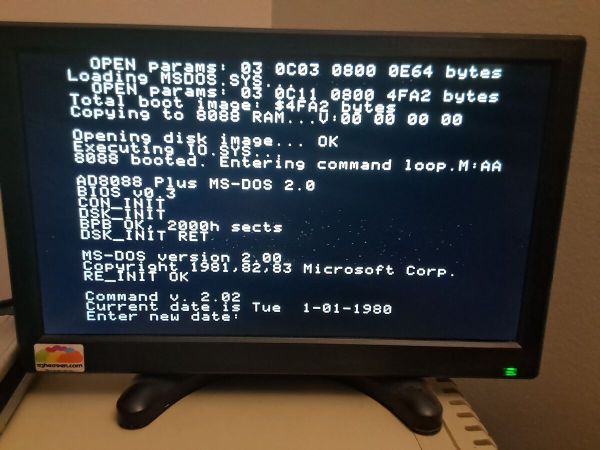
Although the Apple II range of computers were based around the 6502 processor, they could still run x86 software using expansion cards that were effectively self-contained computers. This way an Apple IIe owner, for example, could install an Intel 8088-based AD8088 co-processor card by ALF Products and run CP/M-86 as well as MS-DOS. Unfortunately, as [Seth Kushniryk] discovered while digging into this MS-DOS option, there don’t seem to be any remaining copies of the accompanying MS-DOS 2.0 software.

The obvious response to this is of course to try and port it once again, which [Seth] did. So far he got it to boot, though it’s not quite ready for prime-time yet. Although the AD8088 card is fairly self-contained, it still has to talk with the Apple IIe system, which poses some challenges. To help with the porting he’s using the MS-DOS 2.0 OEM Adaptation Kit that was released along with the sources a while back.

The Apple II has to first load the basic MS-DOS files into the 8088’s RAM before handing over control, which works now along with the basic functionality. Before [Seth] releases the port to the public he still wants to fix a number of issues, in particular the clock. ProDOS on the Apple IIe encodes the year differently than MS-DOS, so that the latter’s clock is off by a few years, and the console driver is still not quite as robust as [Seth] would like it to be.

Beyond this there is also working with the other cards in the Apple II2 system, including the Super Serial Card, and working with the ProDOS filesystem.

Supercon 2023: Building The Ultimate Apple IIe, Decades Later

The Apple II was launched in 1977, a full 47 years ago. The Apple IIe came out six years later, with a higher level of integration and a raft of new useful features. Apple eventually ended production of the whole Apple II line in 1993, but that wasn’t the end. People like [James Lewis] are still riffing on the platform to this day. Even better, he came to Supercon 2023 to tell us all about his efforts!

[James]’s talk covers the construction of the Mega IIe, a portable machine of his own design. As the name suggests, the project was based on the Mega II chip, an ASIC for which he had little documentation. He wasn’t about to let a little detail like that stop him, though.

The journey of building the Mega IIe wasn’t supposed to be long or arduous; the initial plan was to “just wire this chip up” as [James] puts it. Things are rarely so simple, but he persevered nonetheless—and learned all about the Apple II architecture along the way.

Continue reading “Supercon 2023: Building The Ultimate Apple IIe, Decades Later”

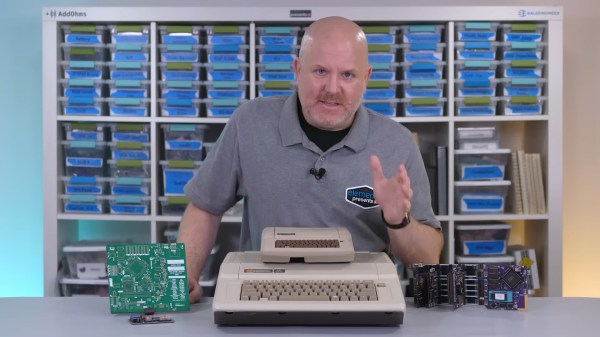
A bald white man stands behind a table with an Apple II, a large green PCB, and a modular purple and black development board system. Atop the Apple II is what appears to be a smaller Apple II complete with beige case and brown fake keyboard.

Mini Apple IIe Now Fully Functional

Here at Hackaday, we love living in a future with miniaturized versions of our favorite retrocomputers. [James Lewis] has given us another with his fully functional Apple IIe from the Mega II chip.

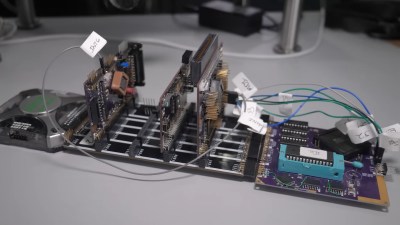
When we last checked in on the Mega IIe, it was only just booting and had a ways to go before being a fully functional Apple II. We really love the modular dev board he designed to do the extensive debugging required to make this whole thing work. Each of the boards is connected with jumper pins, which [Lewis] admits would have been better as edge connectors since he should’ve known he’d be unplugging and replugging them more than he’d like.

A set of PCBs sits on a table. There is a logic analyzer plugged into one end that looks like a grey square. Three boards stick up at right angles from the main plane which consists of a purple square PCB with the IIe ROM and MEGA chips and a black rectangular PCB with four sets of headers for PCB modules to slot into.

This modular prototyping system paid dividends late in the project when a “MEGA bug” threatened the stability of the entire system. Since it was confined to the keyboard PCB, [Lewis] was able to correct the error and, swapping for the third revision of the board, everything that had been crashing the system now ran.

There were still some issues going to the final unified PCB that nearly made him give up on the project, but perseverance paid off in the end. Combining vintage chips and multiple RP2040s isn’t for the feint of heart.

Now that you have a more conveniently-sized Apple II, why not teach it some new tricks like digital photography or ChatGPT?

Continue reading “Mini Apple IIe Now Fully Functional”

Mini Apple IIe

The Mini Apple IIe That Runs On C.H.I.P.

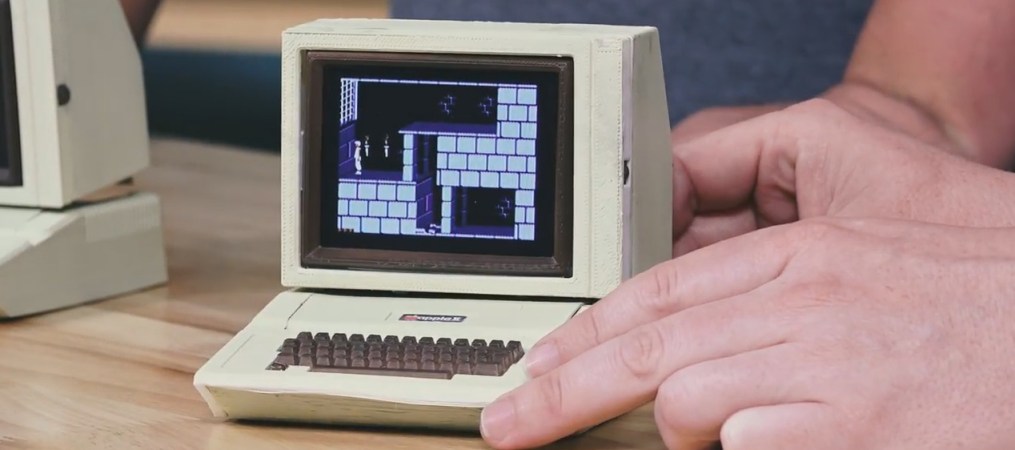
[Cupcakus]’s mini Apple IIe must surely be a contender for the smallest computer running an Apple II emulator. We’d mentioned it a few months ago in a Links post when it had been posted to a forum along with a few videos of it in action, but now popular YouTube channel, [Tested], has released a video wherein they not only show what’s inside, and interview [Cupcakus] about his trials and tribulations in making it, but also go through the steps of making one of their own. Also, at the time of writing the Links post, [Cupcakus] hadn’t yet announced his detailed GitHub page about it.

This mini Apple IIe runs on a C.H.I.P., a small $9 single board computer, and has a speaker and a TFT LCD display. Input is via a full-sized wireless keyboard. He doesn’t have joysticks working but that was an oversight and having realized how many games require joysticks, he has plans to add support for them. The case is 3D printed from models available on Thingiverse and links are on the GitHub page, along with all other details for making one yourself.

He did have to do some hacking. The video signal from the C.H.I.P. wasn’t available from the pin headers so he had to solder a wire directly to the board itself. The C.H.I.P. requires from 3.3 V to 5 V whereas the display wants 6 V to 12 V. To accommodate both he gets power from a 12 V drone battery and uses a 5 V buck converter for the C.H.I.P. And he had to modify the emulator to be legible on the low resolution of the display. The code for that is also available through the GitHub page.

While he uses the display as the screen for the Apple II emulator, it actually has two video inputs. So just in case he wants to show something on the display from another source, perhaps to watch a video, he’s made the second video input available using a socket in the back.

Want to see all the details for yourself? Check out [Tested]’s video below.

Continue reading “The Mini Apple IIe That Runs On C.H.I.P.”

A Full Speed, Portable Apple //e

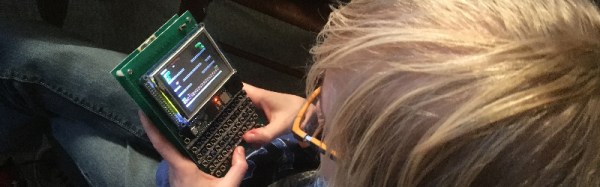
A while back, [Jorj] caught wind of a Hackaday post from December. It was a handheld Apple IIe, emulated on an ATMega1284p. An impressive feat, no doubt, but it’s all wrong. This ATapple only has 12k of RAM and only runs at 70% of the correct speed. The ATapple is impressive, but [Jorj] knew he could do better. He set out to create the ultimate portable Apple IIe. By all accounts, he succeeded.

This project and its inspiration have a few things in common. They’re both assembled on perfboard, using tiny tact switches for the keyboard. The display is a standard TFT display easily sourced from eBay, Amazon, or Aliexpress. There’s a speaker for terribad Apple II audio on both, and gigantic 5 1/4″ floppies have been shrunk down to the size of an SD card. That’s where the similarities end.

[Jorj] knew he needed horsepower for this build, so he turned to the most powerful microcontroller development board he had on his workbench: the Teensy 3.6. This is a 180 MHz ARM Cortex M4 running a full-speed Apple IIe emulator. Writing a simple 6502 emulator is straightforward, but Apple IIe emulation also requires an MMU. the complete emulator is available in [Jorj]’s repo, and passes all the tests for 6502 functionality.

The project runs all Apple II software with ease, but we’re really struck by how simple the entire circuit is. Aside from the Teensy, there really isn’t much to this build. It’s an off-the-shelf display, a dead simple keyboard matrix, and a little bit of miscellaneous circuitry. It’s simple enough to be built on a piece of perfboard, and we hope simple enough for someone to clone the circuit and share the PCBs.

VCF East: The Swyft Card

Ninety five percent of the population will say Apple computers is the brainchild of [Steve Jobs]. The other five percent will be right, but what nearly no one knows is that the Macintosh project was originally conceived by [Jef Raskin]. He holds the honor of turning the Mac into an, ‘information appliance’ and being one of the first people to seriously consider how millions of people would interact with computers.

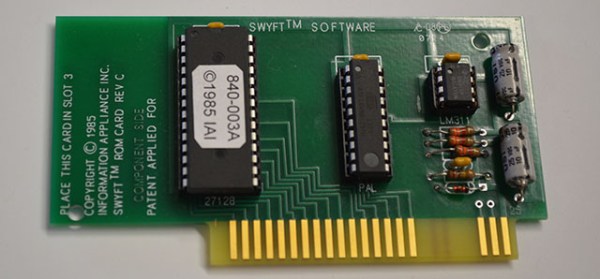
The Mac wasn’t [Jef]’s first project at Apple, though. Before the Mac project he was working on something called Swyft – an easy to use command line system that was first implemented as a firmware card for the Apple IIe. [Mike Willegal] was kind enough to bring one of these Swyft cards to the Vintage Computer Fest this weekend, and did a demo of it for us.

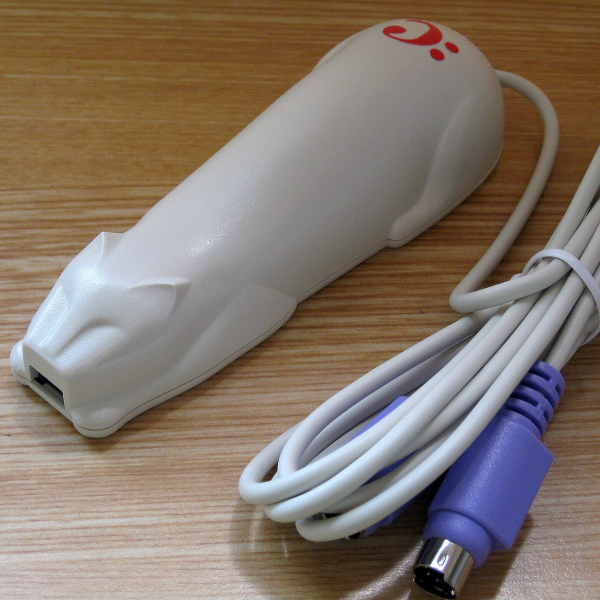
The basic idea behind the Swyft card was to have an integrated word processor, calculator, and access to Applesoft Basic. Holding down a ‘leap’ key – in the case of the Apple IIe add-on, the open apple key – allowed the user to search for text and perform operations on any result. It’s odd, but it just makes sense in some strange way.

[Mike] is doing a build class at the VCF today where anyone attending can build their own Swyft card. He also has instructions for building your own, should you want to experiment with one of the ‘could have beens’ of user interface design.

Continue reading “VCF East: The Swyft Card”