Portable Gets A Proper Home In An Arcade Controller

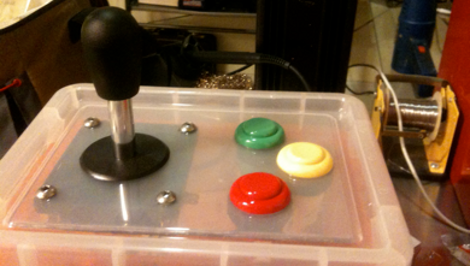
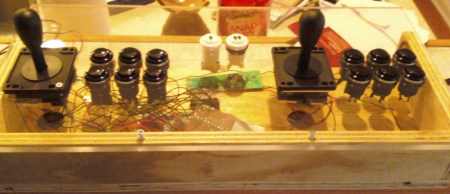
[Luke] wanted an arcade-style controller that he could use for some gaming at home. He decided to use a portable game emulator as a base and then added his own joystick and buttons along with a custom case.

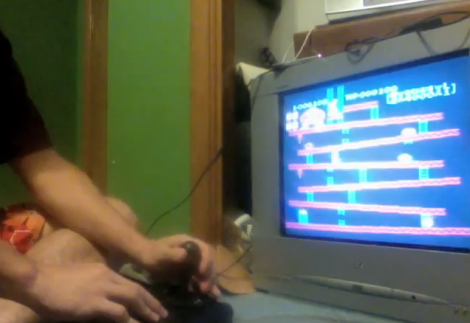
The donor hardware is a Dingo A320. It’s a nice little handheld with a 2.8″ screen, and plenty of potential to emulate games like Donkey Kong seen above, or to play homebrew. It’s even been the target of some RAM upgrades we looked in on in the past. The best part for [Luke’s] project is that it includes a video out port.

In the clip after the break you can see that [Luke] now has a compact controller with a huge arcade joystick, four buttons on the top surface, and the rest of the controls all around the edges of the enclosure. The video out option is selected in the menu system, so he preserved the original LCD for use during configuration.

Continue reading “Portable Gets A Proper Home In An Arcade Controller”

A MAME Cabinet Fit For A Doctor (Who)

tardis_mame_console

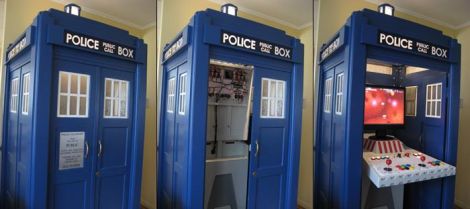
While many people would be satisfied leaving a MAME console on their desk, others take the time to put their MAME creations in a nice, authentic arcade cabinet. Some people like [Simon Jansen] take the craft to a whole new level, crafting a TARDIS from the ground up in order to house a MAME console.

It all started with a computer that had no real purpose. [Simon] decided it would be great to use as a MAME console, so he started brainstorming ideas for an enclosure. As he tells it, he was staring out a window looking for inspiration when his eye caught a giant billboard for [Dr. Who], complete with a TARDIS. The rest was history.

The MAME cabinet is about 3/4 the size of an on-set TARDIS, and crafted mostly from MDF. Plenty of time was spent analyzing the different TARDIS designs featured on the show over the years, paying special attention to even the smallest of details. Once the construction of the TARDIS was complete, [Simon] started work on the MAME portion of the project.

His MAME console was built to completely fit inside the TARDIS when closed, but it also had to take into account the box’s inward folding doors, which take up a good bit of space. The base was also made from MDF, and includes a durable white plastic panel in which the controls are mounted.

The final result is amazing – it does the TARDIS justice, and it looks like plenty of fun to play as well.

Adding Persistent Memory And Ethernet To Vintage Arcade Machines

z80_bus_tapper

If you are a frequent reader, you are undoubtedly familiar with hacker [Sprite_tm]. He has been working with fellow members of the TkkrLab hackerspace to get things ready for their official grand opening on May 28th, and wrote in to share a project he recently completed to kick things off.

As part of their preparations, they have been stocking the joint with all sorts of hacker-friendly goodies including plenty of tools and Club Mate, as well as a vintage ‘1943’ arcade cabinet. The game is a group favorite, though every time the power is turned off, it loses all of the hard-earned high scores. [Sprite_tm] knew he could improve on the current paper-based score register, so he pulled the machine open to see what could be done.

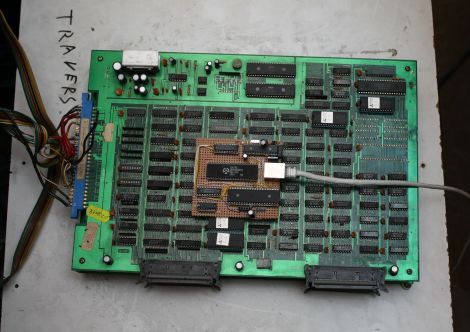
He used an AVR to tap into the machine’s Z80 logic board, allowing him to read and write to the entirety of the game’s RAM whenever he pleased. This enabled him to keep tabs on the high scores, restoring them to memory whenever the machine is powered back on. The addition of the AVR also allowed him to add a TCP/IP interface, which is used to send high scores to Twitter whenever someone beats the previous record.

His modular bus tap can be used in all sorts of Z80-based hardware, so if you have some vintage equipment laying around, be sure to swing by his site for a more detailed look at the build process.

Arduino Arcade Rom Dumper

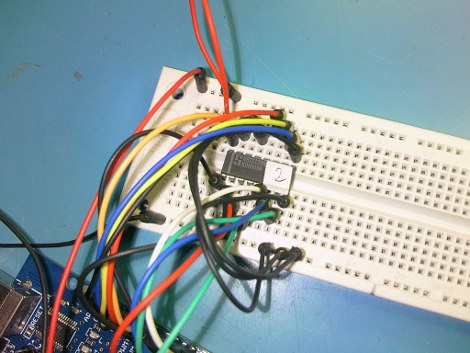
[Vincenzo] wanted to read some 82S129 bipolar proms, and why not, they were very common in the 1980’s arcade scene. The problem is that its kind of an odd ball part now, and typically only (even) more expensive EPROM programmers can read them. An Arduino, breadboard and some quick scripting quickly takes care of that problem with this Arcade Rom Reader.

You stick the prom in your breadboard, and wire it up to the appropriate ports and pins of the Arduino, which bit bangs the prom and returns the results though the serial connection of the Arduino. Using a terminal program on the pc side you capture the text and use a script to convert the ascii values into a binary nibble format and save as hex.

This makes it much easier for us to dump roms from old arcade boards, because you never know when you might run across an old Polybius arcade board on your next outing to the salvage or scrap yard.

Join us after the break for all the details and as always comments!

Continue reading “Arduino Arcade Rom Dumper”

Mini Arcade Cabinet Looks As Good As The Real Thing

mame_cab

[Ed] had a netbook he no longer needed and decided to make it into a mini MAME cabinet for some of his family members. MAME cabinets are pretty plentiful, but this one was so nicely done, we wanted to share it.

He removed the monitor from an EeePC 901 in order to get some precise measurements, then went about crafting a mini cabinet from MDF. The whole thing was wrapped in sticky label paper adorned with old-school Galaga graphics, then covered in plexiglass for a nice sleek look that also protects the artwork.

He used an iPac 2 controller board to wire up all of the buttons and joystick to the netbook, opting to solder the controller’s wires directly to the USB header on the eeePC’s motherboard. A power switch was added up on top for easy operation, and the cabinet was sealed shut, though the back does open easily in the event that maintenance is required. The system is managed using the Maximus Arcade front end for MAME, which [Ed] claims is incredibly easy.

If you are interested in making your own MAME cabinet, check out some of the other MAME-based projects we have featured in the past, and don’t miss the video below of [Ed’s] cabinet in action.

Continue reading “Mini Arcade Cabinet Looks As Good As The Real Thing”

MIDI Controller Fit For An Arcade

arcade_midi_controller

MIDI controllers can be relatively expensive depending on feature sets and requirements, so Instructables user [fraganator] went about building one on his own for just under $100. He originally wanted to replicate a commercially available MIDI controller, which used arcade buttons in lieu of the more common rubberized buttons, since they are large and have a better feel when pressed. Once he drew up plans for his MIDI clone, he realized he wanted more features in his controller than were available in the commercial version, so he started revising.

His final plan included three rows of four arcade buttons as well as four rotary and two sliding potentiometers. All of the components were mounted in a small keyboard enclosure, then wired to an Arduino clone, which manages all of the controller’s functions. The controller is connected to a PC via USB and can perform any number of operations once the buttons are mapped in MIDI-compatible software.

There are no videos of the controller in action just yet, though [fraganator] says one is forthcoming.

SNES Arcade Controller

[Daniel] is making a mini arcade cabinet with an SNES housed inside. He wanted to build an arcade controller for it and chose to construct something from scratch instead of destroying an original piece of hardware. We can almost feel you guys sighing with relief at that one. He sent us some nice photos of his build and pointed out that he’s using one of the Evilmadscientist AVR boards housing an ATtiny2313. The arcade buttons are readily available at sparkfun. The source code for this project is available after the break.

Continue reading “SNES Arcade Controller”