Automatic Dog Dish Filler Never Goes Dry

automatic_water_dish

[Avatar-X] has a Siberian Husky that gets a lot of exercise throughout the day, and as you would imagine, drinks a ton of water as well. We all suffer from memory lapses at one time or another, and while he is normally good about keeping the bowl filled, he occasionally forgets. He has tried a handful of various auto-filling dog dishes, but none of them seemed to work all that well, and they often rapidly built up healthy bacterial colonies.

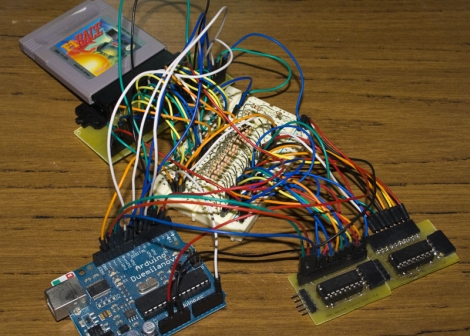
With the help of some friends, he rigged up an automatic water dish filler, that ensures his pup always has a sufficient supply of water. He tapped into his kitchen water supply with a standard refrigerator hookup kit, and ran some tubing up into his cabinets, where he placed a garden irrigation valve. The valve is controlled using an Arduino which senses the bowl’s water level using a pair of wires.

The system looks like it works pretty well if the video embedded below is any indicator. [Avatar-X] provides code and schematics for the water control circuit on his site, free to anyone looking to build a similar system for their pets.

If you are interested in learning more about automating some of your pet’s care, be sure to check out these hacks we featured in the past.

Continue reading “Automatic Dog Dish Filler Never Goes Dry”

Recycled Sound – An Art Installation Not Lacking Arduinos

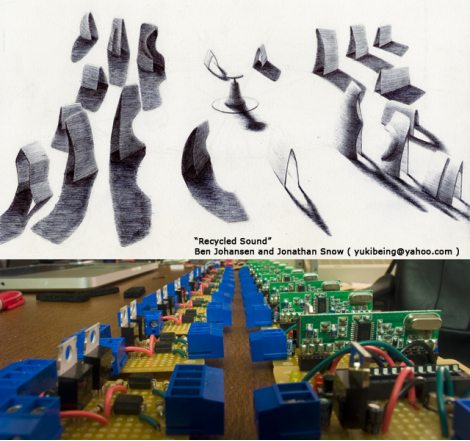
[oakkar7] wrote in to show us [Ben Johansen] and [Jonathan Snow]’s  interactive art installation, Recycled Sound(Website has a virus). The exhibit will premiere  in the TWU Arts Triangle Walking Tour March 25th from 5-7pm.

Currently a work in progress, the final plan is for the outdoor installation to feature a podium in the center with a rotating top, and various islands surrounding. As the podium’s top is rotated the surrounding islands come to life with a variety of light and sound displays which vary depending on how the podium is turned. While the electronics are not recycled, the actual sculptures and music making elements themselves consist of scrap yard parts and factory waste.

The whole display runs off of 12.. yes TWELVE Atmel 328s with Arduino boot loaders! The center podium houses a transmitting circuit consisting of two atmega 328s with Arduino boot loaders sharing a crystal, an hmc 6532 magnetometer breakout board and two RF transmitters.  The Islands each contain a receiving module with, obviously,  an Arduino and RF receiver. The receiving Arduinos connect to opto isolated switching modules for motors and lighting. Check out [Ben]’s blog for in progress shots, code, and build information.

If you are looking to control some 12V motors/lights with your 5V Arduino be sure to check out the pictures in the blog. While we here at Hackaday may be quick to jump into soldering [Ben] follows the proper development progression to the letter. Each aspect is bread boarded, then refined, then transferred to a soldered perf board.

update: His site has some kind of malware going on. None of us noticed it in Firefox, but after complaints we fired up ol IE. Yup, nastyness there. You can go there at the following link if you dare.

More after the jump:

Continue reading “Recycled Sound – An Art Installation Not Lacking Arduinos”

Laser Light Show Features Full XY Control Via Homemade Galvanometers

[Rich] over at NothingLabs has put together a really cool laser light show that you really must see in an effort to win a laser cutter from Instructables.

His walkthrough discusses the mechanics of laser light shows – specifically how galvanometers are typically used to precisely aim mirrors in order to draw images and write text. Commercial galvanometers tend to be pretty expensive, so he opted to build his own, using relatively cheap and easy to find parts.

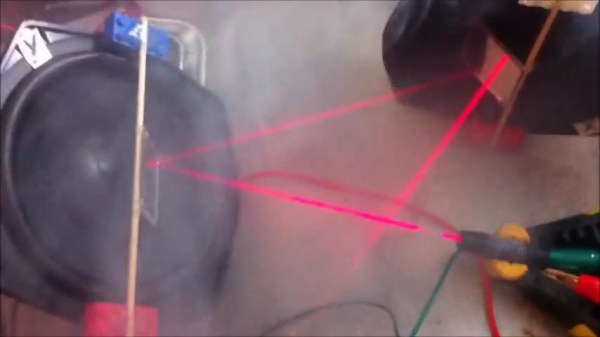
The galvanometers were constructed using a pair of old speaker woofers, a few Lego bricks, and some acrylic mirror squares. The mirrors were mounted on the speakers, which were then wired to an Arduino. He removed the batteries from a cheap red laser pointer and permanently wired it to the Arduino, which it now uses as a pulsed power source. Once he had everything built, he positioned the laser using a fog machine for guidance.

As you can see in the video below, the laser show is quite impressive. His homemade galvos provide a somewhat rough quality to the final projected image, and we like that a lot. It looks almost as if all of the text and images were hand drawn, which is a pretty cool effect.

Just as [Rich] mentions, we hope to see some cool hacks based off his work in the future.

If you are interested in some of our previous laser features, check these out.

Continue reading “Laser Light Show Features Full XY Control Via Homemade Galvanometers”

RoboTouch Adds Physical Game Controls To The IPad

robotouch

[ProtoDojo] wanted to play a racing game on his iPad, but he was not a big fan of using the touch interface for this particular title. Instead, he put together a pretty neat little hack that allows him to play games on his iPad using an old NES controller.

He built a set of custom conductive arms which he mounted on three micro servos. The servos were attached to the iPad screen using small suction cups in the locations where it expects to receive button presses. They are also wired to an Arduino that interprets button presses from the attached NES controller. When the Arduino senses that the D-pad or buttons have been pressed, it triggers the servos, which in turn press the virtual buttons on the screen.

In the video below, you can see that after adjusting the servo positions, the setup seems to work pretty well. You might expect to see some sort of lag with a setup like this, but we didn’t notice any. The [ProtoDojo] web site is currently down due to heavy traffic, but you should be able to find some more build details there, once it becomes functional again.

Continue reading “RoboTouch Adds Physical Game Controls To The IPad”

Giving “sight” To The Visually Impaired With Kinect

NAVI

We have seen Kinect used in a variety of clever ways over the last few months, but some students at the [University of Konstanz] have taken Kinect hacking to a whole new level of usefulness. Rather than use it to control lightning or to kick around some boxes using Garry’s Mod, they are using it to develop Navigational Aids for the Visually Impaired, or NAVI for short.

A helmet-mounted Kinect sensor is placed on the subject’s head and connected to a laptop, which is stored in the user’s backpack. The Kinect is interfaced using custom software that utilizes depth information to generate a virtual map of the environment. The computer sends information to an Arduino board, which then relays those signals to one of three waist-belt mounted LilyPad Arduinos. The LilyPads control three motors, which vibrate in order to alert the user to obstacles. The group even added voice notifications via specialized markers, allowing them to prompt the user to the presence of doors and other specific items of note.

It really is a great use of the Kinect sensor, we can’t wait to see more projects like this in the future.

Stick around to see a quick video of NAVI in use.

[via Kinect-Hacks – thanks, Jared]

Continue reading “Giving “sight” To The Visually Impaired With Kinect”

Electronic Diaper Bag Reminds You To Pack Everything But The Baby

lilypad_diaperbag

[jnorby] knows what it’s like to leave the house with her baby in tow, only to realize that she has left something she needs at home. Instead of relying on a paper checklist, she decided to craft her own diaper bag that alerted her if she had forgotten to pack a particular item.

She built her bag from scratch, wiring small circuits into each of the pockets she created on the inside of the bag. Wires were run to each half of a snap fastener, so that they would complete the circuit when the snaps touch. The LEDs and snaps were then connected to a LilyPad Arduino, which checks the status of the snap circuits, lighting the appropriate LED once the proper item has been packed.

While we like the idea of a bag that uses functional indicators that remind you to pack items, we do think that the use of the Arduino, or any microprocessor for that matter, is massive overkill. We would ditch the LilyPad and snap fasteners for reed switches or perhaps normally closed micro leaf switches that turn the LEDs off once the proper item has been packed, rather than the other way around.

Tilt And Pivot Camera Base Uses Just Two Servos

[Caled] shows us how to build a tilt and pivot camera base. One of these can be quite handy for taking precisely aligned images that can later be stitched together into panoramic, or even spherical images. We have grand visions of being able to produce something along the lines of these stunning interactive images with hardware that is cheaper and easier to build than this other motorized rig.

The design utilizes just two servo motors. In the image above you can just make out a pair of discs that serve as the base for the rig. In the center of the upper disc is the first servo, pointing downward, which rotates the camera. Two upright supports on either side of the point-and-shoot provide the framework for the tilt feature. The camera is mounted in a frame whose center is a threaded rod on the near side, and the second servo motor on the far side. An Arduino with a servo shield controls the movements along with a button pad and LCD screen as a user interface. The last step in the project log points to software options for combining the captured photos.