Flaming Guitar Hero

[Chris Marion] knew he wanted to play with fire, or more accurately with fireball spewing valves, but he need a good project in which he could use them. Inspiration finally struck and he built this controller that matches fireballs to the fret buttons on a Guitar Hero controller. There’s quite a lot that goes into this but we think that he hit a home run. The basic components are a manifold with electronically actuated valves, another manifold for the pilot lights, and a modified Guitar Hero controller.

To interface the controller he used an Arduino along with [Bill Porter’s] PS2 library to read signals from the buttons. But the real labor intensive part of the build came with the manifold. There’s a hardware store’s worth of fittings and flexible copper pipe that go into that assembly. In the end this all came together in just one week.

[Thanks Bill]
More Bike-controlled Google-travelling

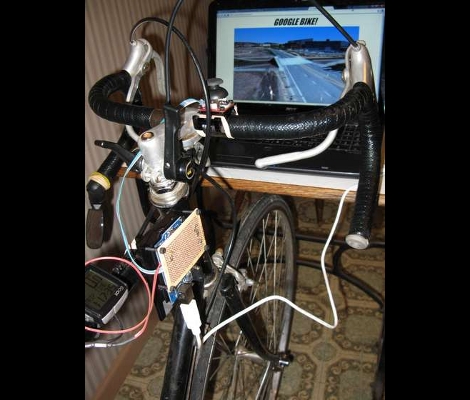
This is becoming such a popular hack we figure someone needs to come up with a name for it like Google-travelling or Google-cising (exercising with Google). It’s a bike controller for Google Earth. [Braingram] broke out his road bike, setting it up in the trainer in front of his laptop. If you already have a computer with a cadence sensor this will be a snap. These measure the crank rotation using a magnet and reed switch. So as not screw up his summer biking [Braingram] spliced into the sensor while leaving it attached to the bike computer. From there it is read by an Arduino which also monitors an analog joystick attached to the handlebars. A little bit of Python scripting and you’ll be ready to go.

Be sure to check out some of the other variants like using an exercise bike, or adding a wearable display.

Controlling Real Objects Using Minecraft

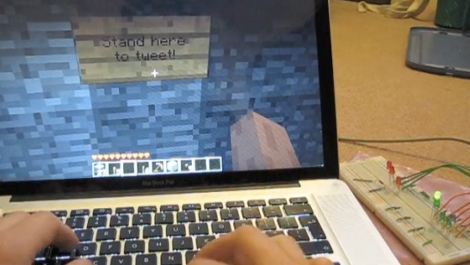
Most augmented reality takes images of the real world and superimposes virtual data on top of them. [Michael Winston Dales] went a different direction, using the virtual world of Minecraft to control objects in the physical world. In the video after the break you can see him use switches that he built inside the game to turn the LEDs pictured above on and off. You’ll also notice that in-game sign instructing a player to stand in one spot to Tweet. Since Minecraft is written in Java there are some mods that allow you to hook onto in-game events. [Michael] does just that, triggering his own scripts to send data to an Arduino, or use a Twitter API. Now this something that should be used with the Minecraft ALU. It takes the sandbox method of gaming to a new place, doesn’t it?

Continue reading “Controlling Real Objects Using Minecraft”

Shutter Remote For RICOH Cameras

[Toby] wanted to have a remote shutter trigger for his RICOH GR III camera. This brand doesn’t have a dedicated port for remote operation but a bit of research allowed him to build his own trigger. The camera’s USB port is used for triggering but not using the USB protocol. Instead, a pulse pattern on the 5V line identifies the half-press, full-press, and release states of the shutter button. From there it was just a matter of wiring up a circuit centering around an Arduino that leaves room for a lot of expansion into realms like photo automation.

Tardis Tree Topper

If your holiday tradition means waiting until Christmas to decorate the tree, it’s not too late. Build yourself Dr. Who’s Tardis as a tree topper. [Hybrid Blue] just finished the project, with includes illumination which you can see in the video after the break. The structure is made from balsa wood, painted, then filled with Arduino driven RGB LEDs. It’s sure to please the time lord in your family.

Continue reading “Tardis Tree Topper”

Hackaday Unleashes A Troll Sniffing Rat

Sometimes we like to take a few minutes away from Hackaday to spend time with our families. But just when you take your eyes off of the incoming comments, Trolls are bound to strike. Well, [Caleb] and I found a solution to the problem in the form of a troll sniffing rat. This beady-eyed vermin sits on my desk and waits. When a trolling comment is detected its eyes glow red and an alarm is sounded. Join us after the break for more about this silly project.

Continue reading “Hackaday Unleashes A Troll Sniffing Rat”

Garage Monitor Has An Extra Arduino

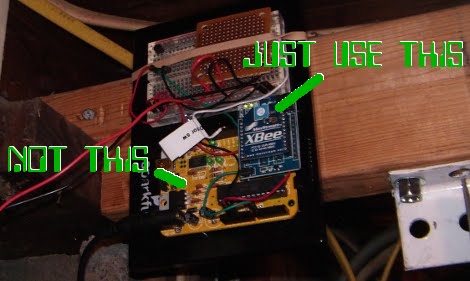
[Jody] wanted to know when his garage door was open. He details his setup which uses a temperature sensor read by an Arduino to send over XBee radio to a computer running a Windows Service. We have seen this twice before, and is noteworthy as a lesson. The XBee radios have the ability to read analog data, relay digital signals, and a lot more. This means the Arduino is completely unnecessary. For example, the Tweet-a-Watt uses two of an XBee’s ADCs to measure voltage and current in a Kill-a-Watt power meter. Programming an XBee is really simple, with the help of tutorials from SparkFun and Adafruit. A bit of programming and soldering should get [Jody] back his Arduino. We hope this note will help you find more creative uses of XBees without microcontrollers.

[Via Make]