Giant Fabric Keyboard


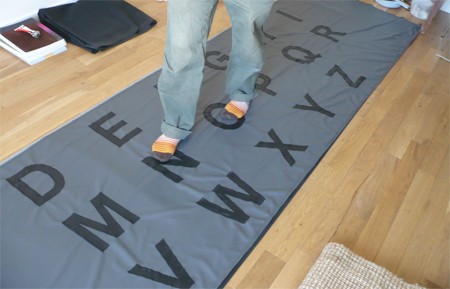
[ladyada] pointed us in the direction of this giant fabric keyboard built by [Maurin Donneaud]. The construction of it looks fairly simple, like the buttons used in [fbz]’s WiFi detecting backpack strap, but on a larger scale. We’ll take you through its construction, pictures and all, after the break.

Continue reading “Giant Fabric Keyboard”

Twittering From The Command Line

Twitter users often have trouble explaining just exactly what the service is for. The site specifically asks “What are you doing right now?” A simple interface and multiple ways to update means people have started hooking it to different real world objects… objects that aren’t reporting what they had for lunch. After the break, we’ll cover a couple devices that have interfaced Twitter to the real world and how you can update from your command line.

Continue reading “Twittering From The Command Line”

Arduino Beer Brewing


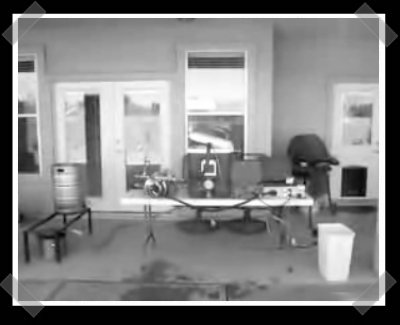
[Yuri] spent some time building a computer controlled, arduino interfaced beer brewing rig. A cooler serves as a mash tun, while the arduino controls a steam source that’s used to raise the temperature of the mash as desired. A java app talks to the arduino to set the temperature parameters and monitor the steam boiler. You can catch a nice video walkthrough of the setup, see some screen shots of his java interface.

PCB Milling Hell Sunday Extra


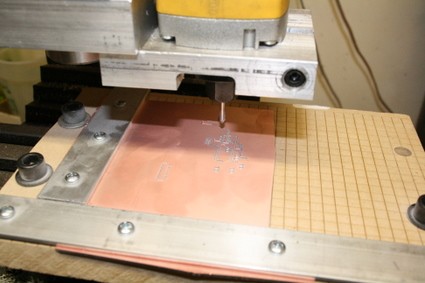
I’ve spent about 18 of the last 24 hours working on milling a PC board for my upcoming how-to. So far I’ve murdered several copper clad boards, built a hold down table, redesigned the board in eagle at least five times and snapped off a $15 half round engraving bit.

If you’re wondering, my new board milling table is a piece of MDF that I laser etched a .25″ grid onto, then added some aluminum strips to act as hold-downs. On the side of the strip opposite the board, I put thin slices of PC board to level out the hold downs. As usual, I’m building the board in eagle. To turn the board into something the mill can handle, I’m using pcb-gcode, a nice little g-code generation tool for eagle. I may switch methods later, but if I can get the settings tweaked, it’ll make my design to board milling process very fast.

[Scott] sent in the beginning of his attempt to build a frequency detector. He’s started out with just simple LCD matrix. Nothing intensely interesting just yet, but I like it when people send in stuff they’re working on.
If you haven’t checked out the Arduino yet, do it. It’s the easiest micro controller dev platform I’ve seen. If you’ve got one, now you can hook up a Wii-Nunchuck to it. If you like smaller and cheaper, check out [ladyada]’s boarduino.

[eliot] wanted me to mention this video on hacking drive through speakers. It’s a bit cheesy – and all I could think of was Thunder Run – where the geek character swapped the crystals in the CB radios. (Warning, The FCC might have some expensive words for you if you get caught.) Update: this is what you get if you don’t watch the entire video and catch the joke about taking apart toasters.

Tomorrow I should be picking out some winners for my laser etched laptop (or whatever) offer. You can still win some free etching time! Just send in a tip! The winners are selected from the ones that get published on Hack-A-Day.

Arduino Blimp


Here’s a good rule of thumb: “Don’t update your firmware five minutes before you’re going to fly an autonomous robot ten feet away from a former Vice President of the United States.”
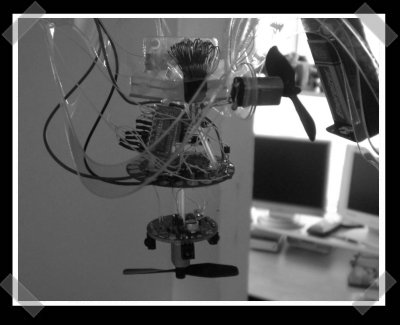
That was one of the afterthoughts of [Chris Anderson] after presenting his Arduino controlled blimp at TED. (I might have to squeeze TED into my con schedule next year.) The project itself is somewhat documented here, with some hi-res photos, parts list, and some firmware. Apparently the blimp was overcome by the A/C in the auditorium, but I still dig it.

Interactive Textile Construction

The e-textile construction kit by [Leah Buechley] consists of stitch-able sensors and microcontrollers. Stitch-able refers to the fact that these parts can be sewn with a needle and thread into wearable clothing or other fabric-based housings. A paper (PDF) on the e-textile construction kit project contains the first version. The second version of the e-textile construction kit, the LilyPad Arduino, is available this month through SparkFun’s site. Especially interesting are her instructions for modifying the clock speed on the Arduino to make it suitable for battery powered wearables.

We’ve covered [Leah Buechley]’s work twice in 2005 for her wearable led matrix work.

Update: [Leah] updated her site since we posted this and added this new how-to.