New Record Resurrects Long-Dead CD Graphics Format

Audio CDs were the ubiquitous audio format of the 1990s. Lesser known were the extensions to the format that packaged all kinds of interesting additional data into a musical release. Now, a new record from [Aizysse Baga] has brought back some of the most quirky and obscure CD features that time and industry long forgot.

[Aizysse Baga] worked with [Adelaide] on the Divacore record, which was to be released on a mini-CD. The original plan was to include additional CD+G data, featuring artwork to go with the music. CD+G, or CD+Graphics, was often used to display synchronized lyrics for karaoke releases, and stored data in formerly-unused subcodes next to the track start, track number, and running time data. This format allowed storing a slideshow of images with a resolution of 288 x 192 with a 16 color palette.

Note the quality difference between the 16-color CD+G and the 256-color CD+EG images.

The duo got handy with art and some smart dithering to get great 16-bit artwork packed in to the audio CD release, with the aid of a custom Python encoder. CD-TEXT metadata was thrown in for good measure. Then, the existence of the more advanced CD+EG became apparent. This was a 256-color extension to the CD+G format that was backwards compatible to boot. It was a format that was barely ever implemented on any commercial releases, and very little hardware could even display it. Naturally, Divacore had to have it. Much work was done to understand the Red Book documentation on the standard and figure out how to implement even higher quality artwork for the record.

After so much work to understand and implement the CD+G and CD+EG data, the question was whether it would survive the CD reproduction process for the final release. Thankfully, the final discs came out perfectly, and the full 256-color CD+EG artwork can be seen in all its glory if you happen to play Divacore on a Sega Saturn or a super-obscure Victor VS-G2 or VS-G3. Throw it in a less-sophisticated karaoke machine or something like an Amiga CD32, and you’ll still get to see the 16-color versions for your trouble.

We love to see ancient formats brought back to life, particularly those that never got their time in the sun. If you’re working hard to resurrect something the mainstream media world has forgotten, let us know on the tipsline.

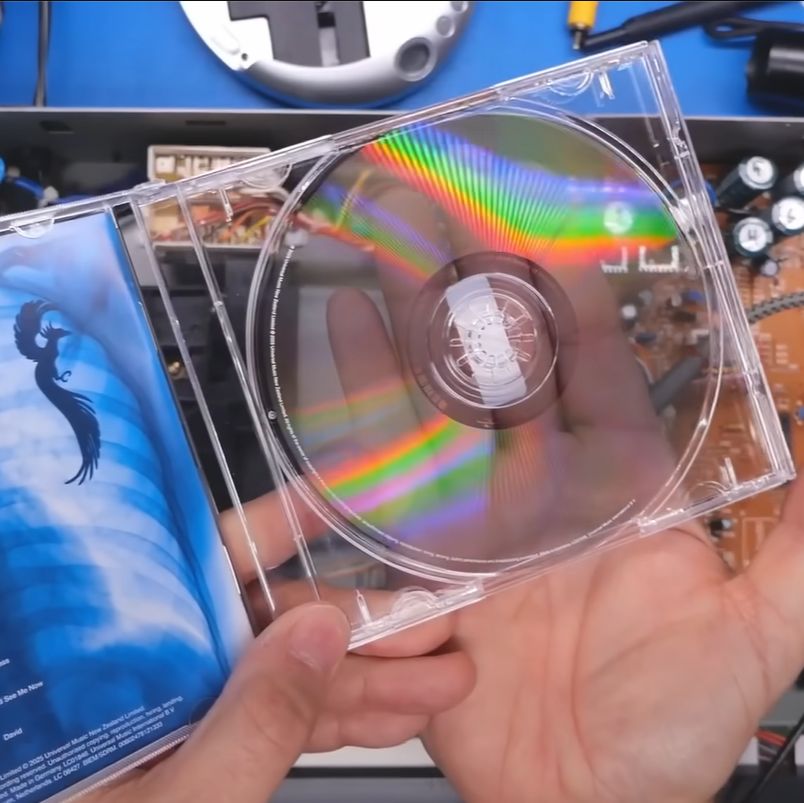
2003 Samsung CD player playing a clear vs normal audio CD. (Credit: Adrian's Digital Basement)

Why Lorde’s Clear CD Has So Many Playback Issues

Despite the regularly proclaimed death of physical media, new audio albums are still being published on CD and vinyl. There’s something particularly interesting about Lorde’s new album Virgin however — the CD is a completely clear disc. Unfortunately there have been many reports of folks struggling to get the unique disc to actually play, and some sharp-eyed commentators have noted that the CD doesn’t claim to be Red Book compliant by the absence of the Compact CD logo.

The clear Lorde audio CD in all its clear glory. (Credit: Adrian's Digital Basement, YouTube)
The clear Lorde audio CD in all its clear glory. (Credit: Adrian’s Digital Basement, YouTube)

To see what CD players see, [Adrian] of Adrian’s Digital Basement got out some tools and multiple CD players to dig into the issue. These players range from a 2003 Samsung, a 1987 NEC, and a cheap portable Coby player. But as all audio CDs are supposed to adhere to the Red Book standard, a 2025 CD should play just as happily on a 1980s CD player as vice versa.

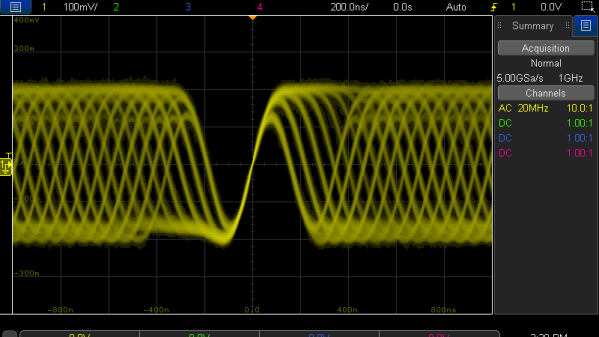
The first step in testing was to identify the laser pickup (RF) signal test point on the PCB of each respective player. With this hooked up to a capable oscilloscope, you can begin to see the eye pattern forming. In addition to being useful with tuning the CD player, it’s also an indication of the signal quality that the rest of the CD player has to work with. Incidentally, this is also a factor when it comes to CD-R compatibility.

While the NEC player was happy with regular and CD-R discs, its laser pickup failed to get any solid signal off the clear Lorde disc. With the much newer Samsung player (see top image), the clear CD does play, but as the oscilloscope shot shows, it only barely gets a usable signal from the pickup. Likewise, the very generic Coby player also plays the audio CD, which indicates that any somewhat modern CD player with its generally much stronger laser and automatic gain control ought to be able to play it.

That said, it seems that very little of the laser’s light actually makes it back to the pickup’s sensor, which means that along with the gain the laser output gets probably cranked up to 11, and with that its remaining lifespan will be significantly shortened. Ergo it’s probably best to just burn that CD-R copy of the album and listen to that instead.

Continue reading “Why Lorde’s Clear CD Has So Many Playback Issues”

Custom Slimline CD Player Hides Out Under Speaker

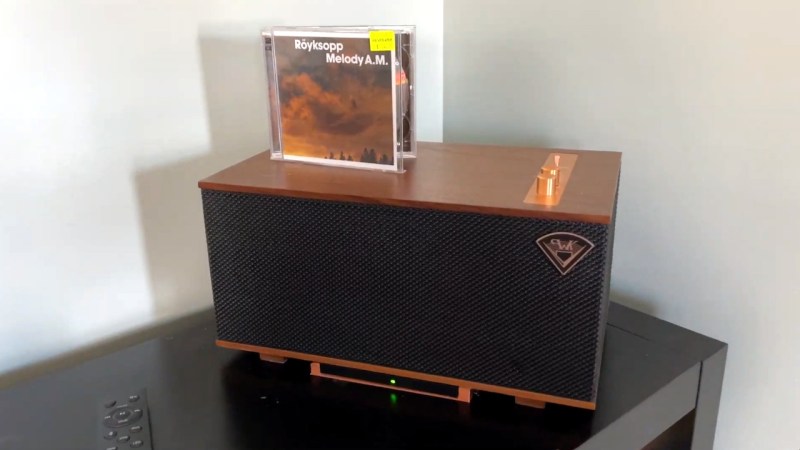
In the era of digital streaming, the market is full of wireless speakers that will play content from your smartphone or pull it down from the Internet directly over WiFi. But if you’re feeling a bit nostalgic and want to throw on one of your old CDs, well, you might have a problem. That’s the situation [Chad Boughton] recently found himself in, so he decided to build a compact CD player that could discreetly connect up to his fancy Klipsch speaker.

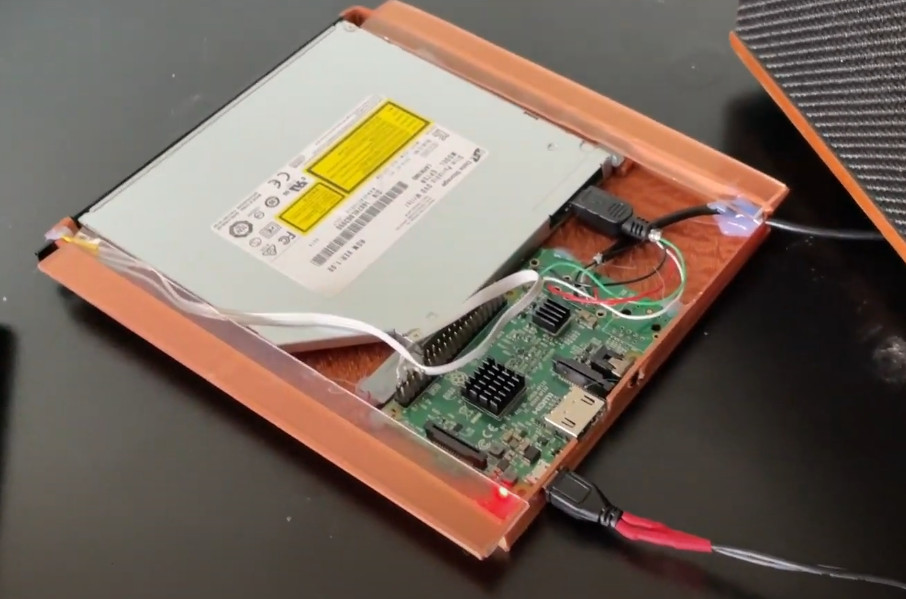
The optical drive itself was the easy part, as [Chad] already had a laptop-style drive in an external enclosure that he could liberate. But of course, the speaker wouldn’t know what to do with an external disc drive, so there needed to be an intermediary. Enter the Raspberry Pi.

It might not look like it at first glance, but that’s a Pi 3 tucked into the back of the 3D printed frame. It would have been too tall in its original configuration, so [Chad] removed the USB and Ethernet ports; a modification we’ve covered in the past. Of course, he still needed to use the USB ports, so he ended up soldering the two cables — one to the CD drive and the other to the back of the speaker — directly to the Pi.

When plugged into the Raspberry Pi, the Klipsch speaker shows up as a USB audio device, so the software side of things was relatively simple. [Chad] installed VLC to handle CD playback, but he still needed a way to control everything. To that end, a IR receiver hooked up to the Pi’s GPIO pins means the Pi can detect the signals coming from the speaker’s original remote and pass the appropriate command on to VLC. The whole thing is very well integrated, and you could be forgiven for thinking it might be some kind of stock upgrade module at first glance.

Despite recently celebrating its 40th birthday, the CD is unlikely to completely disappear from our lives anytime soon. Manufacturers can turn their back on the standard if they want, but so long as folks still want to play them, they’ll keep coming up with inventive ways to make it happen.

Continue reading “Custom Slimline CD Player Hides Out Under Speaker”

Decoding Compact Disc Audio From Scratch

In the rare case we listen to an audio CD these days, we typically rely on off-the-shelf hardware to decode the 1s and 0s into the dulcet tones of Weird Al Yankovic for our listening pleasure. [Lukas], however, was recently inspired to try decoding the pits and lands of a CD into audio for himself.

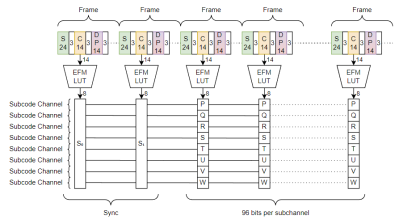
A fair bit goes into decoding Red Book digital audio.

[Lukas] did the smart thing, and headed straight to the official Red Book Audio CD standard documents freely available on archive.org. That’s a heck of a lot cheaper than the €345 some publishers want to charge. Not wanting to use a microscope to read the individual pits and lands of the disc, [Lukas] used a DVD player. The electrical signals from the optical pickup were captured with an oscilloscope. 4 megasamples of the output were taken at a rate of 20 megasamples per second. This data was then ported over to a PC for further analysis in Python.

[Lukas] steps us through the methodology of turning this raw data of pits and lands into real audio. It’s a lot of work, and there are some confusing missteps thanks to the DVD player’s quirks. However, [Lukas] gets there in the end and shows that he truly understands how Red Book audio really works.

It’s always interesting to see older media explored at the bare level with logic analyzers and oscilloscopes. If you’ve been doing similar investigative work, don’t hesitate to drop us a line!