ProtoDeck – MIDIBOX Based Controller

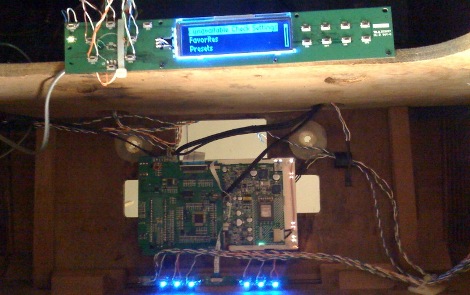
[Julien] let us know about his ProtoDeck. A MIDIBOX based controller for Ableton Live using a Big Max for live patch interface.

One thing that we have seen is less and less hacks for are MIDIbox projects. It is no wonder, considering now a days we have touch screen and multiple other interfaces and sound creation tools – MIDI almost seems like a dying art.

The ProtoDeck uses 87 pots, 90 buttons, and 81 RGB LEDs all controlled by 2 PIC 18F4620s. [Julien] says his main goals where to have lots of color and buttons. We think he succeeded.

Aural Twitter

[POTUSCamacho] listens to his @public_timeline rss feed. In part one of his project, he describes creating a bash script in which he uses cURL get his private feed, sed to clean it and eSpeak to output a WAV file. In parts two and three, he goes on to discuss how he created an audio stream (currently down, opens in a new window) of @public_timeline and how he plans on tweeting vocally.

Center Speaker Amp For An IPod

center_speaker_ipod_amp

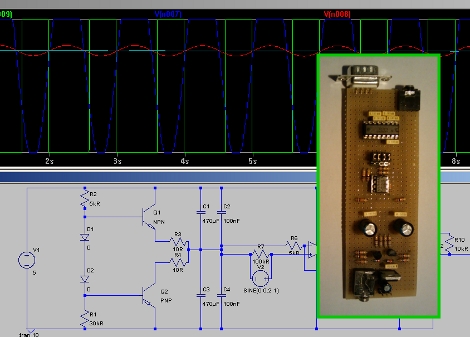
A few weeks ago we saw [Jaroslaw’s] universal credit card spoofer. Now he’s sent in a project that incorporates an amplifier into a center speaker for use with an iPod or any device with an audio jack.

The build has two main components; an LM4950 audio amplifier and a center channel speaker he picked up for $3 at Goodwill. The circuit used is straight from the datasheet and he’s provided the four necessary resistor values for you in his writeup. An old set of headphones was butchered for the audio connector and DC power can be provided by any 6-12V source.

The final circuit was built on some protoboard. The speaker housing has plenty of room to fit everything in for a nice finished look. Pretty simple, and except for the IC, this should be an easy salvage project for most folks.

XR-NOISE Box

[youtube=http://www.youtube.com/watch?v=3l5DOGn_rFw&hl=en&fs=1&]

[denha] has assembled a noise box he calls the XR-NOISE using an XR-2206 multi-waveform function generator. The output has an impressive number of controllable settings, and uses a set of LEDs to indicate sound level and rate. The XR-NOISE uses 1/4″ jacks for both in and out, and can also be controlled by the tap-sensitive mic located on the front of the box. Unfortunately, there doesn’t seem to be any further documentation or schematics to provide context, but it seems that this function generator chip has also been used for other audio hack projects as well, including a scratch-synth using resistive pressure sensors.

[via MatrixSynth]

Klipsch Speaker Mods

P1010021 (Custom)

[Patrick] has a pair of Klipsch speakers that continually needed the volume knob cleaned. After a bit of research, he found it was a common problem with the potentiometer chosen for the task. He decided to resolve the problem, not by replacing that potentiometer, but by modifying the speakers to be passive and running them from an external amp. While this does sound simple at first, he wanted to retain the rest of the electronics in the unit, so a bit of hacking was required. You can follow along through the whole process on his site.

Parts: DS1801 SPI Audio Volume Potentiometer

ds1801

Dallas/Maxim’s DS1801 is an audio volume potentiometer with a simple SPI interface. This chip has two channels of volume control that might be useful in a DIY audio project. We previously looked at the DS1807, a similar part with an I2C interface. This week we’ll show you how to use the SPI version.

Continue reading “Parts: DS1801 SPI Audio Volume Potentiometer”

Parts: I2C Audio Volume Potentiometer (DS1807)

ds1807ii

The DS1807 contains two logarithmic digital potentiometers (pots) for audio volume adjustment. Each pot has 64 volume levels plus a mute setting. The volume level of each pot is set over a two-wire I2C serial interface. We’ll show you how to connect and interface the DS1807 below.

Continue reading “Parts: I2C Audio Volume Potentiometer (DS1807)”