BattMan II: The Charger Your Batteries Deserve

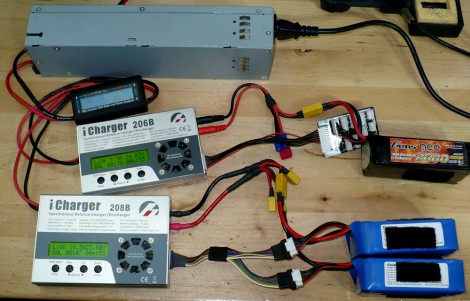
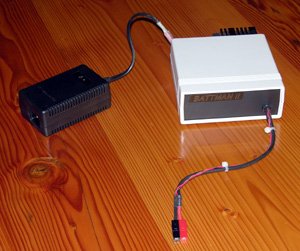
When your radio controlled device batteries are drained, you’ve got no better option than to call on BattMan II. This device is packed full of features for cycling and charging various types of batteries. It is computer controlled via your parallel port (yeah, remember those?) and has companion software that allows you all kinds of control and data.

The writeup is rather extensive and includes schematics so you could build your own. There’s also a step by step breakdown of how each section functions as well as an explanation of each different charging method. Great work [Stefan]

if you just want a peak at the lengthy feature list, keep reading.


Continue reading “BattMan II: The Charger Your Batteries Deserve”

Outdoor Stereo Helps Your Neighbors Learn To Issue Noise Complaints

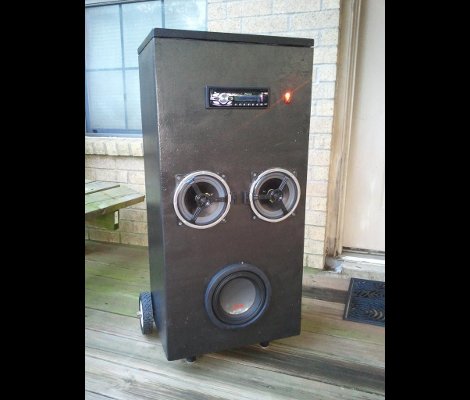
Backyard parties are going to rock over at [Effin_dead_again’s] house. That’s because he just finished building this outdoor stereo. It carries its own power supply so you can take it on the road with you, and we don’t think you’ll have trouble hearing it with the 240 Watt amplifier hidden inside.

He shared the equipment details in his Reddit conversation. A 12V lawn mower battery sits in the base of the wooden enclosure. One of the commenters mentioned the dangers of hydrogen off-gassing from that power source, but [Effin_dead_again] thought of that and included venting around the lid. The subwoofer is an 8″ Alpine, and speakers are out of a Hyundai car. The head unit has Bluetooth built in for easy connection to your smart phone. It of course has the ability to play CDs and MP3s too, and we’d bet you can tune the radio if there’s an antenna connected.

Need similar power but a bit more portability? Check out this stereo built into a cooler.

Motorized Skateboard Just Begging To Be Your Next Project

You’re not going to be doing any flip-tricks with this board, but it’ll let you get around without getting sweaty. The ZBoard is a motorized skateboard which is in the pre-order stages thanks to a successful Kickstarter campaign. It’ll set you back $500 now or $600 later. With that kind of budget wouldn’t it be fun to build your own?

This base model can go about five miles or five hours between charges. It carries a seal lead-acid battery (really?) but if you upgrade to the pro model for just $250 more you get a LiFePo that doubles the range (but curiously not the run time). To make it go there are pressure sensitive foot pads on the front and rear of the deck. This allows you to go slow with just a bit of pressure, or put the pedal to the metal to get up to the 15 mph speed limit. It’s even got regenerative breaking to slow things down while giving a boost to the battery.

The idea is nothing new. But the cleanliness that this product brings to market is something to be respected. We’re hoping this sparks some inspiration for a rash of DIY clones, kind of like we’ve seen with the Segway.

Continue reading “Motorized Skateboard Just Begging To Be Your Next Project”

Geeks Living Off The Grid Are Hard On Batteries

Many of you will remember [Mikey Sklar] from the multitude of times he’s been on hackaday. What you may not have noticed is that he is an ubergeek, living off the grid.

He has Solar PV battery bank, three electric vehicles, a shipping container loaded with battery powered tools and a small army of iRobot Roomba’s for cleaning. Getting the maximum lifetime out of a battery by removing sulfation is essential to keep expenses down.

Keeping expenses down is nearly a full time job when trying to live the homestead lifestyle. Our current culture makes it extremely difficult to survive completely on self made/grown things and bartering. They seem to be doing pretty well though. One way he can reduce his costs while still getting to enjoy some modern gadgets is to get longer life out of his batteries.  He does this by using a capacitive battery charger and desolfator that he designed and affectionately calls “Da Pimp”. He also brings in a little bit of income by selling kits!

 A capacitive charger behaves like a constant current power supply dynamically adjusting the voltage to get over the batteries internal resistance. Plus there is a pulse from the AC/DC conversion. This allows for old batteries to last longer and for dumpster dived to be used as replacements. Capacitive chargers are small, silent and super efficent (up to 60% more so than cheap transformer based chargers).

Of course, [Mikey] is a supporter of sharing information so you can also go to his site and download the schematics,bill of materials, gerber files, and files for the housing,  to build one yourself.

Prototyping A Solar Charger For Your Truck

[Bryan] got his hands on a solar panel and decided to take it on the road rather than throwing it on the roof of the house. On sunny days it will top off the car battery, letting him use his stereo in the middle of nowhere without needing to keep the engine running. Instead of buying a ready-made solution he chose to design and build his own charging circuitry.

The charger uses an Arduino, which draws its own power from the panel via a regulator. It senses the voltage level of the battery and the available juice from the panel, connecting or disconnecting it from the electrical system as necessary. The system includes a set of LED indicators, which he installed in the dashboard near the cigarette lighter. This also gave him an excuse to install a voltmeter which uses a 2.5 digit seven segment display to read out the battery voltage. You can see a brief overview after the break.

Continue reading “Prototyping A Solar Charger For Your Truck”

Simple Trick For Replacing Game Boy Cart Batteries While Retaining Game Saves

[Adr990] wants to make sure his Game Boy game saves aren’t lost to aging batteries. They’re stored in SRAM with a small coin cell inside the cartridge to keep the memory energized when the game is not being played. But if you pull out the battery in order to replace it the data will be lost in the process. It turns out that you can hot-swap the battery without too much effort. As shown in the video after the break, he disassembled the case of the cartridge, then replaced the battery while the Game Boy is switched on. The edge connector feeds power which will keep the SRAM active while the backup battery is removed. We’re sure this could be done with a bench supply as well, but you’ll need to do your own testing before risking those prized game saves.

The other option is to backup your SRAM before replacing the batteries. We’ve seen an AVR-based cartridge dumper, and also one that uses an Arduino. Both should be able to read and write SRAM data. Continue reading “Simple Trick For Replacing Game Boy Cart Batteries While Retaining Game Saves”

Shocking Use Of Ice Cube Trays

Looks like ice-cube trays are once again proving their versatility as this one is serving as the vessel for a home made lead-acid battery. With a collection of uniformly sized non-conductive containers, it makes the perfect base for a set of small cells. This project is the culmination of a Hackerspace class about batteries, and was put together to turn theoretical knowledge into a hands-on lab.

This is a captured image from the low-quality video found after the break. [Carpespasm] describes the setup; the black pieces are lead plates which are bent into a U-shape to straddle two ice-cube compartments. The each end of the plate is dipping into the acid to make the connection. Once assembled the battery was connected to a charger for about two hours. It puts out 8.5V and is tested by powering an LED cube. This works for just a short period and really drives home the lesson that battery concepts are easy to understand, but reliable battery technology is a bit harder to achieve.

Continue reading “Shocking Use Of Ice Cube Trays”