This Man Will Take Your Picture While Macing You

pepper

Odds are you don’t have a photographic memory, so if you ever have to mace someone, you probably won’t remember exactly what your attacker looks like. Compound that with talking to the police and looking at a few dozen mug shots, and it’s highly unlikely you’ll ever be able to identify the person you maced. This was the problem [John], [Cordelia], and [Adrian] chose to solve for [Bruce Land]’s microcontroller course at Cornell this semester.

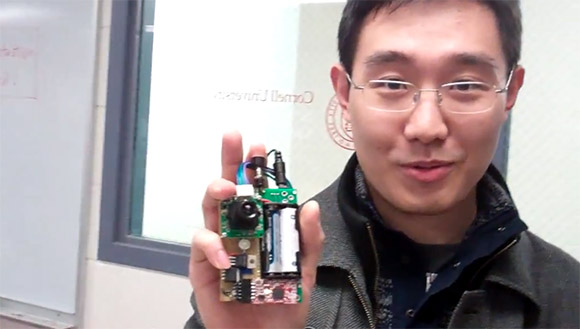
The device they created, PepGuard, adds a microcontroller and a serial JPEG camera to a canister of pepper spray. When the button on top is pressed, the microcontroller flashes a LED, takes a picture with a camera, and sends that picture to a phone over a Bluetooth connection.

PepGuard is always connected to the user’s phone via Bluetooth, and this allows for some interesting possibilities. With their Android app, the team can set up the phone to call emergency services when the device is activated.

You can check out the demo of the device after the break, or read the team’s report here.

Continue reading “This Man Will Take Your Picture While Macing You”
Adding A Bluetooth Terminal To Your Router

bluetooth-router-terminal

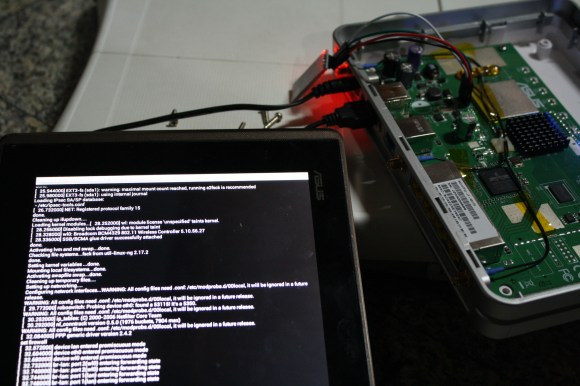
This image shows an Android tablet monitoring the terminal of a router via Bluetooth. It makes it a snap to tweak your router from a multitude of devices as long as you’re within range (usually BT works up to about 30 feet or so). The only part that [Yohanes] needed to pull off the hack was a Bluetooth module which he picked up for a few dollars.

All routers will have serial connections somewhere on the board. His model (Asus RT-N16) even had the GND, RX, TX, and VCC pads labeled. He soldered a SIL pin socket to the port which accepts the pin header from the Bluetooth module. Before plugging that in he had to issue a few commands to the device to get it using the same baud rate and settings as the router’s serial port. With that taken care of he can now wirelessly monitor and control the device via the serial terminal.

The one issue which he did encounter is that the module is slower to boot than the router. This means that at power-up you will not see anything on the terminal until the router has already started to load the Linux kernel. If you don’t plan on doing any bootloader hacks this shouldn’t make any difference.

Polaroid Catcher Make Print Screen Do What It Says

polaroidcacher_2

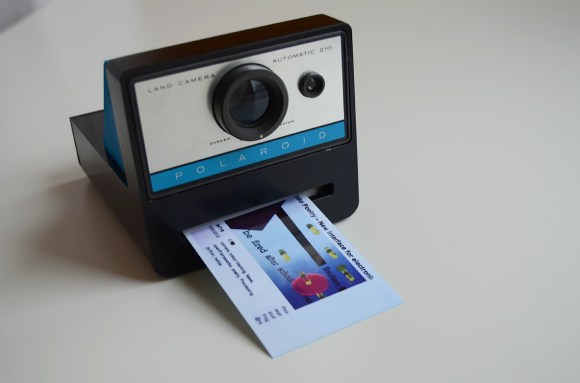
As part of their coursework at ITP New York a group of students developed the Polaroid Catcher. It’s a way to make your digital experiences more permanent. When you have something on-screen that you’d like to keep as a memory you can print the screen on this old Polaroid camera. Of course you’re not going to get the chemical-filled container you may remember from ages past. But we thing you’d agree the nostalgic camera makes a nice enclosure for a modern image printer.

The workings of the system are shown off quite well in the clip after the break. But we’re always interested in the particulars of how they pulled it off. The system uses a Google Chrome extension to capture what is being displayed in the browser. Before the image is sent to the printer the user has the opportunity to frame up the subject of the photo. Once decided, the image is pushed to a Bluetooth photo printer using some scripts written by the team.

Continue reading “Polaroid Catcher Make Print Screen Do What It Says”

A Bluetooth Trackpad From A Resistive Touchscreen

touch

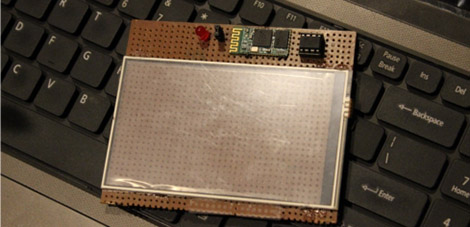
If you’ve checked out your favorite online retailer of absurdly inexpensive Chinese electronics, you’ll find a whole bunch of replacement parts. Phone parts are especially common, with high-resolution LCDs available for just a few dollars. There are also a few touchscreen kits – resistive touchscreen digitizers that can easily be read with a microcontroller. [Vinod] got his hands on one of these touchscreen digitizers, and with the help of an 8-pin micocontroller turned it into a Bluetooth trackpad.

The clear plastic touchpad is a relatively simple device. By reading a pair of analog values, it’s easy to find the coordinates of a finger or stylus on the touchpad. [Vinod] programmed an ATtiny13 to read these values and turn them in to x y coordinates, but he needed something useful to do with this data.

By connecting a small bluetooth module to his microcontroller, [Vinod] could send these coordinates to his computer. The result is a homebrew touchpad, able to move a cursor around, left and right click, and emulate a scroll wheel.

Continue reading “A Bluetooth Trackpad From A Resistive Touchscreen”

Bluetooth Network Monitor

Bluetooth Network Monitor

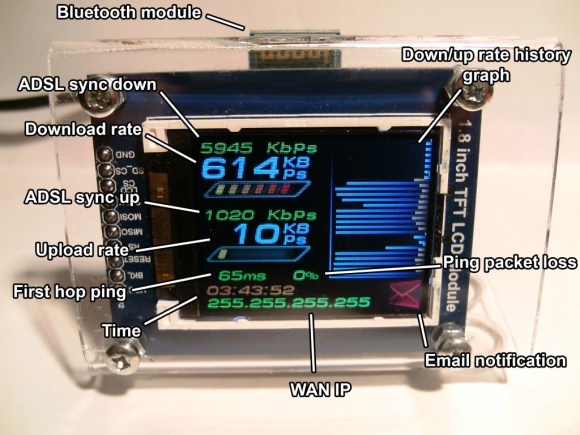
[Zak] wanted to keep tabs on his network connection without needing to log into his router. Since his router was a PC running Debian Linux, he rigged up a Bluetooth Network Monitor to display the information.

The monitor is based on a ATMega328P that reads data from a Bluetooth serial connection and displays it on the TFT screen. It uses a low cost Bluetooth module to receive data from a router. A shell script fetches the data and formats it into a string that can be sent over the Bluetooth link.

A USB connection with a desktop computer is used to power the device, but [Zak] also added USB support using V-USB. He plans to use it to get data from the desktop. For example, he could display CPU load and temperature data.

Overall, this is a nice project for fetching data wirelessly and displaying it on your desk. [Zak] has provided the code and Eagle files with his write up for anyone interested in building their own.

Glass Delay Line Slide Used In An RGB Lamp

glass-delay-lines-lamp

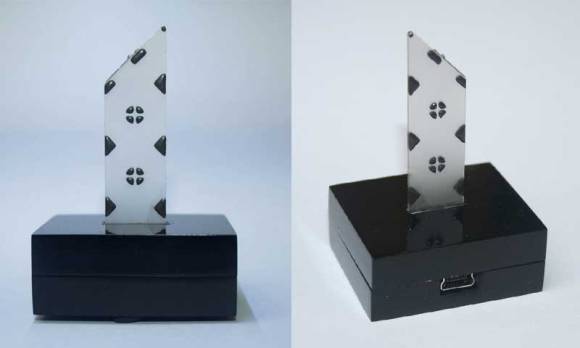
The spire used in this lamp is a part from an old television. It’s a glass delay line slide which pipes the light up from the Bluetooth controlled RGB lamp (translated) in the base.

We have looked at delay lines previously when [Dave Jones] tore down a camcorder to get at one. But we must have missed the EEVblog follow-up episode which explains how the glass slides work. The device uses physical distance to form a delay. Waves directed into the edge of the glass slide bounce around at an angle before being sensed at the collection point. [Lukas] liked the visual appearance of the part and decided to use it to add visual interest to his lamp project. The nature of the glass makes it perfect for directing the light up and away from the PCB.

The lamp consists of one RGB LED module controlled by an ATtiny2313 microcontroller. Also on board is a HC-05 Bluetooth module. This along with an app he wrote lets the user change lamp color and behavior wirelessly. You can see the lamp in action in the video after the break, but we think the camera shot probably doesn’t do it the justice it deserves.

Continue reading “Glass Delay Line Slide Used In An RGB Lamp”

Bluetooth Hack For Serioux Panda Speakers

bluetooth-powered-panda-speakers

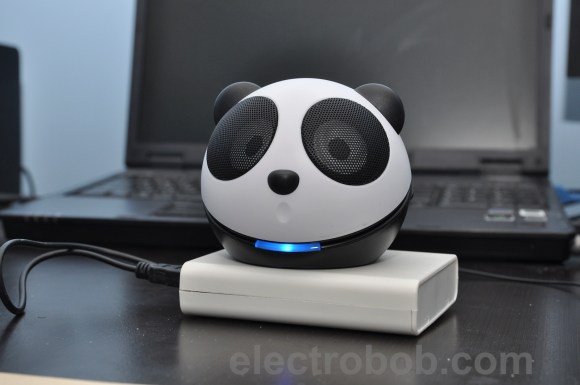
[Bogdan] received this set of Serioux Panda speakers as a gift. I turns out that they sound very good and he decided to make them more useful to him by converting them to work as Bluetooth speakers.

To begin with he bought the cheapest A2DP device he could find. This is the protocol that identifies a Bluetooth audio device. The unit is designed to provide a Bluetooth connection for a set of headphones. He patched into the headphone port on that board, but also wanted to keep the option of using the Panda speakers’ line-in. To do this he added a 1k resistor to each of the audio channels. A connection was made from the 5V rail of the speakers to power the Bluetooth module rather than leaving it with its own battery.

Speaking of batteries, the Panda speakers can run from three AAA cells. This battery compartment was a perfect place to mount the add-on hardware. But the speaker can still be powered from a USB connector. Above [Bogdan] is using a portable USB power supply.