Head-mounted Memory Catcher

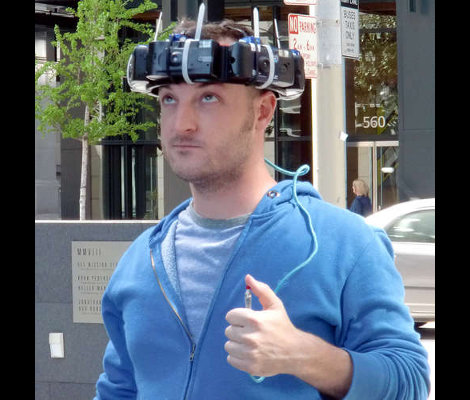
A picture’s worth a thousand words so what is a hat that can take 360 degree pictures worth? Just make sure you put it on whenever leaving the house and capturing that next memorable moment will be just one click of a button away.

[Mikeasaurus] recently put together this… special… headgear. He used film-based disposable cameras and this choice presented a few interesting challenges. But the choice is not necessarily a bad one, as you can get six of these without really blowing your budget. He cut the top off of a plastic garbage can to serve as a headband on which to mount the hardware (zip-ties to the rescue). But things get hairy when it comes to triggering all of the shutters at once. These are spring-loaded shutter releases and you can’t just patch into them electrically like you could a digital camera. His solution is a group of six servo motors which do the button pushing for him.

A thirty-six exposure trial run turned out okay. Several times the shots didn’t come out, but at the end of his post he shares a few of the good ones that did. We’re going to stear clear of this one as we can’t abide manually winding all six cameras between each shot. But it does give us an idea for a single-camera hat that uses a 45-degree mirror which swivels. We’ll just put that one in the growing pile of ideas we need to make time for.
Keep An Eye On Your Palatial Estate With This Solar Powered WiFi Cam

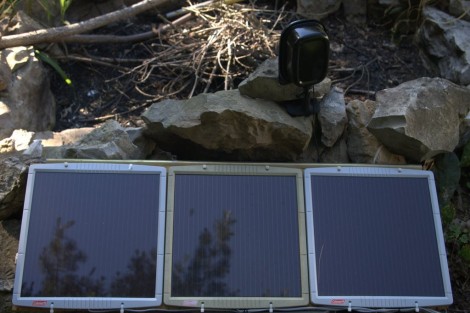
If you’re expecting the serfs to hop the fence with pitch forks and torches you may want to employ a surveillance system. WiFi cameras are a cheap way of doing this, but you’ll need power. [CheapGuitar] decided not to run extension cords, and instead added solar power to his wireless camera. The solar panels are easy to spot in this image, but you’ll have to look close to see the camera.

He already had everything on hand, and this included a cheap WiFi camera which runs on 5V. To weatherproof it he used a plastic sandwich meat container. This is actually one of our favorite project enclosures, we used it for our door-bell button garage door lock. [CheapGuitar] painted it black to help keep it hidden after cutting a hole in the lid for the camera lens. Under the solar panels you’ll find a 12V car battery which uses a USB car charger to regulate voltage for the camera. Each of the panels is a 5W trickle charger and they’re designed to top off deep cycle batteries. The entire thing is cleverly hidden behind his existing landscaping.

[via Reddit]

Quick And Easy Wildlife Camera

This wildlife camera is really easy to put together. You should keep it in mind if you’re ever tying to figure out what’s eating the heads off of all of your tulips. [Revoltlab] put it together, and although there’s one fatal flaw in this particular system, the concept is quite sound.

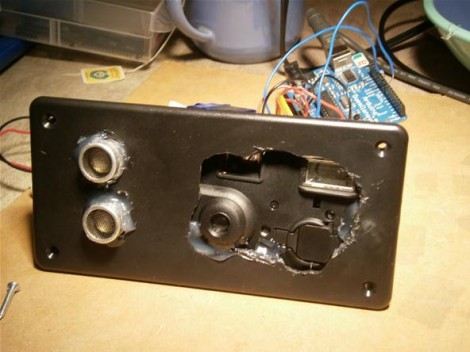
The build uses a camera, paired with an ultrasonic range finder. When something passes within the pre-set distance for the sensor, a servo motor clicks the shutter button on the camera. It’s all driven by an Arduino and powered from a 9V battery.

If you watch the video after the break you’ll discover the flaw we mentioned. This is a disposable film camera and requires winding between pictures. That hasn’t been implemented yet. But we’ve got an old digital camera with a broken LCD screen which would be perfect for the job. We’d have to do a bit more work to turn the camera on before taking the picture though.

There are a couple of possible upgrades to the idea. [Revoltlab] mentions removing the IR filter from the camera and adding an infrared flash for night-vision shots. But we would also recommend ditching the servo motor for a simple remote shutter solution as a way to avoid scaring the wildlife with the motor noise.

Continue reading “Quick And Easy Wildlife Camera”

A Camera That Describes A Picture For You

[Matt]’s Descriptive Camera looks just like any other point and shoot camera, albeit a little more boxy and homemade-looking. It even works just like the Polaroids of yesteryear – snap a picture and in a few minutes you’ve got a reproduction in your hands. Unlike any other camera before, [Matt]’s camera doesn’t give you an image. [Matt]’s camera gives you a description of the picture you took, printed out on  easily-scrapbooked thermal receipt paper. Yes, mankind is now that meta.

To build the hardware of his camera, [Matt] took a BeagleBone single-board Linux computer and attached a webcam and a thermal receipt printer. The real magic is in the artificial artificial intelligence that is Mechanical Turk. [Matt]’s camera sends his picture up to the Internet where some random stranger describes his picture. This description is sent back and printed on the receipt paper.

Even though [Matt] is spending $1.25 to have a single picture described on Mechanical Turk, there’s probably not another camera as retro-meta-fabulous-fantastic out there.

Stop Motion Animation Creation

PVC man stop motion animation

Stop Motion Animation has always been interesting to me since I “discovered” that one could make animated flip books by drawing each frame a little different. Fast forward 20 years or so, and computer technology has gotten to the point where this sort of thing can be done electronically quite easily and at an incredibly low price of a camera, computer, and free or paid-for software (here’s the technique using GIMP, a free, good quality photo editing tool) to put everything together.

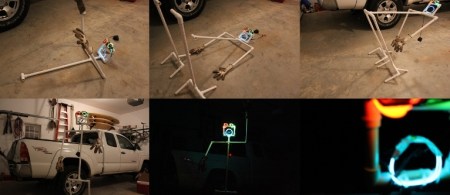
The frames in the picture above are of my latest [PVC man] animation, which can be made with some electroluminescent lights, gloves, and some PVC pipe.  Each frame was individually photographed, and after several hours of work we had enough footage for 17 seconds of so of stop-motion animation.

Although by no means perfect, the quality of these animations has gone up dramatically from the first animations that I made using an old ENV2 camera phone. Although I was using a “custom mount” for it, it’s amazing these came out as well as they did. As with everything hacking related, this process is a constant work in progress. Check out the videos after the break for the [PVC man] video as well as one of the early ENV2-produced stop-motion shorts!

Continue reading “Stop Motion Animation Creation”

Sliding Camera Mount Is Good Enough For Amateur Photography

[Unihopper] built this sliding camera mount to add some motion to his freestyle unicycle videos. It’s extremely simple, but still pulls off a pretty nice effect as you can see in the clip after the break.

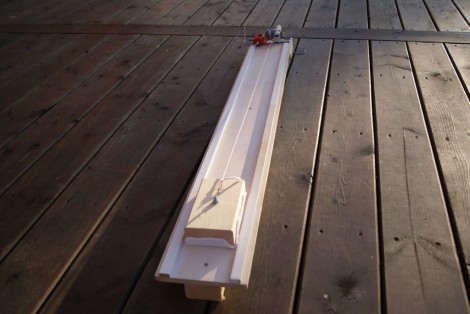
The image above shows the mount without a camera attached.  You can see the threaded peg on the block in the foreground which is used for that purpose. Felt has been wrapped around the base of the block, which rides in a wooden channel. The string, which connects to an eye hook in the wood block, is attached to a spool on the far end of the plank. A K’nex motor drives that spool, slowly sliding the camera toward it.

Unlike other toy-based sleds, the use of a track system helps to maintain proper orientation of the camera. Obviously this isn’t going to achieve the perfectly smooth and precise motion you’d get out of a sled system like this rail and linear bearing version. But honestly, most of us don’t have cameras of the quality to warrant that type of high-end system. Continue reading “Sliding Camera Mount Is Good Enough For Amateur Photography”

Old Timey UAV Cameras

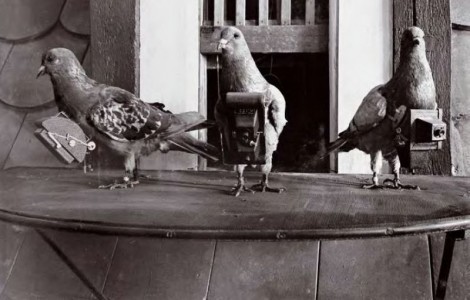
These brave birds are weapons of war. Well, not these actual birds… they’re just models used for this photograph courtesy of a taxidermist. But their living relatives were used to take spy photographs during World War I. [Dr. Julius Neurbronner] didn’t suddenly jump into the field of avian photography. He, like his father before him, used homing pigeons to deliver prescription drugs in loads of up to 75 grams. This makes us wonder if the birds are ever used in modern drug running?

The inspiration came when the doctor found out about subminiature cameras available at the turn of the twentieth century. Those cameras included a tiny roll of film, allowing for several images to be taken. He figured out a way to make a timer that used a pneumatic system to trigger the shutter in the camera. You can see a diagram of the timer mechanism here. The idea is that the birds will always be able to find their way home. So if you take them to a starting point that puts the enemy lines in between them and home base, they’ll fly over and get some juicy recon in the process.

That’s pretty old school. But we’re still tying things onto birds these days. Here’s some modern tech that uses sun-up/sun-down to track travel habits.

[Thanks F via The Atlantic]