Pick Up That Can, [Jeri]

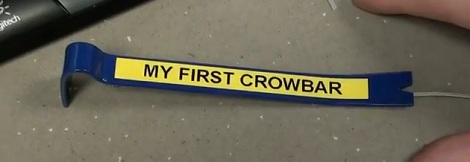
We all need an excuse to play Half-Life 2 sometimes. [Jeri Ellsworth] put together a My First Crowbar controller to throw a few headcrabs across the room. It’s pretty much Half-Life 2 for the Wii.

The build is very simple – just a tilt switch hot glued to the underside of a childs-size crowbar. Two leads go from the tilt switch to the contacts on a (PS3?) controller. All you need to do to attack is swing the crowbar wildly.

[Jeri] has us wondering what other awesome game controllers could be made. Of course we’ve been wanting a real-life Gravity Gun or Portal Gun for years now, but right now we’re thinking about a real Katamari. We might need more hot glue.

As far as building our own, we’re thinking about using one of the Cheap DIY tilt switches we saw the other day. It’s a simple build, and sure looks like a lot of fun.

Continue reading “Pick Up That Can, [Jeri]”

N64 Controller Input Using An ATtiny85

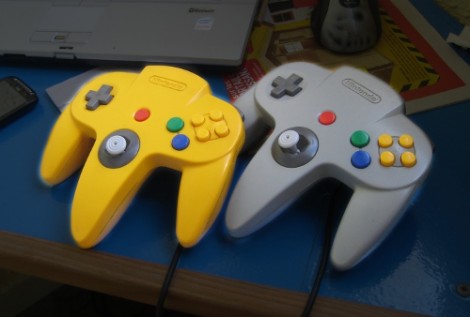
[Larsim] worked out the timing necessary to read button and joystick data from an N64 controller using an ATtiny85 microcontroller. The project was spawned when he found this pair of controllers in the dumpster. We often intercept great stuff bound for the landfill, especially on Hippie Christmas when all the student switch apartments at the same time.

Instead of cracking the controllers open and patching directly to the buttons, [Larsim] looked up the pinout of the connector and patched into the serial data wire. In true hacker fashion, he used two 5V linear regulators and a diode in series to step his voltage source down to close to 3.6V, as he didn’t have a variable regulator on hand. It does sound like this causes noise which can result if false readings, but that can be fixed with the next parts order.

The controller waits for a polling signal before echoing back a response in which button data is embedded. This process is extremely quick, and without a crystal on hand, the chip needs to be configured to use its internal PLL to ramp the R/C oscillator up to 16Mhz. With the chip now running fast enough, an external interrupt reads the serial response from the controller, and the code reacts based on that input.

It seems the biggest reason these N64 controllers hit the trash can is because the analog joystick wears out. If you’ve got mad skills you can replace it with a different type.

PlayStation 3 Controller Made Fully Remappable

[Hazer] managed to take a PlayStation 3 SixAxis controller and modify it so that all of the buttons can be remapped in hardware. Aside from this being really cool, he had a good reason for doing it. Regular readers should remember the feature regarding [Chuck Bittner’s] internet petition calling for button mapping as a feature in all games. As the industry still hasn’t taken up the torch in this area, [Hazer] developed this mod for [Chuck] to use and has released it for any others out there who wish to give it a try.

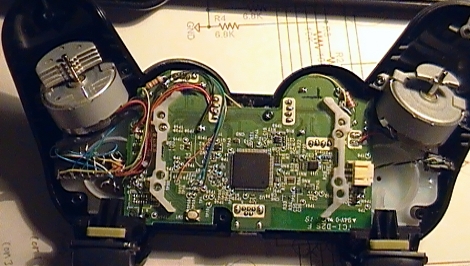
The hardware alterations are pretty hardcore. On the left of the image, just below the rumble motor, a DIP microcontroller is nestled dead-bug style. This is a PIC 18F14K50. It’s running a bootloader, and has its own USB port on the opposite side of the controller. By cutting traces and soldering to vias, this chip intercepts button presses and shoots them off to the controller’s processor based on alternative mapping stored in EEPROM. There’s a helper app that lets you plug the controller into a computer to specify what each button does, including features like toggle for the buttons. Check out [Chuck’s] thoughts on the hardware in the video after the break.

Continue reading “PlayStation 3 Controller Made Fully Remappable”

SNES Gamepad Coversion To USB

[Kekszumquadrat] wanted to use a classic controller to play emulator games on his Android tablet so he set out to convert an SNES gamepad to connect via USB. He found an old USB keyboard at a yard sale for about 3 Euros. He knew that the emulator he prefers has the option of remapping all the inputs to keyboard keys which means a USB keyboard has all of the electronics he would need to pull this off.

Once he had separated the keyboard circuitry from the case [Kekszumquadrat] plugged it into his Linux box and used Xev to establish how the keyboard matrix is set up. Xev is a common package that opens up an active window on the X desktop. When run from command line, any events that happen to the window will be echoed along with verbose data about that event. When it comes to keypresses, you’ll get the keycode you need. He simply shorted columns and rows until he found the desired mapping, then it was on to soldering.

The SNES controllers are very simple devices. As we’ve seen with previous projects, they use a serial-to-parallel shift register to gather button data and send it to the console. [Kekszumquadrat] simply soldered between button traces and keyboard matrix contacts. Once he finished, the keyboard parts were tucked inside of the controller case and he’s left with a USB controller that appears to be unaltered.

Using Classic Game Controllers With A Wii

[Bruno]’s Wii RetroPad Adapter was sent into the tip line, and we’re loving the possibility of using Playstation 2, Genesis, NES and SNES controllers with our Wii.

While there are commercial solutions that connect an NES or SNES controller to a Wii, everything connects to the GameCube port and there is no adapter for Sega or Playstation controllers. For his build, [Bruno] used an ATmega168 to read data from the classic controllers and translate that to the Wiimote I2C bus. Think of it as a new classic controller with the same form factor your 8-year-old self knew and loved.

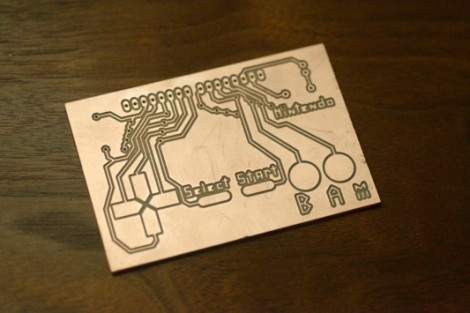
The schematic for the build is very simple and [Bruno] has all the software out in the open. Even the PCB is single sided and looks like it would be a great candidate for a homebrew PCB. There’s no indication [Bruno] is trying to monetize his creation, so he’s either doing right, or so very wrong. Check out the Dualshock 2/Mario 3 demo of this board after the break.

Continue reading “Using Classic Game Controllers With A Wii”

Broken Xbox 360 Converted Into An Arcade Controller

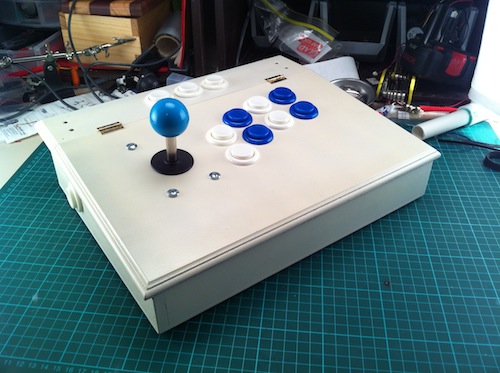
xbox_360_arcade_controller

Like many Xbox 360s out there, [Aaron’s] console succumbed to the dreaded three red lights of death. Since it seemed to be unrepairable, there wasn’t a lot that could be done with it other than throw it out. Rather than be wasteful however, [Aaron] thought of a great way to reuse the console’s outer shell.

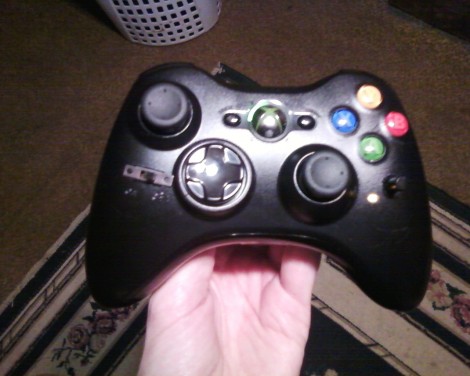
He’s a big fan of fighting games, and as everyone knows, this genre is best played with an arcade-style controller. The 360’s shell seemed to be just about the right size, so he gutted it and got busy constructing his own arcade controller. With the console cleared out, he installed all of his arcade bits, wiring them to a stripped third-party Xbox controller.

He installed a four port USB hub to the front of the console, enabling use of the 360’s USB ports, and rewired the power button to trigger the Xbox Guide button. A shiny coat of paint later, and he was ready to play.

Keep reading to see a short video of [Aaron’s] arcade stick in action, and check out the picture gallery he put together of the controller’s construction.

Continue reading “Broken Xbox 360 Converted Into An Arcade Controller”

Bass Hero Combines Guitar Hero With Dance Dance Revolution


Standing up to play Dance Dance Revolution type games is sooooo much work. Thankfully, [Jebadiah0001] is taking the strenuous exercise component out of the game by altering a guitar controller to play dancing games.

He’s calling it Bass Hero because the DDR games only use four inputs, reducing the guitar controller to four string buttons like an electric bass would have. His implementation uses a GameCube controller to connect to the console. He took it apart to get at the button connections. Each string button on the guitar is connected on one side to a button on the GC controller, the other side is a common connection. But instead of pulling those straight to ground, he routes that signal through the strumming actuator. This way the player can get the correct buttons ready, then strum at just the right time to complete the circuit.

It certainly makes the harder levels of DDR quite a bit easier. See for yourself in the video after the break.

Continue reading “Bass Hero Combines Guitar Hero With Dance Dance Revolution”