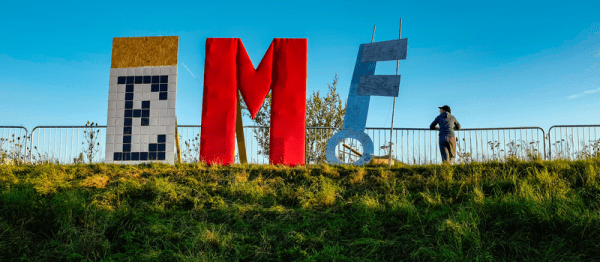
Electromagnetic Field: A Hacked Knitting Machine, Knitting The Universe

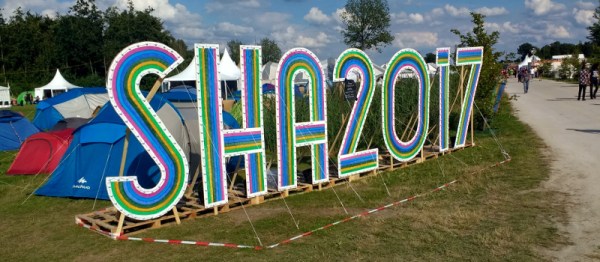
A large hacker camp attracts attendees from all over the world, and at the recent Electromagnetic Field in the UK there were certainly plenty of international visitors. Probably one of those with the longest journey was [Sarah Spencer] from Australia, and she deserves our admiration not just for her work but also for devoting much of her meagre luggage space to the installation she’d brought over for the event. In the lounge tent you could find the Knitted Universe, a map of the night sky with light-up Neopixel constellations covering an entire wall, and among the talks you could find her in-depth description of how  she created it by hacking a 1980s Brother knitting machine into a network printer.

She starts with a potted history of knitting machine hacking, leading to the use of an emulated floppy drive replacing the mechanical item used to store scanned designs on the original hardware. She took an existing hack for a 16-bit Brother knitting machine and re-wrote it for her later 32-bit model, and then created a web interface for it called Octoknit which runs upon a Raspberry Pi. We’re then taken through the operation of a knitting machine and her further adventures in reverse engineering the file format. She ends up with a dithered 4-colour image, but there remains a problem. On the Brother, colour changes are performed by pressing a button, so something to automate the process was required. This task was taken on by her husband, who created an Arduino-driven mechanical button-presser in what had become a team effort. With this in place her only manual task became a periodic adjustment of the weight that preserves the tension in the finished knit.

Finally she moves on to the Knitted Universe itself, which at that point had become something of a viral sensation.  Those of us who have created hacker camp installations will appreciate the volume of work that went into the piece, and she truly deserves the applause at the end of the talk. Watch it below the break, it’s a fascinating half-hour.

Continue reading “Electromagnetic Field: A Hacked Knitting Machine, Knitting The Universe”

Looking Forward To Electromagnetic Field 2018

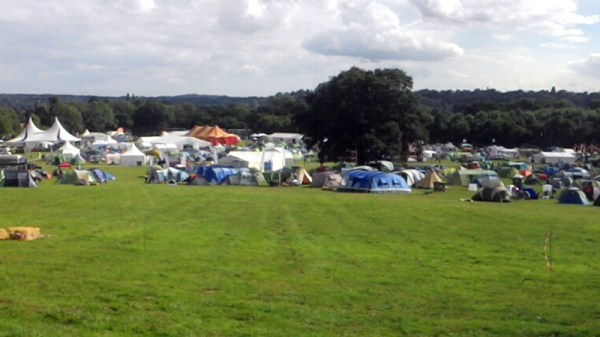
There is an air of excitement among the hackerspaces of Europe, because this month is hacker camp season. In Denmark they have Bornhack beginning on Thursday, in Italy IHC was held earlier in the month, while here in the UK we are looking forward to Electromagnetic Field. We’re excited be at Eastnor Castle for Electromagnetic Field at the cusp of August and September for several days under canvas surrounded by our community’s best and brightest work. We’ll even have a Hackaday Readers’ Village this year!

If you’ve never been to a hacker camp before, this is one that’s not to be missed. Technically this is camping, but where every structure from the smallest tent upwards has mains power and gigabit Ethernet. It’s the equivalent of a music festival if you replace the music with technology and other cool stuff from our world. There are talks on a huge variety of fascinating subjects, the chance to see up close some of the things you’ll have read about here on Hackaday, and best of all, a significant proportion of Europe’s hackerspace communities all together in one place. They are a uniquely stimulating and exciting environment.

Continue reading “Looking Forward To Electromagnetic Field 2018”

Got A Burning Idea For An EMF Camp Presentation? Now’s Your Chance!

Sometimes the world of tech conference presentations can seem impossibly opaque, a place in which there appears to be an untouchable upper echelon of the same speakers who pop up at conference after conference. Mere mortals can never aspire to join them and are destined to forever lurk in the shadows, their killer talk undelivered.

Thankfully, our community is not like that. There is a rich tradition of events having open calls for participation, and the latest we’d like to bring to your attention comes from the British EMF Camp, to be held at the end of August. EMF, (standing for ElectroMagnetic Field) is a 3-day festival that bills itself as “for those with an inquisitive mind or an interest in making things“. In their call for participation, they are seeking installations and performances as well as talks and workshops, and it’s worth saying given the very quick uptake of their early ticket sales, that a couple of tickets will be reserved for purchase by each person with proposals that are accepted.

EMF Camp like other hacker camps is an extraordinary coming together of people from all conceivable backgrounds and interest groups to share a field for three days. It doesn’t matter how experienced you are, what the subject is that you would like to present, or what installation or workshop you would like to bring, there will be a section of the EMF audience who would be very interested to see it. They list a few previous topics, from genetic modification to electronics, blacksmithing to high-energy physics, reverse engineering to lock picking, computer security to crocheting, and quadcopters to brewing. Assuming that certain submissions are accepted, you may also see a Hackaday scribe delivering a talk.

While you’re thinking of what to submit for 2018, whet your appetite with a look at the goings-on from EMF 2016.

Image: Nottingham Hackspace [CC BY-SA 2.0].

Three Wires = One Motor

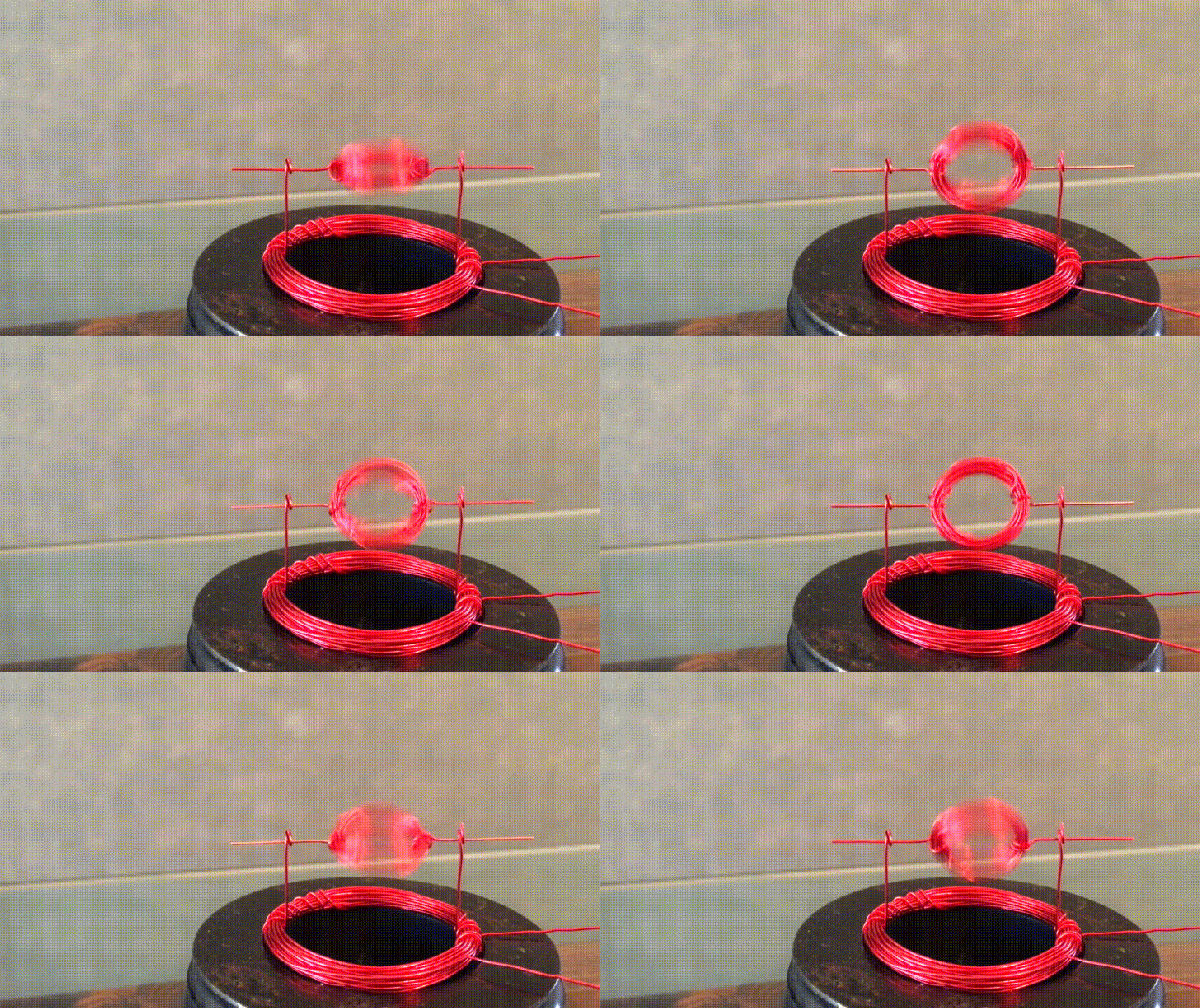
Here’s a quick build to show off fundamentals of electric current to new makers — or a cool party trick that might earn you a buck. [Jay] from the [Plasma Channel] shows off how you can make a simple motor with only three pieces of enameled wire in under five minutes.

Start with a roll of 26-guage — or thicker — magnet wire, and a pair of scissors or knife. For the base, wrap fifteen to twenty turns of wire around any spherical object about one and a half inches in diameter, leaving a few inches extra on both ends. Wrap those ends around your coil a few tines to secure it and straighten out the excess length — one will act as a support and the other will connect to your power source. Another piece of wire — similarly wrapped around the base coil — acts as the other support and the other terminal. Scrape off the wire coating from one side on both support wires and curl them into small loops. Halfway done!

Continue reading “Three Wires = One Motor”

Electromagnetic Field’s Badge Hanging In The Balance

Making conference badges is a tough job. Unless you’re sitting on a gold mine, you have to contact a whole bunch of sponsors for help, work the parts that you can get into a coherent design, and do it all on the quick for a large audience. The EMF team is this close to getting it done, but they need some sponsorship for the assembly. If you know anyone, help them out! If they can’t line something up in the next two weeks, they’ll have to pull the plug on the badge entirely.

Electromagnetic Field is a summer-camp hacker convention / festival that takes place in England and is now in its third iteration. As with other big cons, the badge is a good part of the fun.

The 2016 EMF badge looks to be amazing. It’s powered by an ST STM32L4 low-power micro, a color LCD screen, a TI CC3100 WiFi radio module onboard, and a ridiculous number of other features including a gyro and magnetometer, and a giant battery. It’s also a testbed for the brand-new MicroPython, which aims to bring everyone’s favorite scripting language to embedded processors. In fact, they’ve largely built the MicroPython WiFi drivers for the badge.

If they can’t get a sponsor, all is not lost because everything is open source. We’ll all reap the benefits of their hard work. But that’s not the point. The point is that hundreds of hackers will be standing around in a field outside of London without the most audacious badge that we’ve seen designed dangling from their necks.
If you know anyone who can help, get in touch?

Thanks [schneider] for the tip!