How To Design Your Gears

[Dustyn Roberts] takes us through the process of designing gears for a specific application. Using Inkscape and Ponoko.com [Dustyn] takes us from equation to physical gear. While there is a plugin for Inkscape that allows you to basically drag and drop gears, this writeup will take you through the math to get exactly what you need. Those laser cut wooden gears are pretty cool looking too.

Hackaday Links: June 13, 2010

Painting with light

[Jo0ngle] wanted a fun toy and an easy conversation piece. He painted a square on the back of his door with some glow-in-the-dark paint. Now he can draw on it using a blu-ray laser or a UV flashlight. Either way, the effect is quite pleasing. [Thanks Justin]

Resistor decoder rings

This resistor reference card allows you to spin a wheel and dial in the resistor color code for easy reading. We know, you have the simple act of reading resistor code down cold by now. This is still a fun idea that you might use if you’re ever helping someone get into electronics. [Thanks Osgeld]

Resistor bending template

Speaking of resistors, [Jerome] helped us out by designing a resistor bending template. He’s actually marketing himself at the same time. His bending template is folded from one of his business cards, which he came up with after being inspired by some of the unique business cards we’ve covered in the past.

Fake stained glass using old PCBs

[Agg] floated some old PCBs to his friend [Dan] the mason. [Dan] proceeded to turn out an amazing looking stained glass window unit using the colorful leftovers. The picture above doesn’t do it justice, you have to click through to see the real art.

Monovelo monowheel

[Ernst] asked if we’d heard of the Monovelo monowheel. Well we hadn’t. It’s a human-powered vehicle where you sit inside of one large wheel. We don’t see ourselves building one or riding one, but we enjoyed watching someone else do so. We’d like to catch somebody commuting to work with one of these. Seeing this in the bike lane will brighten up anyone’s day.

Laser Command Game Uses Laser For Control

[vimeo=http://vimeo.com/10819322]

[Eliji Hayashi’s] project for a class at Carnegie Mellon University is absolutely delightful! It is a game he calls Laser Command because a laser pointer is used as the gaming controller. An 8×8 LED matrix serves as the display, but is also used as an 8×8 light sensor, much the same way as the LED advent project did. The display is rapidly switched between producing light and sensing it. The laser is bright enough that it becomes easy to pick up the voltage generated within the matrix during the sensing periods. The game is programmed on an Arduino mini and the whole thing wraps up into an incredibly small package. Brilliant.

[Thanks Juan]

Solenoid Orchestra Led A By Laser Conductor

[youtube=http://www.youtube.com/watch?v=B-rpp28AuXo]

This video brought a smile to our faces. [Griffin Milsap] is creating live music using an orchestra of solenoid instruments. Each solenoid is set up to strike an object such as a bowl or mug. The trigger mechanism is a light sensor inside of a ping-pong ball. The collection of instruments is conducted by a motor-mounted green laser. When the beam of light passes by one of the ping-pong balls the photo transistor inside actuates the solenoid and a note is played. The pitches are quite a bit more random than the Robo-vibe, but it’s delightful to hear the results that [Griffin] has achieved.

Laser Cut And Printable Cases

If you’re like us you’ve got quite a few prototyping tools that are bare PCB boards. If you’re using them a lot you might want to protect them with some type of case but the lack of mounting holes can make this difficult. One popular solution to this problem is to design a case for a perfect fit, then cut it with a laser or print it out of plastic. We’ve got examples of both.

[Stewart Allen] set to work designing laser cut cases for the AVR Dragon and the Bus Pirate V2go after seeing our post about on-the-go prototyping. We think this is especially important if you have an AVR Dragon as it’s been known to bite the dust if the bottom is shorted out. If you have access to a laser cutter you can download is DXF files and the models and cut your own.

If you don’t have a laser cutter but can get some time with a 3D printer check out the Bus Pirate V2go printed case and the Arduino printed case.

On-the-go Prototyping

[Riley Porter] has been working on several different custom enclosure designs. Above, you can see his Proto Desk which holds a breadboard, Arduino, and has two recessed boxes with sliding tops for components and patch wires. He’s got a miniature version that gets rid of the breadboard, as well as slick-looking cases for the Bus Pirate, tinyISP, and face plates for word clocks.

Well, if you’ve got a laser cutter you should be using it right? We’ve seen [Riley’s] wares in the past; he wrote the guide for laser cutting solder stencils.

[Thanks Brian]

3D Laser Printer

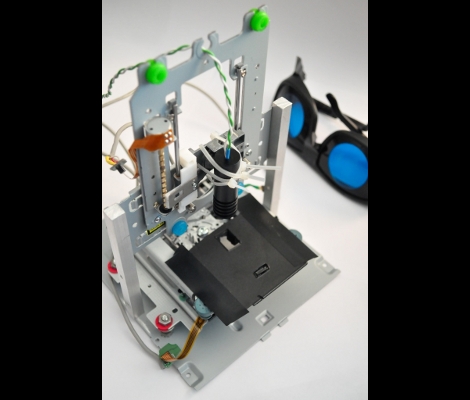
Working with easy replication in mind, [Peter] is building a 3D laser printer. The majority of the machine is made from laser-cut acrylic held together by parts that are inexpensive and available at your local hardware store. In the end this will lay down a layer of powder, use a laser to fuse the powder together in the outline of your choice, then repeat. This is known as selective laser sintering which is sometimes used in commercial rapid prototyping and, like a lot of other cool technologies, came into existence as a result of a DARPA project.

Sorry folks, this is not a fully functioning prototype yet. [Peter] is searching for the right laser for the job and a source for the powder. If you’ve got a solution please lend a hand and let’s see this project through to completion.