Stocker Monitors The Markets

stocker-monitors-the-market

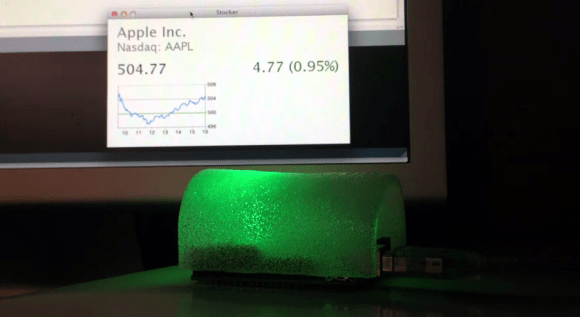
If you can’t help but spend the day checking in on your stock prices this ambient device can help you cope. It monitors how the trading is going and illuminates an LED as feedback. Here the Apple stock is trading up so the light is green. The video after the break shows other stocks trading down, causing it to switch to red.

An Arduino interfaces with the custom application via USB. For now it looks like the two colors are all it’s capable of but we think there’s a lot more potential. Some creative coding could use factors like how much the stock has moved, trading volume, volatility, or a plethora of other data to give feedback. We could see a spectrum of colors (like on a temperature map) used to improve the level of feedback. And if the market really tanks there’s always the ability to add flashing!

The diffuser for the project is quite interesting to us. [Ali Reza Kohani] made it from a leftover scrap of acrylic. The bubbled surface was created with a heat gun before bending the sheet into an arc.


Continue reading “Stocker Monitors The Markets”

LED Cloud Lamp In Any Color You Can Imagine

rgb-cloud-lamp

This lamp which [Dablondeemu] built will add a little whimsy to your home decor. The project started as coursework for a Digital Art and Installations class. But the remote controlled color changing cloud ended up being a pretty neat gift for her little brother.

The prototype uses an Arduino, breadboard, and a collection of LEDs to perform its tasks. [Dablondeemu] admits the next revision should have a standalone circuit board. The electronics are housed in a clear plastic container which was then adorned with Polyfill stuffing which would commonly be found inside a decorative pillow. The polyester fibers do a great job or filtering and diffusing the light. But they don’t seem to interfere with the incoming IR signals from the remote control.

If you like the idea of creatively shaped diffusers you should take a look at this giant LED lamp. It’s molded to look like a through-hole package with the leads hiding the power cord.

Continue reading “LED Cloud Lamp In Any Color You Can Imagine”

Little Sister’s Turn For Hobby Electronic Party Favors

little-sisiters-turn-for-hobby-electronic-party-favors

[Ian Lee, Sr.] made something special for his daughter’s birthday party. It’s pretty common for girls of this age (this was her 5th birthday) to be enthralled with stories of princesses so he made a blinky princess wand for each party guest. The motivation came when she asked what special thing he was going to do for her celebration. You may remember seeing the LED badge kits that were featured at her brother’s party earlier this year. From the look of the party guests he surely satisfied her desire for a memorable party.

The project is very inexpensive, extremely easy to assemble, and might make a perfect kit for supervised Kindergarteners. It’s basically an LED throwie with a stick and a feather added. [Ian] used CR2032 batteries along with an LED and current limiting resistor to light things up. He clipped off one leg of the LED and replaced it by soldering the LED in place. The remaining leads were then pressed to either side of the coin cell and the whole thing was shoved into a slit cut in the end of a balloon rod. The whole thing was wrapped tightly in with a rubber band before being crowned with a ping pong ball. To trim it out he hot glued a feather at the base of the ball.

The only think that has us worried is what he’s going to do next year to top these parties.

Deathly Hallows Mark The Passing Of Time

deathly-hallows-clock

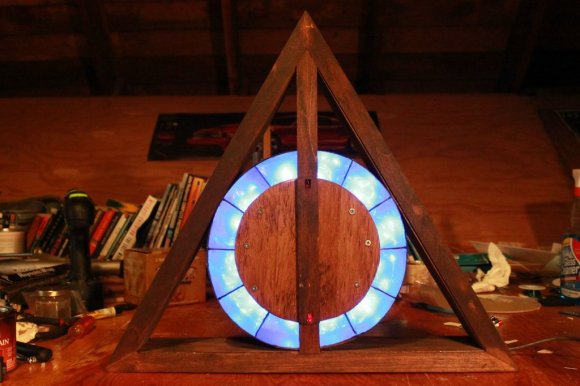
Whether you’re a Harry Potter fan or not we think you’ll enjoy this Deathly Hallows clock. The body is modeled after the triangle, circle, and line that make up the symbol that played a prominent role when concluding the fantasy novel series. A bit of motion and a couple handfuls of LEDs are what allow it to display the time of day.

[Yeenasty] started by building the triangular surround out of wood. In the center he added a circular veneer which was partitioned into twelve chambers. These indicate the hour and are illuminated one at a time from midnight until noon. Once all of the LEDs are switched on (as seen above) they are then extinguish one at a time from noon until midnight. [Yeenasty] mentions that this means the clock isn’t overly bright during the night-time hours.

Minutes are displayed by the wooden slat in the middle of the ring of LEDs. Here it’s showing 30 minutes after the hour because it is vertical and the bottom red LED is lit. The hand is mounted on a 180 degree servo so when it has made half of a rotation the hand backtracks 29 minutes and the LED at the other end is illuminated to continue progress around the face of the clock.

[via Reddit]

Another Take On The Rear-window LED Marquee

re-window-led-display

This rear-window LED marquee will help let the driver behind you know when you’re planing to change lanes or make a turn. But it also includes the ability to send a message like “Back Off!”. [Robert Dunn] was inspired to undertake the project after seeing the one we featured back in October. We’d say his has a better chance of being street legal since it uses all red LEDs.

The marquee is a matrix of 480 LEDs, all hand soldered to form the nearly transparent 48×10 grid shown above. This is important to preserve visibility out the back window of his truck. It makes us wonder about the feasibility of using SMD instead of through hole components. That would certainly make it even less visible when not illuminated, but the assembly process would be much more difficult. That’s because the 5mm LED packages fit nicely in the grid of holes he drilled in some plywood which served as the jig during soldering. The presence of leads also made the soldering process manageable.

Power to an Arduino board is provided from the cigarette lighter adapter. A set of six shift registers drive the columns while the rows are controlled by a 4017 decade counter and some transistors. Check out the blinker test video after the break to get a look at what this can do while on the road.

Continue reading “Another Take On The Rear-window LED Marquee”

Glass Delay Line Slide Used In An RGB Lamp

glass-delay-lines-lamp

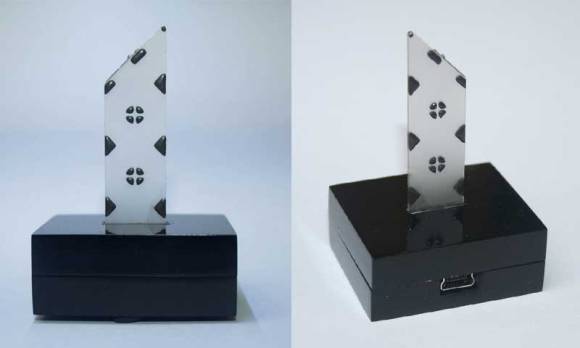
The spire used in this lamp is a part from an old television. It’s a glass delay line slide which pipes the light up from the Bluetooth controlled RGB lamp (translated) in the base.

We have looked at delay lines previously when [Dave Jones] tore down a camcorder to get at one. But we must have missed the EEVblog follow-up episode which explains how the glass slides work. The device uses physical distance to form a delay. Waves directed into the edge of the glass slide bounce around at an angle before being sensed at the collection point. [Lukas] liked the visual appearance of the part and decided to use it to add visual interest to his lamp project. The nature of the glass makes it perfect for directing the light up and away from the PCB.

The lamp consists of one RGB LED module controlled by an ATtiny2313 microcontroller. Also on board is a HC-05 Bluetooth module. This along with an app he wrote lets the user change lamp color and behavior wirelessly. You can see the lamp in action in the video after the break, but we think the camera shot probably doesn’t do it the justice it deserves.

Continue reading “Glass Delay Line Slide Used In An RGB Lamp”

Morse Code Flower Is Trying To Tell You Something

morse-code-flower

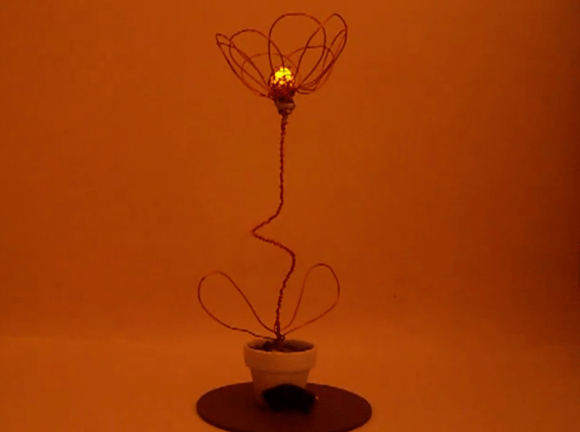
To the casual observer this flower looks nice as its illuminated center fades in and out. But there’s hidden meaning to that light. Some of the blinks are longer than others; this flower is using Morse Code.

[Renaud Schleck] wanted to try a few different things with his MSP430 microcontroller. He decided on an LED that looks like a flower as it will be a nice piece of decor to set around the home. To add the Morse Code message he wanted something a bit more eloquent (and less distracting) than purely digital flashing. So he took the dots and dashes of the hard-coded message and turned them into fading signals by using Pulse-Width Modulation.

He free-formed the circuit so that it, and the coin cell that powers it, would fit in the flower pot. A reed switch is responsible for turning the juice on and off. When placed near a magnet the flower begins its gentle playback.

Continue reading “Morse Code Flower Is Trying To Tell You Something”