Bike Alert Tells Drivers To Back Off

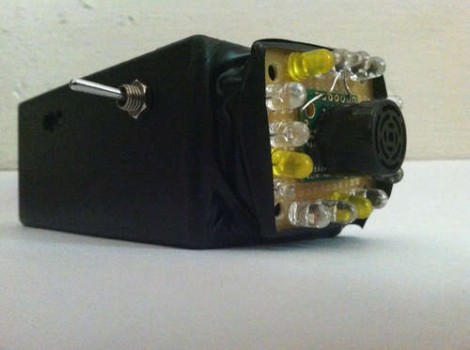
Bicycle commuters are often in a battle with drivers for space on the road. [Hammock Boy] does all of his commuting on two human-powered wheels, and is quite interested in not getting hit by a car. He decided to ply his hobby skills to build a device that helps keep him safe. It’s not just a tail light, it’s a sensor that shines brighter the closer a car is to the back of the bike.

The sensor portion is the ultrasonic range finder seen in the center of the protoboard. Surrounding it is a set of LEDs. Each is individually addressable with the whole package controlled by an Arduino. The sketch measures the distance between the back of the bike and whatever’s behind it. If there’s nothing, one Red led is illuminated. If there is an object, the lights shine brighter, and in different patterns as the distance decreases.

Certainly the next iteration could use a standalone chip without the need for the whole Arduino. This could even work with two battery cells and no voltage regulator. We also think the use of any other color than Red LEDs is suspect but we do love the concept.


Building A Quiz-show Style Buzzer System

Theses are the team buzzer boxes which [Philippe Chrétien] built for his mother. She’s a big fan of quiz shows (we’re thinking Jeopardy and the like) and he thought she’d enjoy a proper setup for home gaming.

Each unit consists of an arcade button and one LED, both housed in a project box. He uses telephone wire to connect each buzzer to the base unit. We like that idea since we’ve got a lot of old telephone cable lying around and our RJ-45 crimp includes an RJ-11 slot. This is perfect for making our own cables.

The base unit houses an Arduino board which polls the buttons to see which is pressed first. The LED on the appropriate buzzer box is illuminated so the players know who got in first. One special feature of this setup is the ability to choose from 30 different buzzer sounds.

There are several other quiz buzzer projects kicking around Hackaday if you’re interested. One of our favorites is this system which uses plastic bowls as the buttons.

[via Adafruit]

A Wedding Cake Made Out Of LEDs

[Andrew] wanted to do something special for his wedding. Since he and his fiance [Missy] decided on a cupcake wedding cake, [Andrew] decided to wow his guests with an RGB LED cupcake holder.

The tiers of [Andrew] and [Missy]’s cupcake holder are made of acrylic laser etched with a damask pattern. These tiers are supported by a cylinder embedded with RGB leds that provide edge lighting for the acrylic panels. The effect is a series of permutating lights that illuminate the cupcake holder with every imaginable color. On the top of the cupcake cake, there’s a great cake topper made of frosted and laser cut acrylic that has the same color fade effect as the cupcake holder.

On the electrical side of things, the cupcake holder has 44 LEDs on all it’s levels. FETs driven by a 40-pin PIC18F control all the LEDs and the whole piece is powered by a computer power supply.

It’s an awesome build, especially considering it was finished just days before the wedding. After the break, you can check out a few more videos showing off the beauty of [Andrew] and [Missy]’s wedding cake.

Continue reading “A Wedding Cake Made Out Of LEDs”

Ask Hackaday: Troll Physics Super Deluxe Edition

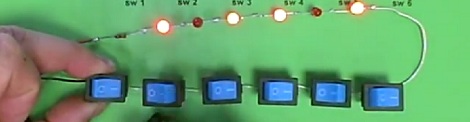
Here’s a brain bender for you: YouTube user [Fredzislaw100] put up a video of six LEDs and six switches wired up in series. After soldering a resistor and 9V battery connector, the first switch turns on the first LED, the second switch turns on the second LED, and so on for the rest of the circuit.

We’ve seen this trick before from [Fredzislaw100], only this time he’s moved up from 3 LEDs to 6. In the reveal of the previous trick, [Fredzislaw] built two AC power supplies inside a nine volt battery connector; one high frequency and one low frequency. The low frequency AC line powers the first two LEDs with the help of diodes in the switches and LEDs. The high frequency AC line turns on the third LED with the help of an inductor inside an LED. Apparently [Fredzislaw] still has some soldering skills to show off; the circuit powering this trick is most likely the work of a soldering god.

From a close viewing, it looks like LEDs are wired up in pairs, i.e. LED 1 works the same as LED 2, LED 3 works the same as LED 4, etc. We’ll let Hackaday readers argue it out in the comments as to how this trick is possible.

Tip ‘o the hat to [Th0m4S] for sending this one in.

Keeping An Old 8mm Projector Alive With High-power LEDs

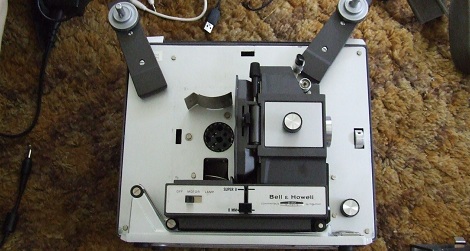
There’s a certain mystique about old home movies and 8mm film; whether it’s footage from a family gathering from 40 years ago or a stop-motion animation you made when you were 12, there’s an immediacy for film that the VHS tapes from your family’s first camcorder can’t match. [Teslas Moustache] has been getting into 8mm cameras and projectors, so when he came across a 8mm/super 8 projector that needed a bulb, he knew he had a worthwhile project on his hands.

To replace the burnt-out and very expensive to replace incandescent bulb, [Teslas] sourced a very bright star LED from Jameco. This 1 Watt LED puts out more than enough light to project a frame of film onto a screen and fortunately doesn’t get as hot as the stock bulb.

To power the LED, [Teslas] used a cell phone charger powered from the 120 VAC incandescent socket to supply the requisite 5 Volts at 1 Amp (Ohm’s Law works on coffee) power for the LED. Right now, there’s still the matter of fabricating a nice enclosure to mount the LED and charger in the bulb socket, but once [Teslas] figures that out, he’ll have a very nice 8mm projector on his hands.

Power Index Window Display Turns Buildings Into LED Matrices

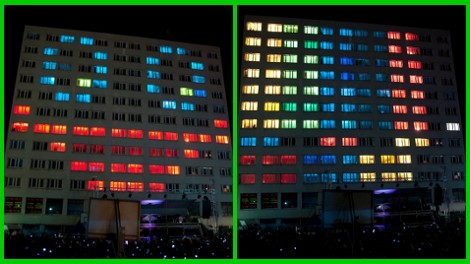
What started off as a fun project using light bulbs picked up some sponsorship and is going on tour. This project now uses LED modules controlled on the 2.4 GHz band to turn buildings into full color displays. It’s the product of students at Wrocław University of Technology in Poland. The group is something of an extra-curricular club that has been doing this sort of thing for years. But now they’ve picked up some key sponsorships which not only allowed for upgraded hardware, but sent the group on a tour of Universities around Europe. Who would’ve thought you could go on tour with something like this?

Much like the MIT project we looked at in April, this lights up the dark rooms of a grid-like building. It does go well beyond playing Tetris though. The installation sets animations to music, with a custom animation editor so that you can submit your own wares for the next show. Don’t miss the lengthy performance after the break.

Continue reading “Power Index Window Display Turns Buildings Into LED Matrices”

Ironman Replica Twofer

We think it’s a bit to late to show up for a screening of The Avengers in full costume, but an arc reactor T-shirt would be pretty cool. [4ndreas] built a chest strap that looks much like [Tony Stark’s] chest-mounted power source. It has a 3D printed enclosure which hosts the ATmega8 and 22 LEDs which provide the pulsing goodness. The thin cellphone battery helps to keep the size of the package to a minimum and a strategically placed hole in a black T-shirt completes the look. It’s even bright enough to shine through the fabric of this black T-shirt.

But if you insist on head-to-toe regalia you’ll appreciate [James Bruton’s] Ironman suit replica build. Not only does he look the part, but he’s trying to build as much functionality into the project as possible. Most recently he finished the helmet. It’s got a motorized faceplate and LED edge-lit eye plates to impress hackers and cosplay fans alike.

Find video of both projects after the break.

Continue reading “Ironman Replica Twofer”