Phone-controlled Light Display Is Simple And Fun

android-phone-light-toy

[Ytai Ben-Tsvi] wrote in to share a little holiday project that he and friend [Al Linke] put together, a dynamic light display that takes its cues from his Android-powered smartphone.

The display fits in a vase that sits in [Ytai’s] family room, and while it wasn’t exactly cheap to build, it sure looks nice. The vase is full of feathery decorative bits which help hide an addressable RGB LED strip. The lights are controlled by an IOIO board which the pair tucked away inside the vase as well.

The IOIO board was also fitted with a USB Bluetooth dongle, allowing it to communicate with just about any handset running a relatively recent flavor of the Android OS. When connected, the phone samples its surroundings with the onboard camera, commanding the vase to mix the colors seen by the phone into its twinkling display.

As you can see in the video below it works pretty well when used with solid, brightly colored objects. While just a fun toy in its current form, [Ytai] and [Al] have more than a few ideas on how to expand its usability.

Continue reading “Phone-controlled Light Display Is Simple And Fun”

StripInvaders Puts Colored Lights Everywhere

There’s not much to be gained by living in a discotheque but colored lights are awesome, especially when they’re as well implemented as [michu]’s StripInvaders.

The StripInvaders project takes a gigantic 5 meter LED strip with WS2801 controllers and turns it into an Ethernet-enabled 24 bit display with the new Arduino Ethernet. While the Ethernet-enabled may seem a little superflous, [michu] implements it quite nicely. The entire 5 meter LED strip can be controlled from a tablet or smartphone.

Apart from a tablet/smartphone interface with OSC, there’s also mDNS support so we’re sure the StripInvaders could make for an interesting LAN party with the appropriate scripts. While the cost of the LED strip itself is fairly high, we’re sure some Hack a Day commenter will come up with a cheaper solution.

The firmware for StripInvaders has been posted on Github, but for a real treat, check out the demo after the break.

Continue reading “StripInvaders Puts Colored Lights Everywhere”

Hackaday Links: December 25, 2011

Ah, Christmas. That wonderful time of year when you can roll out of bed to the screams and wails of children, grab a hot cocoa, and spend several hours arguing with an 8-year-old about which LEGO set to build first. Simply magical. While you’re waiting for the Doctor Who Christmas special to come on, settle down with these wonderful Christmas-themed builds that came in over the last few weeks.

One step closer to Robot Santa

Here’s an interesting way to spice up your seasonal headwear. [Mark] took a Santa hat and added a string of multicolored LEDs to the brim. The lights were picked up at a drug store for a dollar. Control is through a simple push button connected to an ATtiny13. Press the button, the lights cycle in a different pattern. Very cool, so check out the video.

A holographic holiday tree
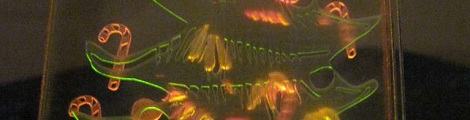
[Auger] posted this very cool light up Christmas tree decoration on Instructables. This tree is made up of three pieces of acrylic. Different designs were laser cut into each piece of plastic – candy canes for the ‘red’ piece, stars and tinsel for the ‘yellow’ piece, and the tree for the ‘green’ piece. LEDs of the respective colors are cemented to the bottom of each bit of plastic. It’s called light piping and is used everywhere. This is the first time we’ve seen three colors, though.

This is what nerds do, and it’s awesome

[Rickard Dahlstrand] was playing around with his phone trying to take deliberately fuzzy pictures of his tree. He noticed the dashes produced from the LED Christmas lights must be produced from PCM dimming. Going through the EXIF data in the picture, he found the exposure time was 1/17th of a second. 1/17 of a second = ~ 58 ms / 5 (cycles on the picture) = ~11 ms per cycle = ~100 Hz frequency on the PCM dimming. Of course this is just about 2 times the line frequency in [Rickard]’s native Sweden, so we’ll call this confirmed. There’s no blog post for this, but we’ve never seen a clearer example of applied geekery. Simply awesome.

Yeah, we measured [Rickard] on a nerd meter
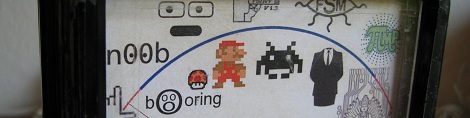
In the spirit of giving, [Johannes] decided to tell the entire world exactly how nerdy he is. He built a ‘Nerd Alert’ meter out of an old 1950s Japanese multimeter. The old guts of the meter were chucked, and a simple amp made out of a transistor amplifies the current flowing through the user’s fingers. A neat scale ([Johannes] measures somewhere between Amiga Workbench and Space invaders) replaces the old, boring, number-based one. Again, no write-up, but here’s some awesome build pictures.

Finally a use for all those old radio tubes
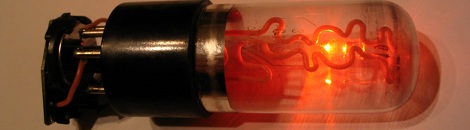
[AUTUIN] took apart a vacuum tube with a blow torch and a diamond cutting wheel. Surprisingly, he was able to put it back together, but not before making a wonderful Christmas ornament. There are two copper wires inside the envelope that are the leads to a single orange-red LED. The whole thing is powered by a watch battery. We’ll be sure to reference [AUTUIN] next time we have to take apart a glass bulb, because he managed not to burn, cut or blind himself.

Six things in a links post? It’s a Christmas miracle!

[Darryl] sent in a nice tool to select and display all of the hacker/maker merit badges available from Adafruit. Oh, we’re still trying to figure out who to give 10 badges to. We’re giving away skull ‘n wrench badges to the top ten hacks ever featured here. Leave a note in the comments, or tell us who should win.

Holiday wishes

Now put the computer down and go spend some time with your families, or failing that, strangers. Of course there’s an all day Doctor Who marathon, and that thing isn’t going to watch itself…

How To Grow Your Own EL Wire DNA Helix Lamp

el-wire-helix-lamp

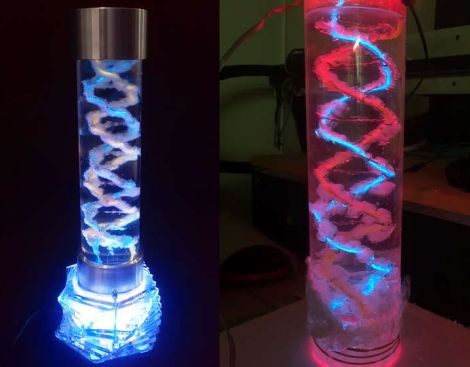
[LucidMovement] was looking for some crystal-based artwork and just couldn’t seem to find anything that fit the bill, so he decided to build something himself.

The inspiration for his desk lamp came from something we’re all familiar with, a DNA double-helix. To grow the crystals he built a helix-shaped growing substrate out of nichrome and EL wires, submerging them in a warm alum solution. Once he had a nice set of crystals, he mounted it in an acrylic tube, filling the air space with clear silicone to seal off the display. He then mounted the silicone-filled tube on top of a rotating acrylic stand that he had cut for the project. The stand is made from several sheets of acrylic and contains both the gearing for movement as well as RGB LEDs to light the display from the bottom.

The lamp looks great when sitting idle, but when he powers it on it really shines (no pun intended). [LucidMovement] put a ton of work into the lamp, and offers up all sorts of tips, tricks, and considerations for anyone looking to build their own. Be sure to check out his writeup for plenty more details, and stick around to see a short video of the lamp in action.

Continue reading “How To Grow Your Own EL Wire DNA Helix Lamp”

led-contacts

[Ben Krasnow] Sticks LEDs In His Contacts Just For Kicks

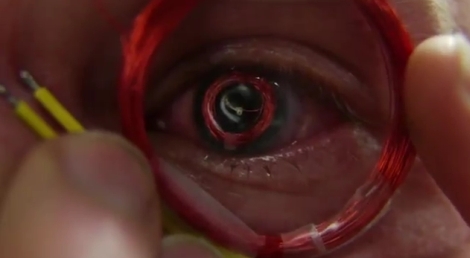
[Ben Krasnow] wrote in, saying that every so often a news story appears covering a project in which researchers embed a single pixel LED display inside a contact lens. The most recent article he saw featured a contact-wearing rabbit, and not being one to shy away from damaging his own body in the name of science, he decided to try the experiment on himself.

He started out by soldering a tiny 0402 SMD LED to a hand wound coil, laminating the display between a pair of regular contact lenses. After trying to adhere the lenses to one another using water, he opted to tack the edges together with a pair of hot tweezers, making for a more secure but uncomfortable piece of eyewear. The LED is powered by a simple inductive coil he put together, which uses a spark gap transmitter to flash the LED on and off.

If you’re not freaked out by people sticking things in their eyes, be sure to check out the video below to see [Ben’s] augmented contact lens in action. While it might not give him Terminator-like vision, it’s pretty awesome considering he pieced it together in his workshop in his spare time.

Continue reading “[Ben Krasnow] Sticks LEDs In His Contacts Just For Kicks”

Head-mounted Light Display Takes Holiday Cheer On The Go

hat-mounted-light-display

Most holiday light displays we see this time of year are stationary, or at least confined to somebody’s home. [Marco Guardigli] wanted to take his lights on the go, and thought that a light up winter hat would be perfect for showing off his holiday spirit.

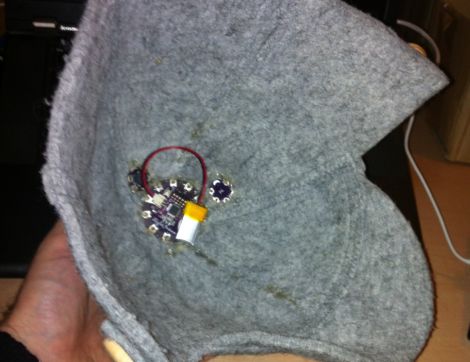
In the winter he sports a sturdy wool felt hat, which was ideal for mounting LEDs. He picked up a basic LilyPad Arduino that uses a small LiPo battery as its power source, mounting it inside the hat with a bit of glue. He wired up a series of SMD LEDs around the perimeter of the hat which blend in quite well in the felt, leaving them nearly invisible to the naked eye when powered off. When he flips the LilyPad on however, there’s no missing the bright blue LEDs nor the music emanating from the tiny speaker he also mounted in the hat.

We think that [Marco’s] display is great, and if we were to build one, we would likely include a copious amount of red and green LEDs in ours. Do any of you take your Christmas light display on the go? We’d love to see them, so be sure to let us know in the comments.

Stick around to see a short video of [Marco’s] hat in action.

Continue reading “Head-mounted Light Display Takes Holiday Cheer On The Go”

Xbee Remote Sensors Tell You When Someone Enters Your Home

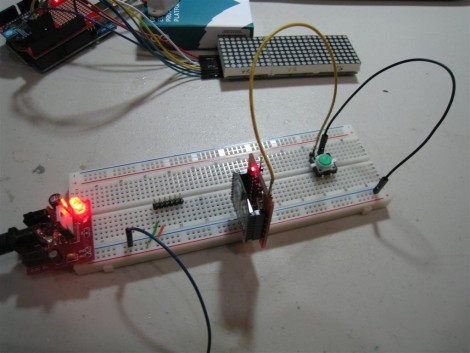
[Bill Porter] is helping a friend out by designing a simple security system for her home. It relies on Xbee modules to alert a base station when doors are opened, or a pressure mat is stepped on.

The door sensors are quite simple, and you’re probably already familiar with them. One part mounts to the door and has a magnet in it, the mating part mounts to the jamb and has a reed switch that closes a contact when the magnet is in place. The floor mat uses two sheets of conductive material separated by bits of foam. When it is stepped on a circuit is completed and can be sensed by the Xbee as a button press.

These sensors report back to an Arduino base station that has a buzzer and three 8×8 LED modules to scroll a message saying which sensor was tripped. [Bill] does a good job of showing what goes into configuring an Xbee network if you’ve never worked with the hardware before.

You’ll find his demo video after the break.

Continue reading “Xbee Remote Sensors Tell You When Someone Enters Your Home”