Macetech Is Looking For A Few Good Processing Programmers

maker_faire_logo

[Garrett Mace] wrote to us in hopes of finding a few good programmers to help him out with a project he’s been working on for Maker Faire Bay Area 2011.

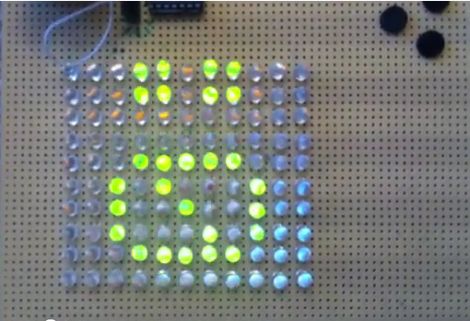
More specifically, he is looking for Processing programmers who are also pretty decent with graphics. Macetech’s big project for this year’s Maker Faire is a large overhead light matrix constructed from Chinese lanterns. They are using their new Satellite LED modules to light the 128-lantern array, which is laid out in a 16×8 matrix.

It seems that the Macetech crew has been so busy getting the array built and tested that they don’t have much time to program any visualizations for it – that’s where you come in. If you are so inclined, simply download his matrix simulation code, put together some cool displays, and send them his way. [Garrett] says that they will be taking video of the visualizations, so even if you can’t attend Maker Faire, we will all be able to enjoy your hard work (though it would be pretty cool if they sent contributors a Satellite LED module “sample” as well!)

Keep reading to see a quick demo video of the simulation software to get an idea of what they are looking for visualization-wise.

Continue reading “Macetech Is Looking For A Few Good Processing Programmers”

Bringing The Game Of Tag Into The Digital Age

tagurit

How long has it been since you’ve played a game of tag?

[Sylvia Cheng, Kibum Kim, and Roel Vertegaal] from Queen’s University’s human media lab have concocted a fun twist on the classic game that just might compel you to start playing again.

Their game, called TagURIt, arms two players with Lumalive LED t-shirts which sport embedded touch sensors. A third player, known as the “chaser” attempts to touch either of the other players in order to capture the token displayed on the player’s chest-based LED matrix. The game is score-based, awarding points to the chaser for capturing tokens, while giving the other players points for avoiding capture.

If both players wearing the LED shirts are near to one another, the token will jump to the other player in an attempt to thwart the chaser. In this game, each player is a location-tagged URI, and proximity is determined by either tracking the users with cameras indoors, or via RF sensors if the game is played outside.

It is definitely an interesting way of playing tag, and we imagine it could be quite fun in large groups.

Continue reading to see a video demonstration of the TagURIt game being played.

[via Adafruit blog]

Continue reading “Bringing The Game Of Tag Into The Digital Age”

Improve Charlieplexing Performance With Interrupts

single_chip_led_matrix

[Dmitry] was shopping for LEDs and accidentally pulled the trigger on the wrong type. Since he didn’t want to be wasteful, he figured he should at least take the time to build something with them.

A LED matrix display was the obvious project choice, but he only had a PIC16F688 at his disposal. Since the micro controller only has 11 output pins, charlieplexing was the only way he would be able to light the entire matrix.

While testing his LED array, he found charlieplexing to be a bit disappointing. The fact that the LEDs can get relatively dim, depending on the number of units lit at any particular time struck him as annoying.

In order to improve the performance of his charlieplexed array, he first decided to scan through all of the LEDs rather than just those that needed to be lit. This ensured that all of his LEDs had the same 1/110 duty cycle and were always as bright as possible. He also chose to use interrupts when lighting the LEDs. This meant that his code does not need to take into consideration any specific timing requirements to maintain persistence of vision. He also double-buffers the display to help reduce flicker.

He says that he ran into certain constraints with the PIC chip he chose, so he used a handful of lookup tables to ensure smooth operation of his display. He was quite satisfied with the results, and we think that the interrupt-driven display looks like it works just fine from where we’re standing as well.

Be sure to stick around for a quick video explaining and demonstrating his single-chip LED matrix.

Continue reading “Improve Charlieplexing Performance With Interrupts”

DIY Sunrise Alarm Clock

sunrise_alarm_clock

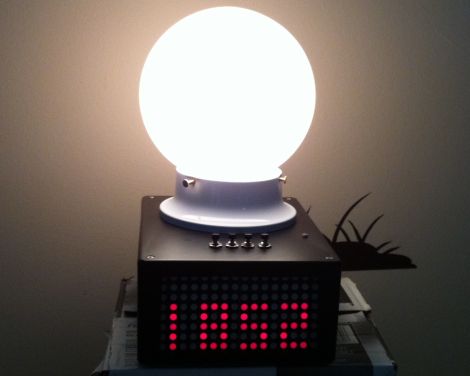
As a project for an embedded systems class, [Alan] recently built himself a sunrise-simulating alarm clock. You are probably familiar with these sorts of timepieces – they gradually light up the room to awaken the sleeping individual rather than jarring them awake with a buzzer or the radio. Since many commercial units with this feature are sold for $70 and up, his goal was to replicate the functionality at a fraction of the cost, using only open source components.

An Arm Cortex M3 processor runs the show, displaying the time via a pair of 8×8 LED matrix panels on the front of the device. The clock is programmed to gently wake up its user by simulating a sunrise over a period of 5, 15, 30, 45, or 60 minutes. If the user has not woken up before the sunrise simulation is complete, the clock resorts to a traditional piezo alarm to rouse the heavy sleeper.

The project is nicely done, and after looking at his bill of materials it seems to be far cheaper than many sunrise alarm clocks you will find in stores.

A Weighted Companion Cube Worth Saving From The Incinerator

companion_cube

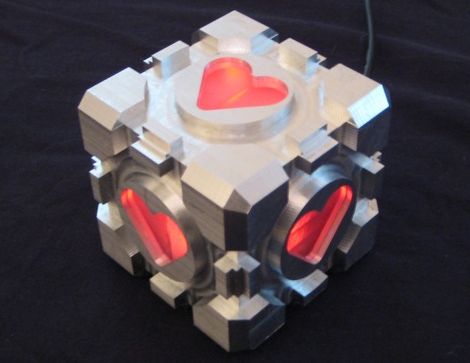
It’s honestly sad that Valve has not released any official Portal-related items to the masses, as a market for them clearly exists. As the saying goes, “necessity is the mother of invention”, and [Jamie] needed a Weighted Companion Cube in the worst way.

Actually he constructed his Companion Cube in order to test out some modifications and upgrades he performed on his homebrew CNC Mill. Judging by how the cube turned out, and the fact that he was able to keep tolerances within .005”, we would say that his mill is working just fine.

The cube was designed in Solidworks, and passed through the BobCAD plugin to generate the GCode for the mill. The base of the cube was machined out of a 3” solid block of aluminum, hollowed out on one side to give him access to the cube’s innards. He milled out heart shaped openings on each side, covering them with frosted Lexan.

He added a BlinkM to the mix, mounting it on the cover plate he milled for the open side of the cube. Once lit it cycles through several colors, including the pinkish tone anyone who has played Portal is quite familiar with.

We would say that it’s a great job, but it doesn’t do his work justice – it’s absolutely stunning. We’re not just saying that because we want one, though we do want one…badly.

Large Remote-controlled Game Of Life Display

game_of_life

Sometimes it’s just plain fun to over-engineer. [Stephanie] gets a warm fuzzy feeling when she successfully adds way more electronics components to a project than she really needs – just because she can. We can’t really argue with her if that is the intended goal, nor can we find fault with the sweet Game of Life display she put together.

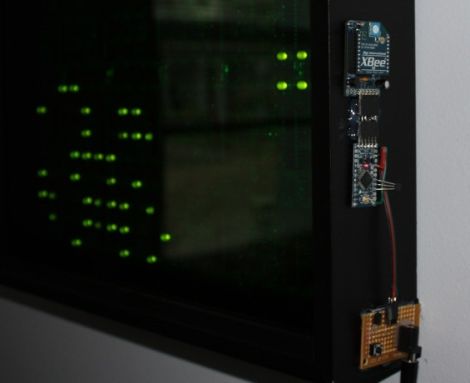
She started off with six Game of Life kits from Adafruit, but she quickly caught the LED bug and her collection grew until she had 20 kits (that’s 320 LEDs for those of you keeping count). After piecing them all together, they were mounted in a wooden frame and placed behind a dark piece of acrylic. It looked great and worked just fine, but it wasn’t overdone enough for her tastes.

In the end, she added a small Arduino and Xbee module to the Game of Life display, which enables it to be controlled by her network-enabled thermostat we featured a few weeks back. The thermostat was fitted with an Xbee unit as well, which allows it to turn the Game of Life on and off at whatever times [Stephanie] specifies.

We’ll take two please.

[via Adafruit Blog]

Diagnosing Diseases Like MacGyver

pancratitis_test

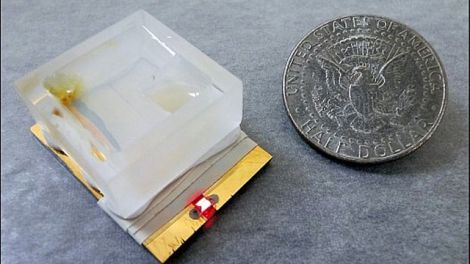
If you ever watched MacGyver as a kid, you know that given any number of random objects, he could craft the exact tool he would need to get out of a sticky situation. If he ever made his way into the medical research field, you could be sure that this test for Acute Pancreatitis would be among his list of accomplishments.

Designed by University of Texas grad student [Brian Zaccheo], the Acute Pancreatitis test seen in the image above looks as unassuming as it is effective. Crafted out of little more than foil, jello, and milk, the test takes under an hour to diagnose patients while costing less than a dollar.

The test works by checking the patient’s blood for trypsin, an enzyme present in high concentrations if they are suffering from pancreatitis. Once a few drops of the patient’s blood is placed on the gelatin layer of the test, it is left to sit for a bit, after which sodium hydroxide is added. If elevated trypsin levels are present, it will have eaten through the gelatin and milk protein, creating a pathway for the sodium hydroxide to reach the foil layer. If the foil is dissolved within an hour, a circuit is formed and a small LED lights up, indicating that the patient has acute pancreatitis.

The test really is ingenious when you think about it, and will be a huge help to doctors practicing in developing countries, under less than ideal working conditions.

[via PopSci via Gizmodo]