Color Clock Makes Telling Time Impossible

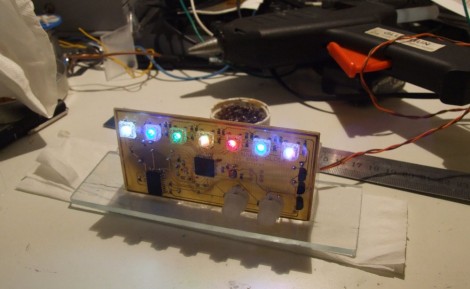
[Bogdan] set out to build the all-too-familiar binary clock. But, he didn’t want to be ordinary, and set the goal of making the clock as hard to read as possible. What he ended up with is a clock that is almost impossible to read correctly.
He’s using colors to tell the time. We immediately thought this might make use of resistor codes as the display but it doesn’t. Red shows the hours, green for minutes, and blue for seconds. Now stack all of them on top of each other in binary and you’ve got the time. That means you’ve got to know all of your color combinations, plus read the binary value correctly, to decipher the time. Add to that the display changing every second and we’re in trouble.
Aside from the user difficulty level, this is a really clean build. It uses an ATmega8535 in conjunction with our favorite DS3232 RTC chip. The etched board is nice and clean, making for an aesthetically pleasing clock.
Six Digit LED Clock

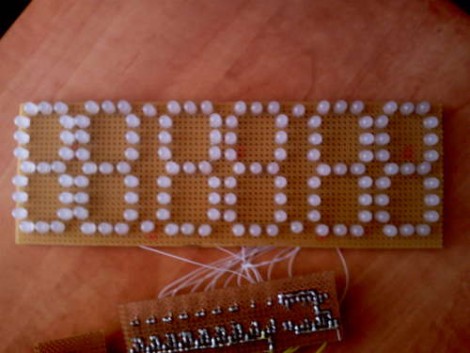
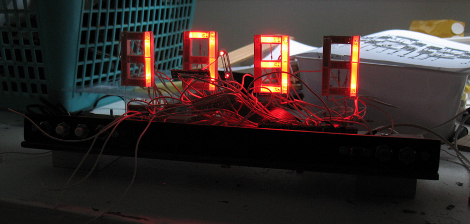
Got a bag of LEDs handy? Why not build a display with them? We’ve seen a lot of clocks that make use of LED modules but soldering your own is a fun pastime. [Vadim Suhovatih] did just that using 130 LEDs to build this clock. Each segment of the 7-segment digits consists of three LEDs in parallel which are switched by some 2N4401 transistors. An ATmega328 in the form of an Arduino controls the device with the aid of a DS1307 real-time clock for timekeeping and a 4017 decade counter to assist with scanning the display. Check out the demo after the break.

Continue reading “Six Digit LED Clock”

Switchmode LED Flashlight Upgrade

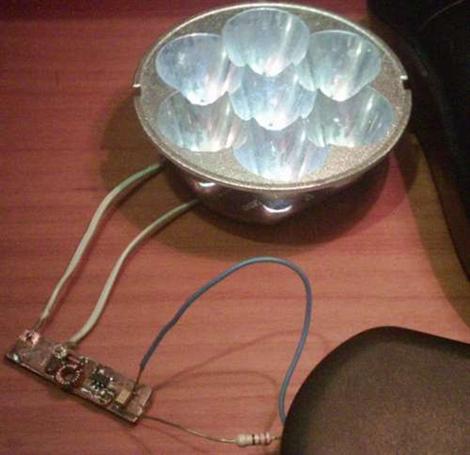
When [Neelandan]’s cheap flashlight’s internal rechargeable battery died, he scrounged for a replacement. Ultimately, the brightness of the light suffered with his new battery, taken from an old cell phone since he had dropped the voltage a bit. Upon inspection he saw that he would have to swap the individual resistors for each lamp to get the desired brightness again. This wasn’t really acceptable as he would have to repeat the process if he used another re-purposed battery with different specs. Instead, he added a new circuit to supply constant brightness until the voltage drops below 2.7 volts. We love to see hardware resurrected, even if it is just a cheap LED flashlight.

May The Phorse Be With You

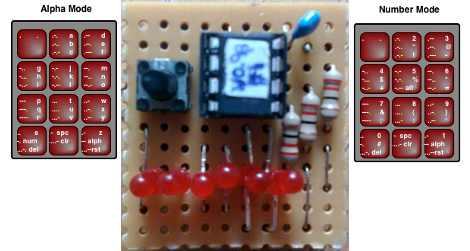
The PhorsePOV by [Julian Skidmore] almost slipped by, but we thought it was a nice easy hack for your Memorial Monday. The gadget uses an ATTINY25 to drive 6 LEDs aren’t standard characters 7 units high? Which when waved in the air produces a readable message. What we were really interested in is the use of a single button for text entry, called Phorse code, or an “easier to learn and remember” version of Morse code. While it seemed silly at first, most of us here could enter messages within a few minutes of trying.

32 LED POV Globe

[youtube=http://www.youtube.com/watch?v=bt1UEGD3BDk]

Here’s a slick version of a POV globe(google translated). Created by [Riko], this globe has 32 LEDs and is powered by a rotating coil. The layout looks fairly solid in operation, with the POV effect showing up very nicely on camera.  You can get the schematics and source code from the project page.

We found this project, just like the previous fantastic LED globe on HackedGadgets.com. Apparently someone linked to this project in the comments. That is fantastic, that is what the comments should be for. Please help keep our comments polite and helpful as well, even if you are just linking to a project that you think is better.

Laser Command Game Uses Laser For Control

[vimeo=http://vimeo.com/10819322]

[Eliji Hayashi’s] project for a class at Carnegie Mellon University is absolutely delightful! It is a game he calls Laser Command because a laser pointer is used as the gaming controller. An 8×8 LED matrix serves as the display, but is also used as an 8×8 light sensor, much the same way as the LED advent project did. The display is rapidly switched between producing light and sensing it. The laser is bright enough that it becomes easy to pick up the voltage generated within the matrix during the sensing periods. The game is programmed on an Arduino mini and the whole thing wraps up into an incredibly small package. Brilliant.

[Thanks Juan]