DIY Synth Takes Inspiration From Fretted Instruments

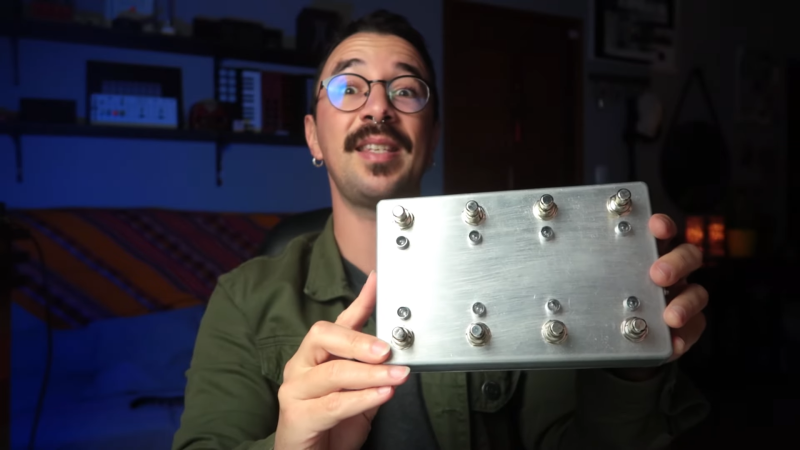
There are a million and one MIDI controllers and synths on the market, but sometimes it’s just more satisfying to make your own. [Turi Scandurra] very much went his own way when he put together his Diapasonix instrument.

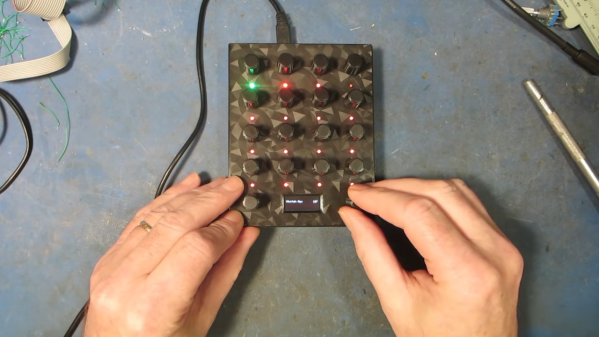
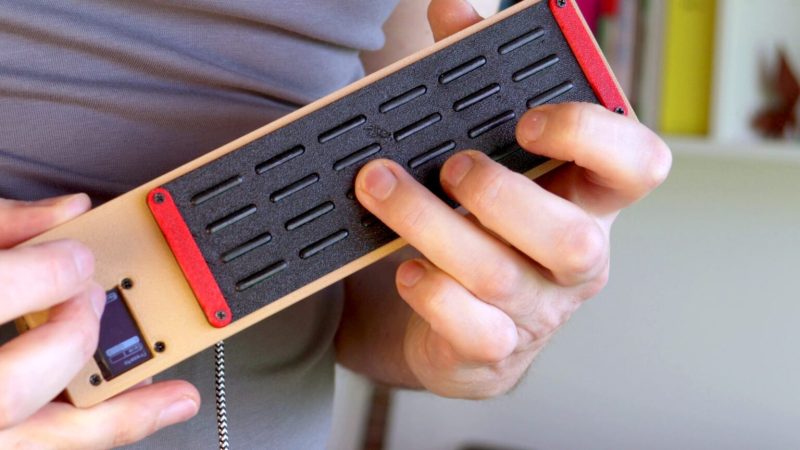
Right away, the build is somewhat reminiscent of a stringed instrument, what with its buttons laid out in four “strings” of six “frets” each. Only, they’re not so much buttons, as individual sections of a capacitive touch controller. A Raspberry Pi Pico 2 is responsible for reading the 24 pads, with the aid of two MPR121 capacitive touch ICs.

The Diapasonix can be played as an instrument in its own right, using the AMY synthesis engine. This provides a huge range of patches from the Juno 6 and DX7 synthesizers of old. Onboard effects like delay and reverb can be used to alter the sound. Alternatively, it can be used as a MIDI controller, feeding its data to a PC attached over USB. It can be played in multiple modes, with either direct note triggers or with a “strumming” method instead.

We’ve featured a great many MIDI controllers over the years, from the artistic to the compact. Video after the break. Continue reading “DIY Synth Takes Inspiration From Fretted Instruments”

A Touchscreen MIDI Controller For The DIY Set

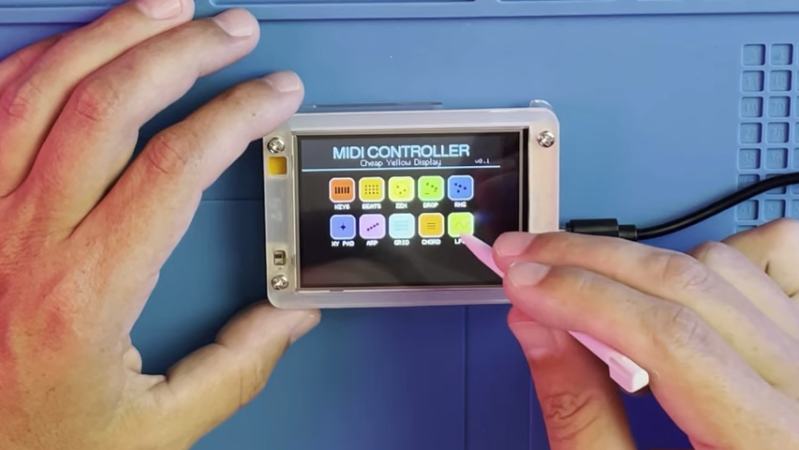
MIDI controllers are easy to come by these days. Many modern keyboards have USB functionality in this regard, and there are all kinds of pads and gadgets that will spit out MIDI, too. But you might also like to build your own, like this touchscreen design from [Nick Culbertson].

The build takes advantage of a device colloquially called the Cheap Yellow Display. It consists of a 320 x 240 TFT touchscreen combined with a built-in ESP32-WROOM-32, available under the part number ESP32-2432S028R.

Continue reading “A Touchscreen MIDI Controller For The DIY Set”

Theremin-Style MIDI Controller Does It With Lasers

Strictly speaking, a Theremin uses a pair of antennae that act as capacitors in a specific R/C circuit. Looking at [aritrakdebnath2003]’s MIDI THEREMIN, we see it works differently, but it does play in the manner of the exotic radio instrument, so we suppose it can use the name.

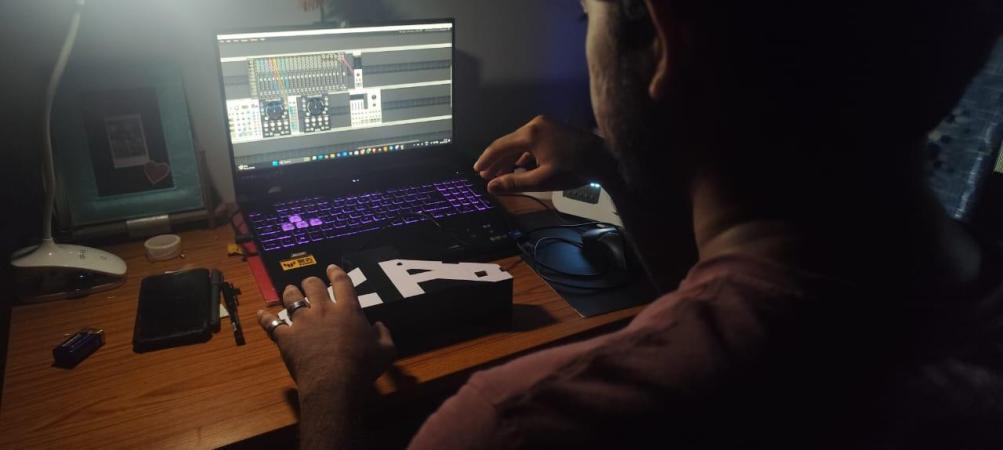
The MIDI THEREMIN is purely a MIDI controller. It sends note data to a computer or synthesizer, and from there, you can get whatever sound at whatever volume you desire. The device’s brain is an Arduino Uno, and MIDI-out for the Arduino has been a solved problem for a long while now.

Continue reading “Theremin-Style MIDI Controller Does It With Lasers”

OpenMIDIStomper Makes Sure Your Gear Does What Your Foot Says

If you’re a solo musician, you probably have lots of gear you’d like to control, but you don’t have enough hands. You can enlist your feet, but your gear might not have foot-suitable interfaces as standard. For situations like these, [Nerd Musician] created the OpenMIDIStomper.

The concept is simple enough—the hardy Hammond enclosure contains a bunch of foot switches and ports for external expression pedals. These are all read by an Arduino Pro Micro, which is responsible for turning these inputs into distinct MIDI outputs to control outboard gear or software. It handles this via MIDI over USB. The MIDI commands sent for each button can be configured via a webpage. Once you’ve defined all the messages you want to send, you can export your configuration from the webpage by cutting and pasting it into the Arduino IDE and flashing it to the device itself.

We’ve featured some great MIDI controllers over the years, like this impressive parts bin build.

Continue reading “OpenMIDIStomper Makes Sure Your Gear Does What Your Foot Says”

Turning A Saxophone Into A MIDI Controller

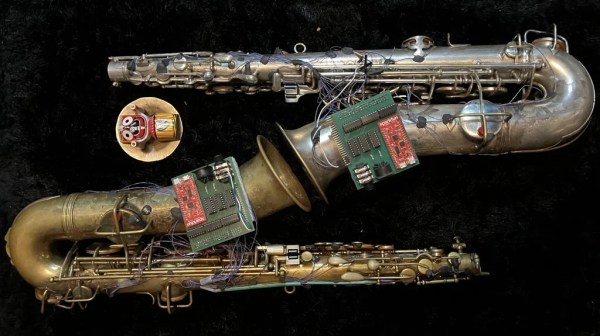
Most of the time, if you’re looking for a MIDI controller, you’re going to end up with some kind of keyboard or a fancy button pad. The saxophone is an altogether more beguiling instrument that makes for one hell of an interface, but there’s a problem: they’re seldom MIDI-compatible. This build from [AndrewChi] changes all that.

This digitized sax relies on a SparkFun ESP32 Thing as the brains of the operation. It uses Hall effect sensors, the digital switch type, to detect the action of the keys of the sax. Choosing parts that are quick to respond is key for musical use, so [AndrewChi] selected the Texas Instruments DRV5023 for its unipolar operation, short output delay and fast rise time. Beyond setting up the basic keys to send MIDI notes, the instrument also received additional octave controls for greater range. With sensors and magnets attached to the saxophone and keys with Sugru, the instrument is ready to serve as a capable MIDI controller. Thanks to the ESP32, it’s capable of sending MIDI data wirelessly over Bluetooth for the maximum freedom of performance.

It’s a nifty build, and a great way for wind players to get into the world of controlling digital synthesizers in an intuitive fashion. We’ve seen some great MIDI controller builds before, too.

Continue reading “Turning A Saxophone Into A MIDI Controller”

Building A Breath-Controlled MIDI Device

When we think of MIDI devices, we typically jump straight to drum machines, rack synths, and keyboard controllers. However, there’s nothing saying you can’t build your own MIDI controllers that use the magic of breath to do their musical duty. That’s precisely what [Xavier Dumont] did with this unique 3D printed build.

The device looks somewhat like an alien ship from an animated 1960s sci-fi movie, but it’s actually a sophisticated MIDI controller. Naturally, it’s peppered with buttons as every good controller should be, and it features a touch-control strip on the back.

However, the real magic is in the breath control. When the user blows into the sensor, the device sends out MIDI signals of varying intensity to control the object of the player’s desire. The breath signal can be used to modulate the mod wheel, pitch bends, or octave shifts, among a variety of other options.

[Xavier] wields the instrument with prowess in the audio demos at the end of the video. We can imagine this futuristic thing being played by a background alien in a celebration scene in a far-flung Marvel movie. Or maybe Star Wars? In any case, a triumph.

Continue reading “Building A Breath-Controlled MIDI Device”

Nanoaetherphone Is A Special MIDI Controller

MIDI controllers can be simple straightforward keyboards, or wild magical devices that seem to snatch notes from the very aether itself. As you might expect from the name, the Nanoaetherphone II is one of the latter.

The device is inspired by the Theremin, and was built to celebrate its 100th anniversary. The Nanoaetherphone II is all about using sensors to capture data from wireless hand-wavey interactions, and turn it into MIDI messages. To this end, it has an LDR sensor for detecting light levels, which determines volume levels. This is actuated by the user’s thumb, blocking the sensor or allowing ambient light to reach it. At the front of the handheld unit, there is also an ultrasonic range sensor. Depending on how close the sensor is to the user’s hand or other object determines the exact note sent by the device. As a MIDI controller, it is intended to be hooked up to an external synthesizer to actually generate sound.

The overall concept isn’t too complicated, and the design makes it easy to pickup and play. We imagine it could even be foolproofed by programming it only to play notes from a given scale or mode, allowing for easy soloing without too many of those ill-tempered blue notes. Jazz enthusiasts might prefer it to just spit out any and all notes, of course.

We love a good MIDI controller around these parts, and we’ve seen everything from knitted models to those made out of old phones. Video after the break.

Continue reading “Nanoaetherphone Is A Special MIDI Controller”