Open Source Synth Sounds Awesome

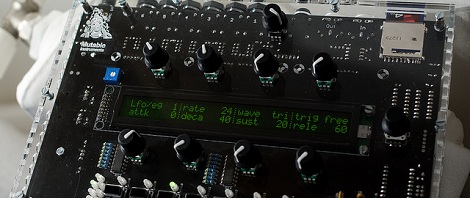
A little bird sent in a tip about a really cool MIDI synth. It’s called the Ambika, and it seems like just the thing to introduce a synth head to the world of soldering.

Compared to an entry-level synthesizer like the microKorg or its ilk, the Ambika is packed full of really cool features that just happen to sound awesome. In addition to the basic saw, square, and sine waves, there is also FM, and wavetable synthesis along with a noise generator, rudimentary voice synth, and a bitcrushed sawtooth wave voice. Really, the sound demos (available after the break) speak for themselves.

The hardware is based on the ATMega644p, a fairly high-powered 8-bit microprocessor notably used in the Sanguino. This synth supports up to 6 voices, each individual voice is contained on a separate circuit board attached to the motherboard.

Of course, the schematics/board files/firmware for the Ambika are freely available along with a pretty amazing set of technical notes. There’s no word on how much the Ambika will cost, but having it available as a kit should make it palatable if you don’t mind spending a Saturday holding an iron.

Tip ‘o the hat to an anon for sending this one in.

Continue reading “Open Source Synth Sounds Awesome”

A Sample Player You Can Slip In Your Pocket

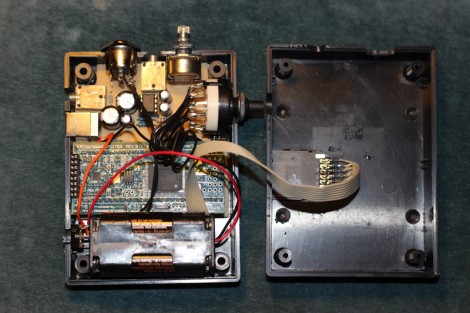
This portable sample player packs quite a punch. [Lee] wanted a nice portable way to take his samples with him, but refused to water-down the features just because it is portable. He set of goal of playing between 3-8 simultaneous notes from a large assortment of stored samples.

Sample space was the first design consideration, and it’s hard to beat the price per megabyte of an SD card. After some calculations he concluded that it is possible to pull these samples off the card quickly enough to achieve his simultaneous note goal at CD quality frequencies, but only if there is little or no latency when reading from the card. This means [Lee] needed a fast processor so he chose the LPC1769 which is an ARM Cortex-M3 processor which can run at 120 MHz.

The project box includes room for a volume knob to control the output from the in-build headphone amplifier. There’s also a rotary encoder for selecting sample sets. But we’re a bit confused on this part as the device is MIDI controlled. [Lee] is the creator of the electronic Moolodeon, which itself has MIDI out and will be used as a controller for this project.

Player Guitar Sounds Wonderful; Makes Us Drool Because Of The Complexity

It becomes obvious when you listen to this player guitar that it’s not a human being playing. But the only reason for that is the unrelenting precision with which the songs are played. In addition to that accuracy, it’s interesting to note that this tune is normally played by a group of guitarists but here the machine manages to do it on one instrument. And we think it sounds fantastic!

This comes from [Vladimir Demin], a maker who previously built an automatic Bayan (like an accordion but with buttons where the keyboard is normally found). This time around it’s the six strings and many frets of a guitar that have been outfitted with one solenoid each. In the image above you can see the strumming mechanism mounted near the tone hole. Six picks are held in place, and it appears that each has two solenoids. From what we can observe in the video, one of the solenoids is used to strum the sting, the other tilts the pick mount so that there won’t be a second strumming when the pick is returned to its starting position.

Continue reading “Player Guitar Sounds Wonderful; Makes Us Drool Because Of The Complexity”

Making Old Organs More Portable With MIDI

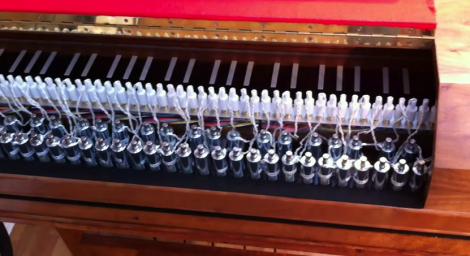
In the 60s 70s and early 80s, roadies would lug hundreds of pounds of musical equipment around to gigs. Although the 8×10 Ampeg bass cabinet wasn’t fun in the least, the absolute worst was the Hammond organ. These behemoths of tonewheel organs sounded great, but moving them was a pain. For better or worse, portable MIDI keyboards caught up with the sound quality of these old electromechanical monsters. Everything is still not right with keyboard players; a good set of organ foot pedals is still hard to come by. To solve this problem, [Jeremy] converted his old Hammond A-100 organ pedals to MIDI giving him all the feel and aesthetics of an ancient instrument without all the heft.

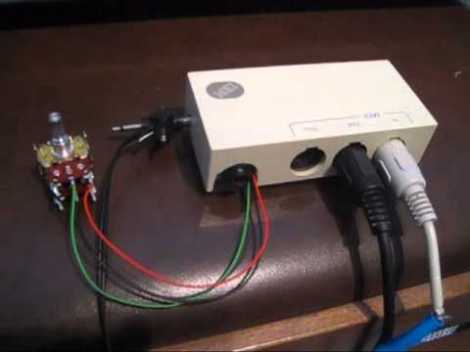
To transform the ancient A-100 bass pedals into a keyboard, [Jeremy] turned to the HighlyLiquid MIDI CPU. This small board provides a few dozen pins to wire up to switches and potentiometers. A new switch assembly was built for the bass pedals using a momentary push button switch under each key. These buttons are wired up to the MIDI CPU, and everything worked out wonderfully.

Although there’s no video of the newly portable Hammond organ in action (something off Zeppelin I, [Jeremy]…) there is a great Flickr photoset of the entire build. Awesome work, [Jeremy]

Building New Interfaces With An IPad

There’s a word – synchronicity – to describe two disparate events that occur together in a meaningful way. We see this a lot in the Hackaday tip line; two people send in somewhat similar hacks solving similar problems in similar ways nearly simultaneously. Here’s two builds by [Bryce] and [spektakx] that hit our inbox within minutes of each other that both implement existing interfaces with iPads.

iPad turntable controller

[spektakx] sent in an iPad powered DJ MIDI controller he built as a prototype to test out the size, orientation and layout for an upcoming build. The turntable controllers are simple USB affairs made to jog and scratch records digitally. Although [spektakx] admits it’s a little unfinished, it’s still just a prototype. Also, he can use a Windows 7 tablet laptop for ‘more suited’ hardware. Check out [spektakx]’ video demo after the break.

an iPad cash register

[Hacktheory] found [Bryce]’s Flickr photolog of a DIY ‘Square’ cash register. The electronics part of this build is practically non-existent; it’s just an iPad with a credit card readers that plugs into the headphone jack. Yes, we just saw these ‘Square’ credit card readers this last week. The fabrication portion of this build is incredible – [Bryce] has a few wonderful pieces of walnut there, and did an exceptional job with the wood work. It’s probably not well suited to high-volume retail, but we couldn’t think of a better cash register for a boutique shop.

Continue reading “Building New Interfaces With An IPad”

Arduino MIDI Sequencer Displays A Lot Of Data

This Arduino MIDI sequencer has no shortage of ways to display loop info. The screen above is a touch-sensitive interface that acts as the user input. But if this screen is not visible, you can still see which tracks have activated samples for each beat and what effects are being used. That’s thanks to the collection of display boards which are shown in the video after the break.

The setup acts as the MIDI front end, relying on other hardware to generate the samples. It presents all of the options through several pages on the 320×240 touch screen display. The Ardunio Mega is responsible for monitoring the UI data, crafting and sending the MIDI commands, as well as updating the LED-based display boards. These include bar graphs for the various effects, a four row by sixteen pixel beat pattern display, and 7-segment displays to track the current location within the loop. All in that’s 368 LEDs driven by 18 shift registers.

Update: Link to a gallery can be found after the break as well.

Continue reading “Arduino MIDI Sequencer Displays A Lot Of Data”

Floppy Drive As An Audio Sampler

Here’s a floppy drive which is being used as an audio sampler. At first glance we thought this was another offering which drives the stepper motor at a specific frequency to generate that characteristic sound at a target pitch. But that’s not what’s happening at all. The floppy is actually being used as a storage device (go figure).

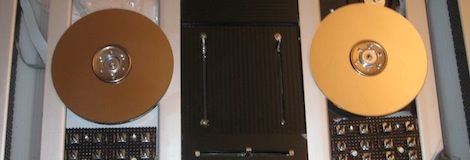
From what we can tell, it’s being used almost like an 8-track tape. A PWM signal is stored on one circular slice of the disk, then the head can be moved back to that same “track” to play back the wave form. The head doesn’t move during playback, but just keeps reading the same track of bits. To the right you can see an Arduino board. This allows for MIDI control of the track selection. [Alexis] shows off some keyboard control in the video after the break. There’s a buffer chip on the breadboard which allows the audio output to be quickly switched off as the floppy drive head is moved. This keeps garbage out of the sound until the new track can be read.

Continue reading “Floppy Drive As An Audio Sampler”