Piezo Pickup Makes Wax Records Easy To Digitize

Sound recording and playback have come a long way in the last century or so, but it’s fair to say there’s still a lot of interesting stuff locked away on old recordings. Not having a way to play it back is partly to blame; finding an antique phonograph that plays old-timey cylinder recordings is pretty hard. But even then, how do you digitize the output of these fragile, scratchy old recordings?

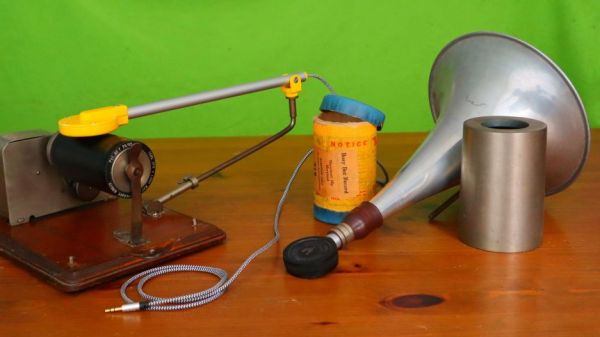
As it happens, [Jan Derogee] is in a position to answer these questions, with an antique phonograph and a bunch of Edison-style wax cylinders with voices and music from a bygone era locked away on them. It would be easy enough to just use the “reproducer” he previously built and set up a microphone to record the sound directly from the phonograph’s trumpet, but [Jan] decided to engineer a better solution. By adding the piezo element from an electronic greeting card to his reproducer, potted with liberal quantities of epoxy and padded with cotton, the piezo pickup was attached to the phonograph arm in place of the original stylus and trumpet. The signal from the piezo element was strong enough to require a shunt resistor, allowing it to be plugged directly into the audio input jack on a computer. From there it’s just an Audacity exercise, plus dealing with the occasional skipped groove.

We appreciate [Jan]’s effort to preserve these recordings, as well as the chance to hear some voices from the past. We’re actually surprised the recording sound as good as they do after all this time — they must have been well cared for.

Continue reading “Piezo Pickup Makes Wax Records Easy To Digitize”
Mattress-made MIDI Device Plays Exotic Tunes

Ever heard of a handpan? If not, imagine a steel drum turned inside out, and in case that doesn’t help either, just think of a big metal pan you play music with by tapping your hands on its differently pitched tone fields. But as with pretty much any musical instrument, the people around you may not appreciate your enthusiasm to practice playing it at any time of the day, and being an acoustic instrument, it gets difficult to just plug in your headphones. Good news for the aspiring practitioners of Caribbean music though, as [Deepsoul77] created a MIDI version of this rather young and exotic instrument.

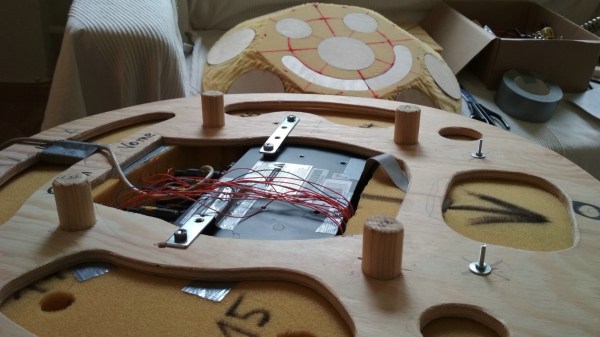
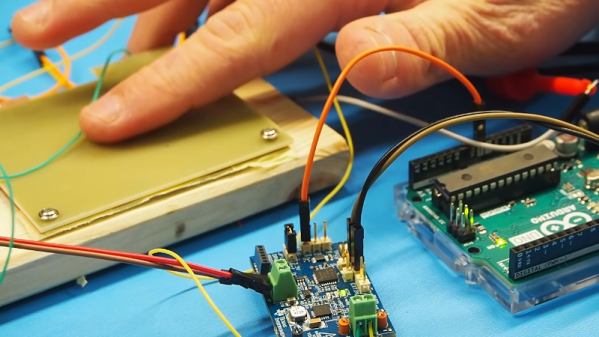
Using the foam salvaged from an old mattress as the core of the handpan, [Deepsoul77] cut a couple of plywood pads as tone fields that will be attached to the foam. Each plywood tone field will then have a piezo element mounted in between to pick up the hand tapping. Picking up the tapping itself and turning it into MIDI signals is then handled by an Alesis trigger interface, which is something you would usually find in electronic drums. From here on forward, it all becomes just a simple USB MIDI device, with all the perks that brings along — like headphone usage or changing MIDI instruments to make anything sound like a trumpet.

Turning what’s essentially a drum kit into a melodic instrument is definitely neat, and to no surprise, we’ve also seen the actual home made drum kit with piezo elements. Of course, using MIDI to quiet down an acoustic instrument isn’t new either, though it also works somewhat the other way around. But then again, it doesn’t always have to be MIDI either.

Remoticon Video: Making Microphones And Finding Sound

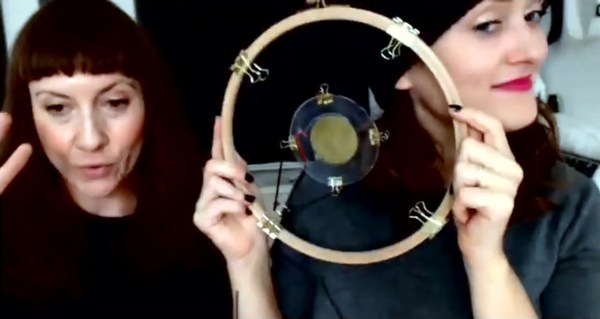
A yogurt lid and embroidery hoop are key components in building this microphone. It’s a super low tech, entry-level project to get into “found sound” and exactly what is needed to start hacking around in the audio world. This workshop presented by Helen Leigh and Robyn Hails shows you how to build a simple microphone and use it as the electronic gateway to all kinds of audio shenanigans.

Key to this build are the piezo element and an amp to process the signals it generates. All other materials are common around most households, but put them together as shown in this live hands-on seminar from the 2020 Hackaday Remoticon, and I think you’ll surprise yourself with how good the thing sounds!

Continue reading “Remoticon Video: Making Microphones And Finding Sound”

Cool Off With A Piezo And A Glass Of Water

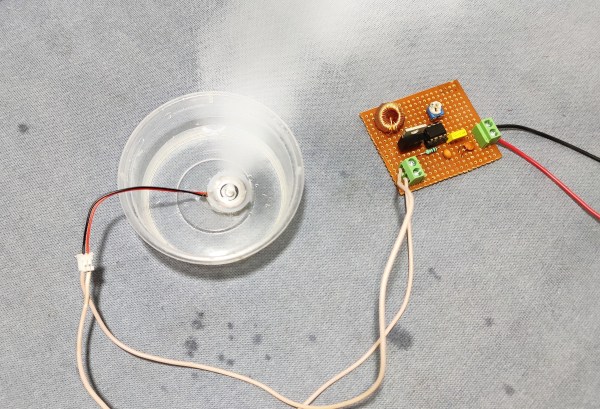
Some cool-mist humidifiers work by flinging water at a vaporizer, but our favorite kind uses a piezoelectric transducer. These work by using high-frequency sound waves to pound the surface of the water with mechanical energy. That energy introduces standing waves that force the water to break apart into a fine mist on the surface of the piezo disk.

The driving circuit for this DIY mist maker uses a 555 to generate 113 KHz, a trimmer potentiometer to fine-tune it, and a MOSFET to amplify the signal. You don’t need much more than that and a handful of passives to recreate this cool junk box experiment, but the spec of the piezo disk is quite important. The circuit is designed for atomizing transducers, which have a resonant frequency of 113 KHz — much higher than your average junk box piezo. Check out the demo and build video after the break.

Atomizing transducers can do way more than than moisten the air for our comfort. They’re not picky about where the water comes from, so if you have enough of them, you can dry a load of laundry in a few minutes.

Continue reading “Cool Off With A Piezo And A Glass Of Water”

Secret Knock Unlocks Door

Watch any movie about the years of prohibition, and you’ll probably see character gain admittance to a speakeasy by using a secret knock on the door. In the old movies, a little sliding door would open so the doorman could check you out and let you in. With [IsmailSan’s] electronic lock, the secret knock automatically unlocks the door. You can see a video of how it works, below.

(Ed Note: Grrr…GitHub repo got pulled between writing and publication. Go check out the in-links in the bottom paragraph if you’re interested in knock-detectors.)

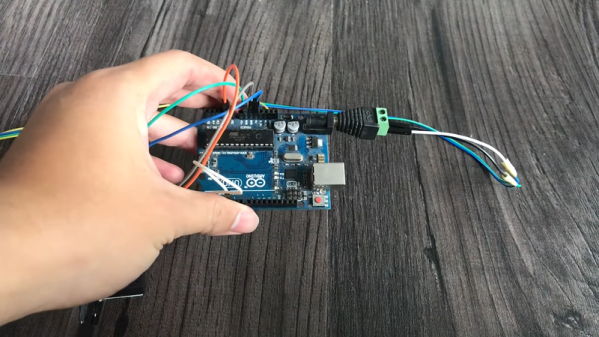
The device uses a piezoelectric speaker to detect the knocking. A speaker is a transducer and like many transducers, it will work — to some extent — in either direction. A servo motor manages the deadbolt. An Arduino runs the whole thing.

Continue reading “Secret Knock Unlocks Door”

This Camera Captures Piezo Inkjet Micro-Drops For DIY Microfluidics

In microfluidics, there are “drop on demand” instruments to precisely deposit extremely small volumes (pico- or nano-liters) of fluid. These devices are prohibitively expensive, so [Kyle] set out to design a system using hobbyist-level parts for under $1000. As part of this, he has a fascinating use case for a specialized camera: capturing the formation and shape of a micro-drop as it is made.

There are so many different parts to this effort that it’s all worth a read, but the two big design elements come down to:

  1. Making the microdrop using a piezo element
  2. Ensuring the drop is made correctly, and visually troubleshooting
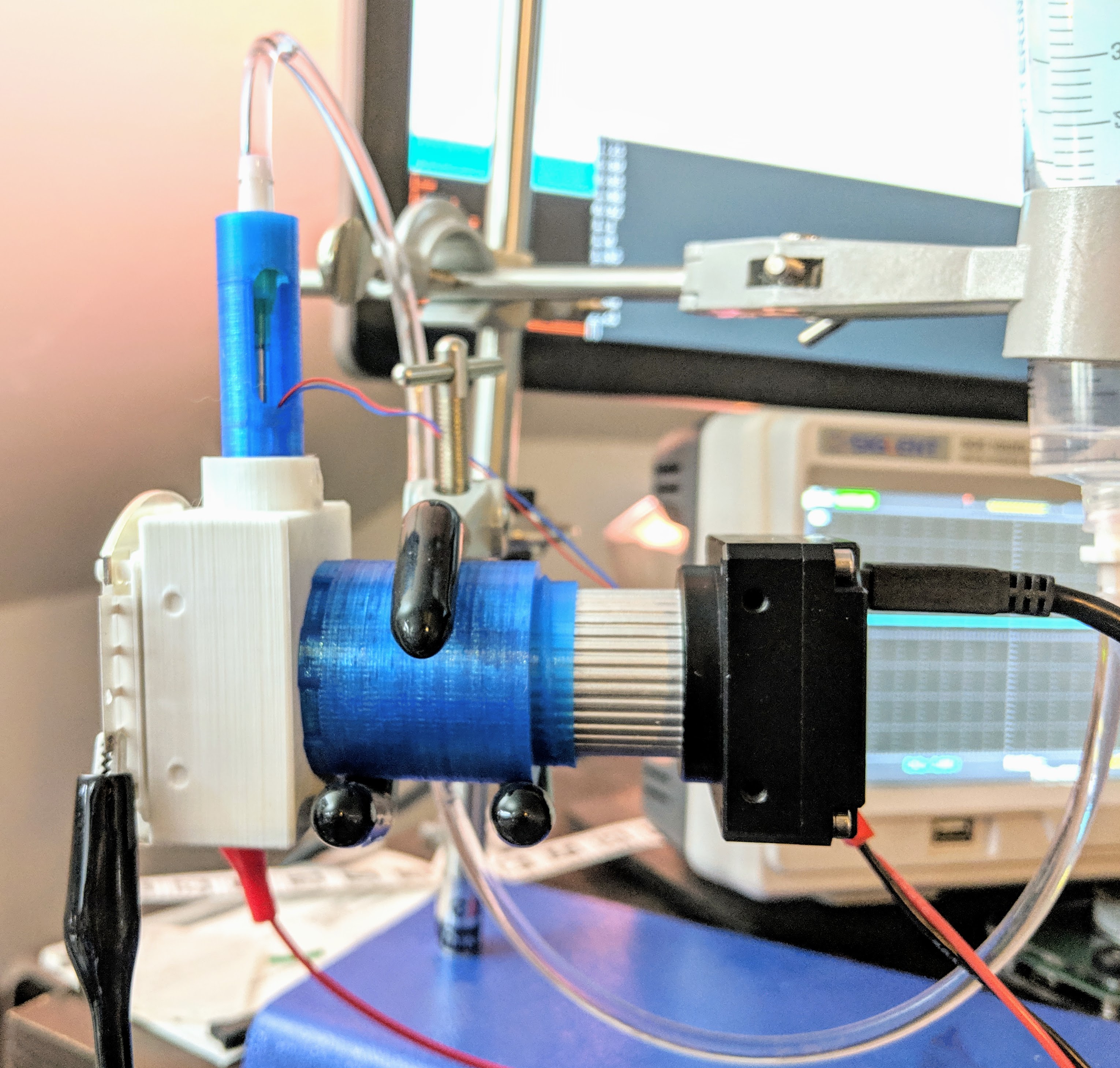
Working prototype. The piezo tube is inside the blue piece at the top. The camera is to the right, and the LED strobe is on the left.

It’s one thing to make an inkjet element in a printer work, but it’s quite another to make a piezoelectric element dispense arbitrary liquids in a controlled, repeatable, and predictable way. Because piezoelectric elements force liquid out with a mechanical motion, different liquids require different drive signals and that kind of experimentation requires a way to see what is going on, hence the need for a drop observation camera.

[Kyle] ended up taking the lens assembly from a cheap USB microscope and mating it to his Korukesu C1 USB Camera with a 3D printed assembly. Another 3D printed enclosure doubles as a lightbox, holding the piezo tube in the center with the LED strobe and camera on opposite sides. The whole assembly had a few false starts, but in the end [Kyle] seems pretty happy with his results. The device is briefly described at a high level here. There are some rough edges, but it’s a working system.

Inkjet technology has been around for a long time (you can see a thirty-plus year old inkjet printer in action here) but it’s worth mentioning that not all inkjet heads are alike. Most inkjet printer heads operate thermally, which means a flash of heat vaporizes some ink to expel a micro-drop. These heads aren’t very suitable for microfluidics because not only do they rely on vaporizing the liquid, but they also don’t work well with anything other than the ink they’re designed for. Piezoelectric print heads are less common, but are more suited to the kind of work [Kyle] is doing.