Spooky Noise Box Plays War Drums

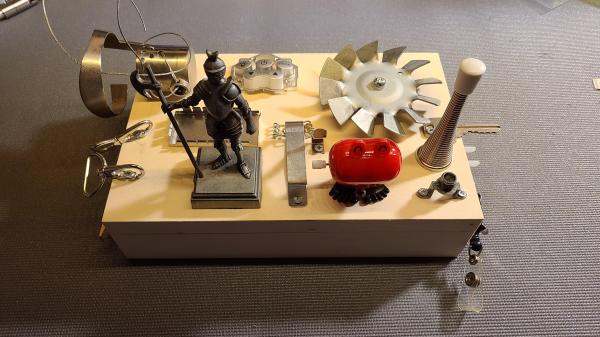
What do you have cooked up to scare trick-or-treaters this Halloween? We humbly suggest adding in some type of noise box, especially one like this offering from [Paisley Computer] that uses reverb and other effects to achieve chilling, thrilling sounds.
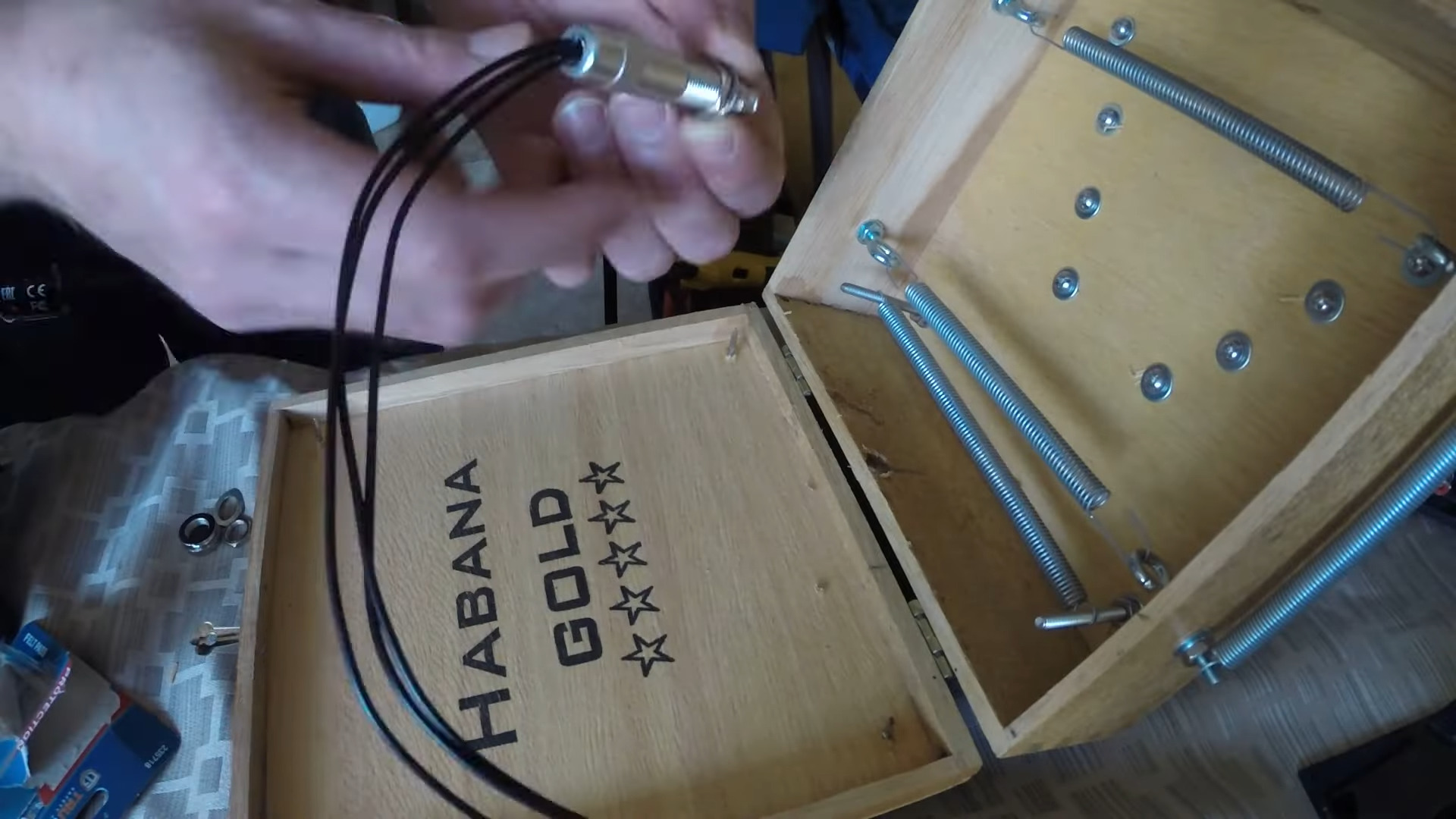
As you can see, this instrument is essentially a bunch of doodads affixed to and through a cigar box. And as you’ll hear in the first video after the break, the various rubber bands make great drum sounds. The springs are nice, too, but our personal favorite has to be the head massager thing. Shhhing!

Inside the box you’ll find a guitar jack and some piezos glued to the underside of the top surface, but you’ll also find springs mounted across the inside that add to the resonance of the cigar box.

You can use either an interface and DAW or an effects pedal chain to really make things freaky, and [Paisley Computer] does a showdown between Focusrite interface versus various stomp pedals in the second video. In the third video, we learn how to make one of our own.

Do you like the idea of a spring reverb? How about a really big one that sounds sort of Satanic?
Continue reading “Spooky Noise Box Plays War Drums”

Spooky Noise Box Has Post-Halloween Potential

There’s more than one way to scare people on Halloween. Sure, there’s always the low-brow jump scare, but that will generally just annoy the person and possibly cause a heart attack. No, what you need is a sustained soundscape of hellish audio. And where does one find hellish audio? Well, you make your own with a spooky-sounds noise box.

And no, we’re not talking about a soundboard that goes ‘boo’ and ‘ooo-OOO-oooh’ and whatnot. This is a full-on DIY instrument that has potential beyond Halloween. Essentially, the wooden box takes input vibrations from various doodads, and these vibrations are picked up by a piezo disk or two glued to the underside of the lid. The piezos are wired up to a 3.5 mm jack, which runs out to the PC and [SvartalfarQc]’s favorite Digital Audio Workstation (DAW). From there, it’s just a matter of playing around with the sounds — looping them, running them through various instrument voices, adding effects, and so on.

We love the the things that [SvartalfarQc] came up with, including a wind-up walking heart thing, a retractable badge holder, and that noise box mainstay, a sproingy doorstop.

We all know piezos are awesome, but have you ever considered that they can be used to digitize old wax cylinder recordings?

Tiny PCB PiezoPiano Plays Just One Octave

Grand pianos are beautiful instruments, but take up altogether too much space. Upright pianos are smaller, but still fairly hefty. When it comes to the PiezoPiano, though, we suspect nobody could complain about its diminutive size. It’s a tiny thing with just one buzzy little octave for your playing pleasure.

The PiezoPiano is a single PCB device with a ATmega4809 running the show. It has eight buttons and eight piezo transducers that give you just one octave’s range on the keyboard. Truth be told, that’s only in one scale; you’re not getting the whole twelve tones of flats and sharps included. And, when we say keyboard, we really mean “tactile buttons.” You get the drift. It’s all assembled in a cute enclosure mimicking the shape of a real grand piano.

Fundamentally, it’s a cute little musical desktoy that reminds us greatly of the Stylophone. Impressively, though, those eight buzzers mean it has eight-note polyphony. That’s nothing to sniff at compared to all the monophonic synths out there. It’s also available on Tindie if you’d like to buy a kit off the shelf. Video after the break.

Continue reading “Tiny PCB PiezoPiano Plays Just One Octave”

Lo-Fi Fun: Beer Can Microphones

Sometimes, you just need an easy win, right? This is one of those projects. A couple months back, I was looking at my guitars and guitar accessories and thought, it is finally time to do something with the neck I’ve had lying around for years. In trying to decide a suitable body for the slapdash guitar I was about to build, I found myself at a tractor supply store for LEGO-related reasons. (Where else are you going to get a bunch of egg cartons without eating a bunch of eggs?) I  noticed that they happened to also stock ammo boxes. Bam! It’s sturdy, it opens easily, and it’s (very) roughly guitar body shaped. I happily picked one up and started scheming on the way home.

Having never built a cigar box guitar before and being of a certain vintage, I’m inclined to turn to books instead of the Internet, so I stocked up from the library. Among my early choices was Making Poor Man’s Guitars by Shane Speal, who is widely considered to be the guru on the subject. In flipping through the book, I noticed the beer can microphone project and was immediately taken by the aesthetic of some cool old 70s beer can with a 1/4″ instrument jack on the bottom, just asking for some dirty blues to be belted into it. I had to build one. Or twelve.

Continue reading “Lo-Fi Fun: Beer Can Microphones”

Hackaday Prize 2022: Ultratower Is A Powerful Gardening Vertical

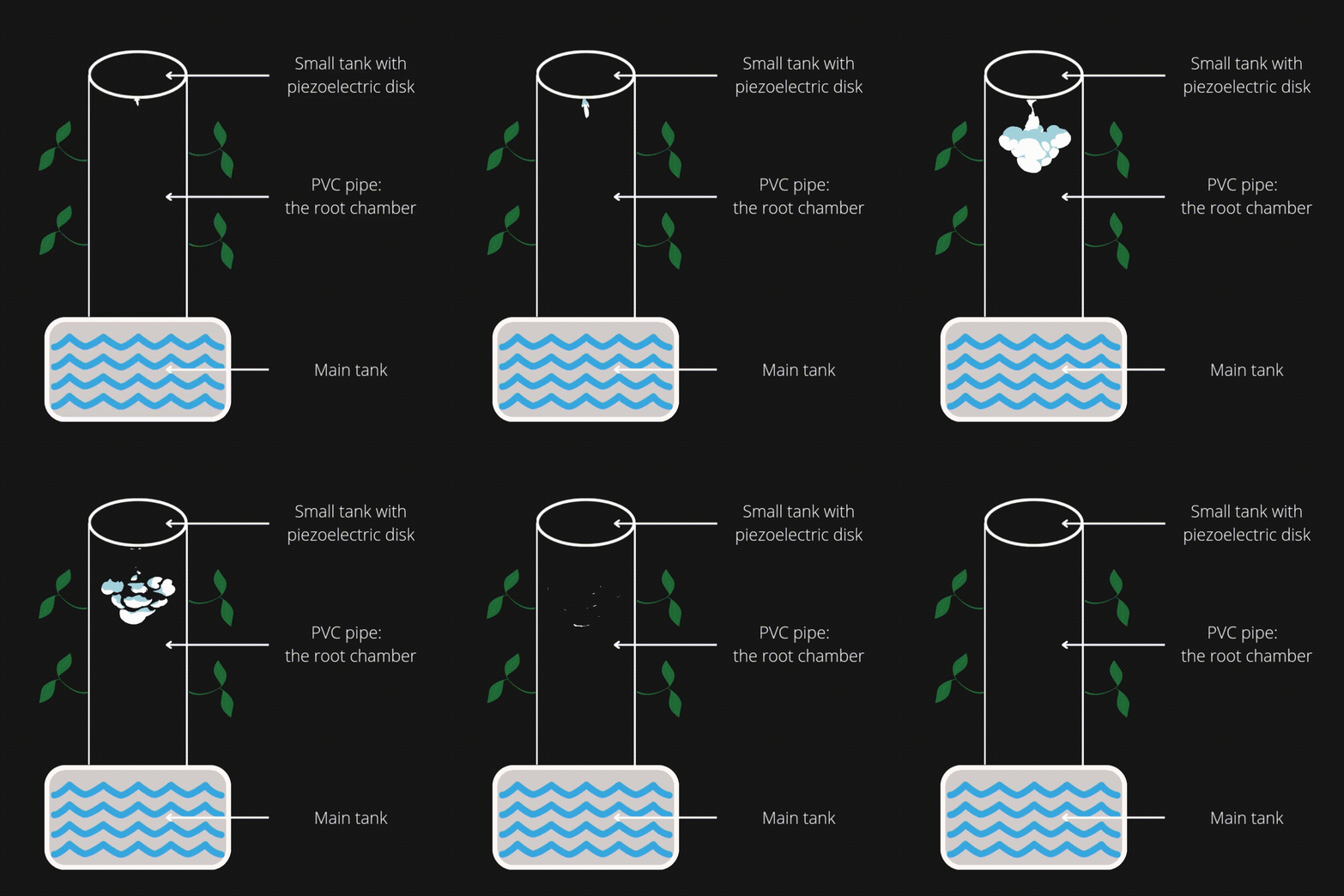
The more people we have on this planet, the more food we need. Naturally, this extends to water, another precious resource that generally plays a part in farming and food production. And honestly, we’d probably all eat a little better if it were really easy to grow healthy things like spinach. Well, that excuse doesn’t work anymore, thanks to [J Gleyzes]’ Ultratower. It’s a simple-to-use hydroponic tower that uses recycled mist to water plants, ultimately saving water in the process.

The ‘ultra’ part is a function of the way mist is created. In this case, it’s done with three piezoelectric disks mounted under a tank in the top of the PVC tube. Stick up to twelve plants in the little cubbies, and their roots will grow down the inside, where they’ll receive a fine shower of water at your command. Water that runs off the roots collects in a small tank at the bottom, where a pump starts the process over again.

At first, [J Gleyzes] had trouble with the piezo disks — using 1.7MHz disks created too much heat, warming the water up to nearly 40°C (104°F). Since cooking the spinach prematurely would be bad, they experimented with other values, finally landing on 108KHz. Be sure to check out the video after the break.

Continue reading “Hackaday Prize 2022: Ultratower Is A Powerful Gardening Vertical”

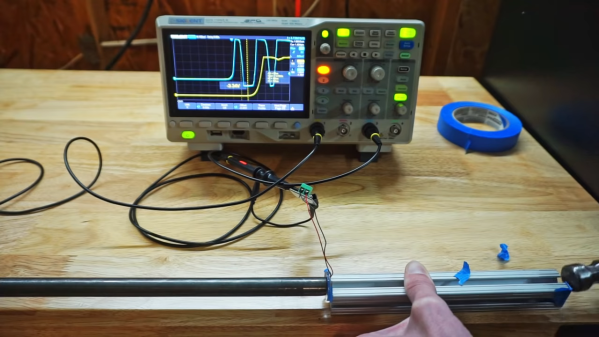
Speed of motion test setup

Simple Setup Answers Complex Question On The Physics Of Solids

Thought experiments can be extremely powerful; after all, pretty much everything that [Einstein] came up with was based on thought experiments. But when a thought experiment turns into a real experiment, that’s when things can get really interesting, and where unexpected insights crop up.

Take [AlphaPhoenix]’s simple question: “Are solid objects really solid?” On the face of it, this seems like a silly and trivial question, but the thought experiment he presents reveals more. He posits that pushing on one end of a solid metal rod a meter or so in length will result in motion at the other end of the rod pretty much instantly. But what if we scale that rod up considerably — say, to one light-second in length. Is a displacement at one end of the rob instantly apparent at the other end? It’s a bit of a mind-boggler.

To answer the question, [AlphaPhoneix] set up a simple experiment with the aforementioned steel rod — the shorter one, of course. The test setup was pretty clever: a piezoelectric sensor at one end of the bar, and a hammer wired to a battery at the other end, to sense when the hammer made contact with the bar. Both sensors were connected to an oscilloscope to set up to capture the pulses and measure the time. It turned out that the test setup was quite a challenge to get right, and troubleshooting the rig took him down a rabbit hole that was just as interesting as answering the original question. We won’t spoil the ending, but suffice it to say we were pleased that our first instinct turned out to be correct, even if for the wrong reasons.

If you haven’t checked out [AlphaPhoenix] yet, you really should. With a doctorate in material science, he’s got an interesting outlook on things, like calculating pi using raindrops or keeping the “ultra” in ultra-high vacuum. Continue reading “Simple Setup Answers Complex Question On The Physics Of Solids”

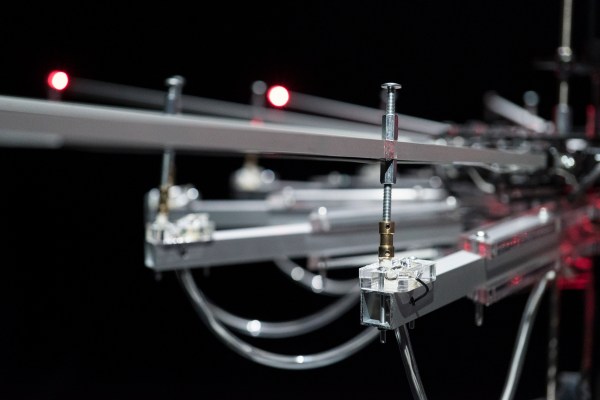
A kinetic art installation with many metal parts

Kinetic Art Installation Brings All The World’s Lightning To One Place

Lightning is a force to be reckoned with: ever since ancient times, humans have been in awe of the lethal power of lightning strikes and the deafening roar of thunder. Quite reasonably, they ascribed these events to acts of angry gods; today, modern science provides a more down-to-earth explanation of the physics involved, and a world-wide network of sensors generates a real-time record of lightning strikes around the globe.

[Dmitry Morozov]’s latest kinetic art installation called Adad is driven by this stream of data. Named after a Mesopotamian god of thunder, it consists of a set of arms that suddenly jerk upwards when a lightning strike is detected anywhere in the world. When an arm falls down again, it strikes a piezo crystal, which generates an electric charge that triggers a bright flash of light as well as a sound effect. Those crystals are pieces of potassium sodium tartrate (also known as Rochelle salt) and were grown specifically for this project. They are housed in plexiglass holders which also provide electrical connections.

Adad‘s spider-like design, its eerie sounds as well as the sudden pops and flashes make this a rather unsettling yet beautiful display of Nature’s violence. And it’s a piece of beauty from an engineering point of view as well: sleek aluminium tubes, servo-driven motion and those transparent crystal holders, all controlled by an Arduino that receives live lightning data through an internet connection.

We’ve seen several types of lightning detectors, usually based on a standard radio receiver or a specialized chip. If you’re interested in growing your own piezo crystals, we’ve covered that too. Continue reading “Kinetic Art Installation Brings All The World’s Lightning To One Place”