Little Lie Detector Is Probably No Worse Than The Big Ones

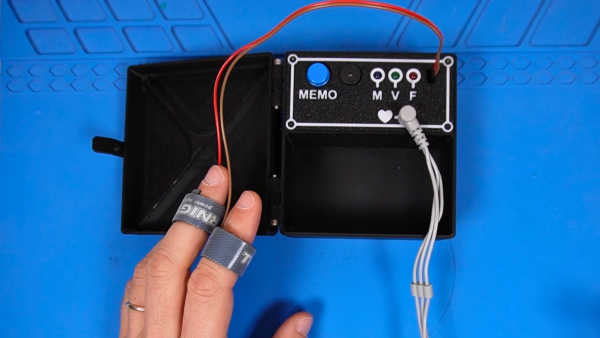
Want to know if somebody is lying? It’s always so hard to tell. [dbmaking] has whipped up a fun little polygraph, otherwise known as a lie detector. It’s nowhere near as complex as the ones you’ve seen on TV, but it might be just as good when it comes to finding the truth.

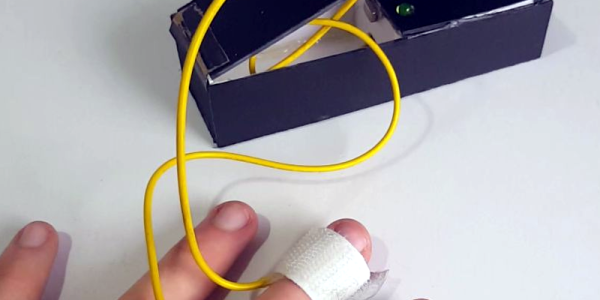
The project keeps things simple by focusing on two major biometric readouts — heart rate and skin conductivity. When it comes to the beating heart, [dbmaking] went hardcore and chose an AD8232 ECG device, rather than relying on the crutch that is pulse oximetry. It picks up heart signals via three leads that are just like those they stick on you in the emergency room. Skin conductivity is measured with a pair of electrodes that attach to the fingers with Velcro straps. The readings from these inputs are measured and then used to determine truth or a lie if their values cross a certain threshold. Presumably, if you’re sweating a lot and your heart is beating like crazy, you’re telling a lie. After all, we know Olympic sprinters never tell the truth immediately after a run.

Does this work as an actual, viable lie detector? No, not really. But that’s not just because this device isn’t sophisticated enough; commercial polygraph systems have been widely discredited anyway. There simply isn’t an easy way to correlate sweating to lying, as much as TV has told us the opposite. Consider it a fun toy or prop to play with, and a great way to learn about working with microcontrollers and biometric sensors.

Continue reading “Little Lie Detector Is Probably No Worse Than The Big Ones”
Arduino Polygraph Shows How It’s Done

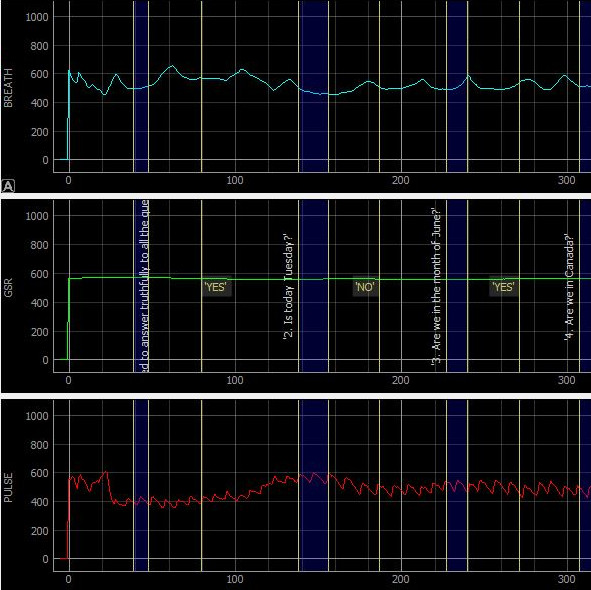
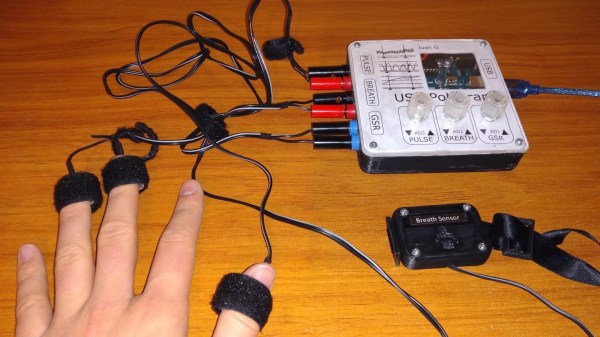
Sometimes, a project comes along that makes a good reference design for anyone doing similar work. In this particular case, it’s a DIY USB polygraph-like machine by [Juangg] using an Arduino and sensors on the hardware side, and a Python front end for data visualization. It’s even complete with 3D printed enclosure and sensor elements.

[Juangg] designed it to use three sensors: a pulse sensor, a breath sensor, and one to measure Galvanic Skin Response (GSR). The pulse sensor uses a piezo element pressed against a fingertip to detect changes in pressure resulting from blood flow. It can be picky about placement, but finding sweet spot can yield remarkably good readings. The breath sensor works on a similar principle but uses a 3D printed fixture to hold the sensor between a strap and the subject’s chest, so that breathing in and out can be detected. The GSR sensor is a voltage divider used to measure small changes in skin conductivity. How well does it all work? That depends on what one is looking to get out of it, but the documentation and design files are available from the project page and the GitHub repository if anyone wants a reference for similar work.

The polygraph may have a mixed reputation, but it makes a good project that demonstrates just how messy biometrics can be from an engineering perspective. And in case you missed it, here’s a reminder that Wonder Woman and the polygraph have much more in common than you might realize.

Wonder Woman And The Real Lasso Of Truth

You might think it is strange that a story about technology would start off talking about Wonder Woman. When you realize the technology in question is a lie detector, you might think, “Oh, that’s right. Wonder Woman had the lasso of truth, so this is just a lame association.” You might think that, but you’d be wrong. Turns out, Wonder Woman and real life polygraphs have a much deeper connection; both the polygraph and Wonder Woman share a common creator.

It makes a good story to say that William Marston — an internationally famous psychologist — created the polygraph, but as you might expect it wasn’t the result of a single person’s effort. However, Marston played a key role and also was behind promoting the technology. So, too, even though he is credited as Wonder Woman’s sole creator, the truth is probably a bit more complex.

Continue reading “Wonder Woman And The Real Lasso Of Truth”

Old fashioned polygraph

Retro-Style DIY Polygraph: Believe It Or Not

A polygraph is commonly known as a lie detector but it’s really just a machine with a number of sensors that measure things like heart rate, breathing rate, galvanic skin response and blood pressure while you’re being asked questions. Sessions can be three hours long and the results are examined by a trained polygraph examiner who decides if a measured reaction is due to deception or something else entirely. Modern polygraphs feed data into a computer which analyses the data in real-time.

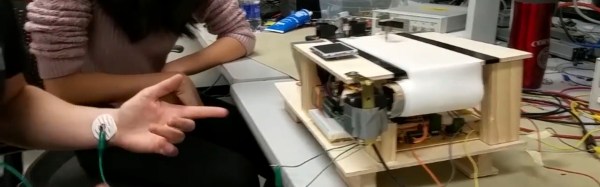
Cornell University students [Joyce Cao] and [Daria Efimov] decided to try their hand at a more old fashioned polygraph that measures heart and breathing rates and charts the resulting traces on a moving strip of paper as well as a color TFT display. They had planned on measuring perspiration too but didn’t have time. To measure heart rate, electrodes were attached to the test subject’s wrists. To measure breathing they connected a stretch sensor in the form of a conductive rubber cord around three inches long to a shoelace and wrapped this around the test subject’s abdomen.

While the output doesn’t go into a computer for mathematical analysis, it does go to a PIC32 for processing and for controlling the servos for drawing the traces on the paper as well as displaying on the TFT. The circuit between the breathing sensor and the PIC32 is fairly simple, but the output of the heart rate electrodes needed amplification. For that they came up with a circuit based off another project that had a differential amplifier and two op-amps for filtering.

Since parts of the circuit are attached to the body they made some effort to prevent any chance of electrocution. They used 12 volts, did not connect the test subject to power supply chassis ground, and tested the heart rate electrodes with a function generator first. They also included DC isolation circuitry in the form of some resistors and capacitors between the heart rate electrodes and the amplifier circuit. You can see these circuits, as well as a demonstration in the video below. The heart rate output looks a little erratic, no surprise given that the body produces a lot of noise, but the breathing trace looks very clear.

Continue reading “Retro-Style DIY Polygraph: Believe It Or Not”

Arduino Detects Pants On Fire

Hard as it is to imagine, lie detectors have been sold as children’s toys for a number of years. A simple battery-operated device clipped to your fingers and would show the conductivity of your skin. The concept — which is probably not very reliable — observers that lying causes you to imperceptibly sweat which causes a sudden increase in your skin’s conductivity. These cheap toys would have a meter and you’d note the meter deflection to determine if the subject was lying.

You can debate the amusement value of interrogating your friends, perhaps, but they were pretty common and still exist (including some that shock you if they detect you are lying). Seventeen-year-old [BuildIt] has his own modern take on this classic device using — what else? — an Arduino. You can see a video of the device below.

Continue reading “Arduino Detects Pants On Fire”