WSPRing Across The Atlantic

wspr

Host of the Soldersmoke podcast, [Bill Meara], contributed this guest post.

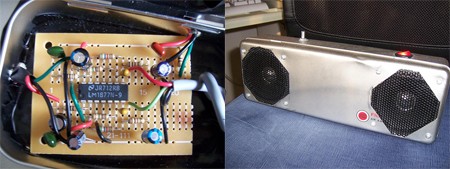
WSPR is a new communications protocol written by radio amateur and Nobel Prize winner [Joe Taylor]. Like the very slow QRSS system described in a previous post, WSPR (Weak Signal Propagation Reporter) trades speed for bandwidth and allows for the reception of signals that are far below the level of radio noise. WSPR takes “low and slow” communications several important steps ahead, featuring strong error correction, high reliability, and (and this is really fun part) the automatic uploading (via the net) of reception reports — [Taylor]’s WSPR web page constantly gathers reports and produces near real-time Google maps of showing who is hearing who. The WSPR mode is very hack-able: [Bill Meara] is running a 20 milliwatt homebrew transmitter from Rome, Italy that features an audio amplifier from a defunct computer speaker pictured below. This contraption recently crossed the Atlantic and was picked up by the Princeton, New Jersey receiving station of WSPR’s esteemed creator, [Joe Taylor]. Continue reading “WSPRing Across The Atlantic”

WiFi Streaming Radio Update

[flickr video=3238566442]

Since our last post about his WiFi Streaming Radio Project, [Jeff] has been hard at work to release part 8 of the project where he adds tuning control to the radio. Interestingly enough, the addition of the tuning control only requires a potentiometer and the completed AVR LCD board from part 7. After wiring the potentiometer to the analog to digital converter on the AVR and adding a few lines of code, the radio can now be tuned quickly and easily. In addition to thoroughly explaining the hardware changes, [Jeff] details the configuration changes required to the OpenWRT framework so that bidirectional communication between the router and AVR is possible, allowing the tuner to function properly. Be sure to check out the video above to see the tuner in action.

Hack A Walkie Talkie For Music

radio1

[nepheron] shows us how he hacked his walkie talkie to broadcast music. While using this to broadcast music is possibly illegal, it could be used to make actual upgrades to your system as well. He has replaced the microphone input with a headphone cable and extended the antenna. It is only mono, and he states it will only run for a minute before shutting off, so there is definitely room for improvement.

WiFi Streaming Radio

wifiradio

[Jeff] is continuing to work on his WiFi streaming radio project and is now into part 7. The reason it’s taken so long is because he’s bothering to document every single piece of the system instead of assuming too much of the reader. The core of the system is an Asus WL-520GU wireless router. It is supported by OpenWRT and has a USB port for use with an external audio card. mpd, Music Player Daemon, is used for playback. This latest part features adding an LCD display for the current track. The router board already has points for the serial port, so it’s just a matter of adding an AVR to talk to the LCD. The next step is building a simple user interface and then boxing everything up. You can view a video of the display below.

Continue reading “WiFi Streaming Radio”

Cigarette Tin Amp


We’re a little confused: [xXxMrCarlosxXx] built an amp out of a cigarette tin and calls it a Mobile Oppression Unit, but we thought all mobile oppression came in the form of giant, invincible crab-shaped palaces. In any case, or more specifically, in a repurposed Lucky Strikes case, he used an mp3 player, some speakers from a garage sale, and a bread board packing an LM1877N-9 chip “optimized for loudness” to construct a great-looking, compact boom box. Check out his Flickr stream at the read link and begin oppressing your neighbors with sheer volume today.

Non-destructive Breakdown Voltage Tester


This applies more to older vacuum technology than your average solid state hardware, but [Richard] put together an interesting project. It’s designed to test a component for its breakdown voltage without destroying it. The general idea of the ‘BVT’ is to increase the voltage applied to a device until some current leakage is detected. Of course, any device that includes notes on probable arc length in relation to kilovolts is awesome by definition.

PCB Milling Hell Sunday Extra


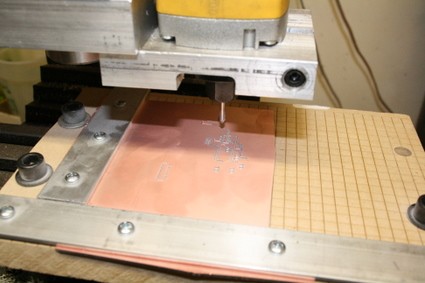
I’ve spent about 18 of the last 24 hours working on milling a PC board for my upcoming how-to. So far I’ve murdered several copper clad boards, built a hold down table, redesigned the board in eagle at least five times and snapped off a $15 half round engraving bit.

If you’re wondering, my new board milling table is a piece of MDF that I laser etched a .25″ grid onto, then added some aluminum strips to act as hold-downs. On the side of the strip opposite the board, I put thin slices of PC board to level out the hold downs. As usual, I’m building the board in eagle. To turn the board into something the mill can handle, I’m using pcb-gcode, a nice little g-code generation tool for eagle. I may switch methods later, but if I can get the settings tweaked, it’ll make my design to board milling process very fast.

[Scott] sent in the beginning of his attempt to build a frequency detector. He’s started out with just simple LCD matrix. Nothing intensely interesting just yet, but I like it when people send in stuff they’re working on.
If you haven’t checked out the Arduino yet, do it. It’s the easiest micro controller dev platform I’ve seen. If you’ve got one, now you can hook up a Wii-Nunchuck to it. If you like smaller and cheaper, check out [ladyada]’s boarduino.

[eliot] wanted me to mention this video on hacking drive through speakers. It’s a bit cheesy – and all I could think of was Thunder Run – where the geek character swapped the crystals in the CB radios. (Warning, The FCC might have some expensive words for you if you get caught.) Update: this is what you get if you don’t watch the entire video and catch the joke about taking apart toasters.

Tomorrow I should be picking out some winners for my laser etched laptop (or whatever) offer. You can still win some free etching time! Just send in a tip! The winners are selected from the ones that get published on Hack-A-Day.