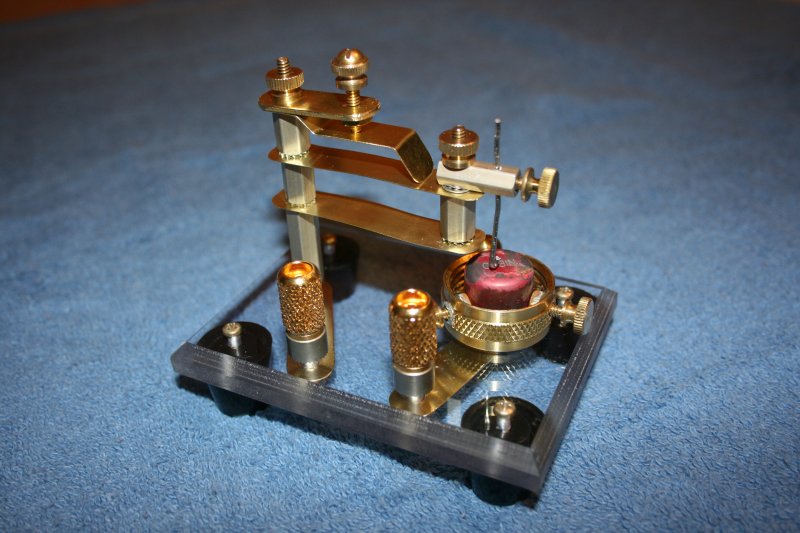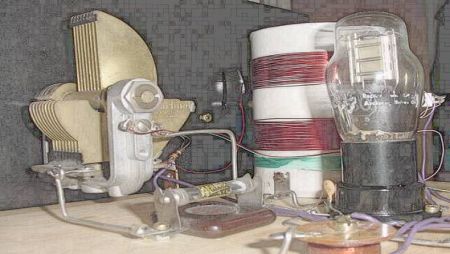
This applies more to older vacuum technology than your average solid state hardware, but [Richard] put together an interesting project. It’s designed to test a component for its breakdown voltage without destroying it. The general idea of the ‘BVT’ is to increase the voltage applied to a device until some current leakage is detected. Of course, any device that includes notes on probable arc length in relation to kilovolts is awesome by definition.
radio570 Articles
PCB Milling Hell Sunday Extra

I’ve spent about 18 of the last 24 hours working on milling a PC board for my upcoming how-to. So far I’ve murdered several copper clad boards, built a hold down table, redesigned the board in eagle at least five times and snapped off a $15 half round engraving bit.
If you’re wondering, my new board milling table is a piece of MDF that I laser etched a .25″ grid onto, then added some aluminum strips to act as hold-downs. On the side of the strip opposite the board, I put thin slices of PC board to level out the hold downs. As usual, I’m building the board in eagle. To turn the board into something the mill can handle, I’m using pcb-gcode, a nice little g-code generation tool for eagle. I may switch methods later, but if I can get the settings tweaked, it’ll make my design to board milling process very fast.
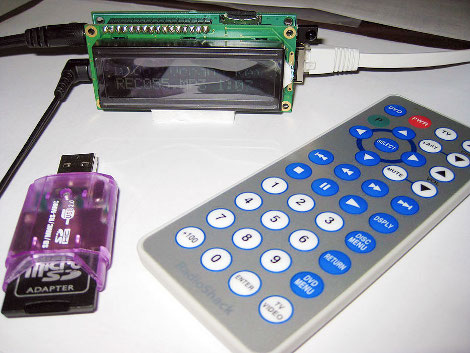
[Scott] sent in the beginning of his attempt to build a frequency detector. He’s started out with just simple LCD matrix. Nothing intensely interesting just yet, but I like it when people send in stuff they’re working on.
If you haven’t checked out the Arduino yet, do it. It’s the easiest micro controller dev platform I’ve seen. If you’ve got one, now you can hook up a Wii-Nunchuck to it. If you like smaller and cheaper, check out [ladyada]’s boarduino.
[eliot] wanted me to mention this video on hacking drive through speakers. It’s a bit cheesy – and all I could think of was Thunder Run – where the geek character swapped the crystals in the CB radios. (Warning, The FCC might have some expensive words for you if you get caught.) Update: this is what you get if you don’t watch the entire video and catch the joke about taking apart toasters.
Tomorrow I should be picking out some winners for my laser etched laptop (or whatever) offer. You can still win some free etching time! Just send in a tip! The winners are selected from the ones that get published on Hack-A-Day.
Build Your Own GPS And GLONASS Receiver

[superlopez] sent in this detailed article (mirrored here and here) which describes how to build a GPS and GLONASS (the Russian version of GPS) receiver. The resulting device is gigantic compared to one of those tiny bluetooth USB GPS units, but the ability to build one’s own receiver is one of those post-apocalyptic skills I sure would like to have. The creator of the article [Matjaz Vidmar] aka [S53MV] also has pages on Packet-Radio (PKT) transceiver improvements (PKT gets my vote for the best post-apocalyptic technology, and the only believable technology featured in the Transformers movie), and a more sophisticated homemade frequency counter than the one featured earlier this summer.
In 2005 we featured a from-scratch GPS receiver as well, thought the project site seems to be down. If your GPS unit just needs a better antenna, check out [Will]’s how-to from last year.