Build A Better Mousetrap… But It Better Be Better!

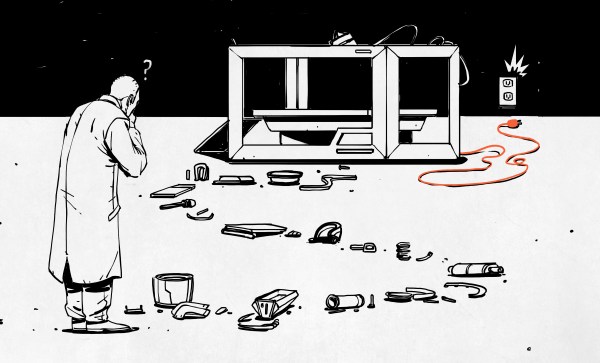
As creative problem solvers, we like to “think outside the box,” and we should strive for that. But what happens if your strange idea isn’t kept in check by cooler heads? There is a real danger — especially if you work alone — to falling so in love with your idea, that you lose sight of what it really means to be better.

Case in point. The self-parking car. Well, not the modern variant, which seems to work pretty well. But did you know that the self-parking car was invented in the 1930s and used an extra fifth wheel? Hard to imagine? See the video below. History tells us that the idea didn’t catch on.

Continue reading “Build A Better Mousetrap… But It Better Be Better!”

Don’t Believe Everything You Read: The Great Electric Toaster Hoax

We’ve all looked up things on Wikipedia and, generally, it is usually correct information. However, the fact that anyone can edit it leads to abuse and makes it somewhat unreliable. Case in point? The BBC’s [Marco Silva] has the story of the great online toaster hoax which erroneously identified the inventor of the toaster with great impact.

You should read the original story, but in case you want a synopsis, here goes: Until recently, the Wikipedia entry for toasters stated that a Scottish man named Alan MacMasters invented the electric toaster in the 1800s. Sounds plausible. Even more so because several books had picked it up along with the Scottish government’s Brand Scottland website. At least one school had a day memorializing the inventor and a TV show also honored him with a special dessert named for Alan MacMasters, the supposed inventor. Continue reading “Don’t Believe Everything You Read: The Great Electric Toaster Hoax”

In Our Own Image: Do We Need Humanoid Robots?

Science fiction is full of things you don’t want to think too hard about. Why do starships with transporters have brigs with forcefields? Why not just beam a prisoner into an enclosed space?  Why do Cylons fly ships with human controls? Why not have a plug in their… well, you get the idea. For that matter, why do Cylons (and Kaylons, and Gort) even look human at all? Why aren’t some Cylons just ships?

Of course, the real reason is so we can identify with them and actors can play them with some cosplay gear and makeup. But real-life robots that are practical rarely look like humans at all.

No one is going to confuse a robot factory arm or a Roomba with a person, yet they are perfectly suited for their purpose. Yet we are fascinated with human-looking robots and continue to build them, like Nadia from IHMC Robotics in the video below. Continue reading “In Our Own Image: Do We Need Humanoid Robots?”

Publish Or Perish: Data Storage And Civilization

Who do you think of when you think of ancient civilizations? Romans? Greeks? Chinese? India? Egyptians?  What about the Scythians, the Muisca, Gana, or the Kerma? You might not recognize that second group as readily because they all didn’t have writing systems. The same goes, to a lesser extent, for the Etruscans, the Minoans, or the inhabitants of Easter Island where they wrote, but no one remembers how to read their writing. Even the Egyptians were mysterious until the discovery of the Rosetta stone. We imagine that an author writing in Etruscan didn’t think that no one would be able to read the writing in the future–they probably thought they were recording their thoughts for all eternity. Hubris? Maybe, but what about our documents that are increasingly stored as bits somewhere?

Continue reading “Publish Or Perish: Data Storage And Civilization”

Unintentional Emissions

First, it was the WiFi router: my ancient WRT54G that had given me nearly two decades service. Something finally gave out in the 2.4 GHz circuitry, and it would WiFi no more. Before my tears could dry, our thermometer went on the fritz. It’s one of those outdoor jobbies that transmits the temperature to an indoor receiver. After that, the remote for our office lights stopped working, but it was long overdue for a battery change.

Meanwhile, my wife had ordered a new outdoor thermometer, and it too was having trouble keeping a link. Quality control these days! Then, my DIY coffee roaster fired up once without any provocation. This thing has worked quasi-reliably for ten years, and I know the hardware and firmware as if I had built them myself – there was no way one of my own tremendously sophisticated creations would be faulty. (That’s a joke, folks.) And then the last straw: the batteries in the office light remote tested good.

We definitely had a poltergeist, a radio poltergeist. And the root cause would turn out to be one of those old chestnuts from the early days of CMOS ICs – never leave an input floating that should have a defined logic level. Let me explain.

The WRT54G was the hub of my own home automation system, an accretion of ESP8266 and other devices that all happily speak MQTT to each other. When it went down, none of the little WiFi nodes could boot up right. One of them, described by yours truly in this video, is an ESP8266 connected to a 433 MHz radio transmitter. Now it gets interesting – the thermometers and the coffee roaster and the office lights all run on 433 MHz.

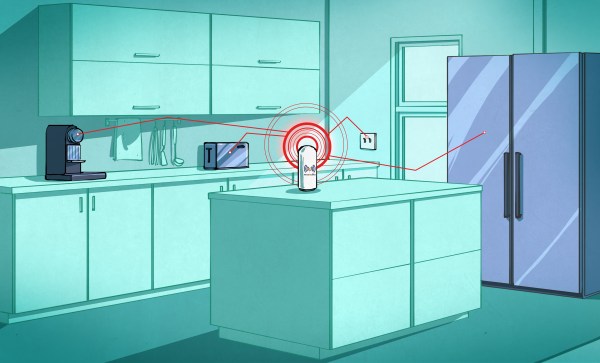
Here’s how it went down. The WiFi-to-433 bridge failed to connect to the WiFi and errored out before the part of the code where it initialized GPIO pins. The 433 MHz transmitter was powered, but its digital input was left flopping in the breeze, causing it to spit out random data all the time, with a pretty decent antenna. This jammed everything in the house, and apparently even once came up with the command to turn on the coffee roaster, entirely by chance. Anyway, unplugging the bridge fixed everything.

This was a fun one to troubleshoot, if only because it crossed so many different devices at different times, some homebrew and some commercial, and all on different control systems. Until I put it together that everything on 433 MHz was failing, I hadn’t even thought of it as one event. And then it turns out to be a digital electronics classic – the dangling input!

Anyway, hope you enjoyed the ride. And spill some copper for the humble pull-down resistor.

A Love Letter To Small Design Teams, And The B-52

The true measure of engineering success — or, at least, one of them — is how long something remains in use. A TV set someone designed in 1980 is probably, at best, relegated to a dusty guest room today if not the landfill. But the B-52 — America’s iconic bomber — has been around for more than 70 years and will likely keep flying for another 30 years or more. Think about that. A plane that first flew in 1952 is still in active use. What’s more, according to a love letter to the plane by [Alex Hollings], it was designed over a weekend in a hotel room by a small group of people.

A Successful Design

One of the keys to the plane’s longevity is its flexibility. Just as musicians have to reinvent themselves if they want to have a career spanning decades, what you wanted a bomber to do in the 1960s is different than what you want it to do today. Oddly enough, other newer bombers like the B-1B and B-2 have already been retired while the B-52 keeps on flying.

Continue reading “A Love Letter To Small Design Teams, And The B-52”

Floppy Disk Sings: I’m Big In Japan

The other day, a medical office needed my insurance card. I asked them where to e-mail it and they acted like I had offered them human flesh as an appetizer. “We don’t have e-mail! You have to bring it to us in person!” They finally admitted that they could take a fax and I then had to go figure out how to get a free one page fax sent over the Internet. Keep in mind, that I live in the fourth largest city in the United States — firmly in the top 100 largest cities in the world. I’m not out in the wilderness dealing with a country doctor.

I understand HIPAA and other legal and regulatory concerns probably inhibit them from taking e-mail, but other doctors and health care providers have apparently figured it out. But it turns out that the more regulations are involved in something, the more behind-the-times it is likely to be.

Continue reading “Floppy Disk Sings: I’m Big In Japan”