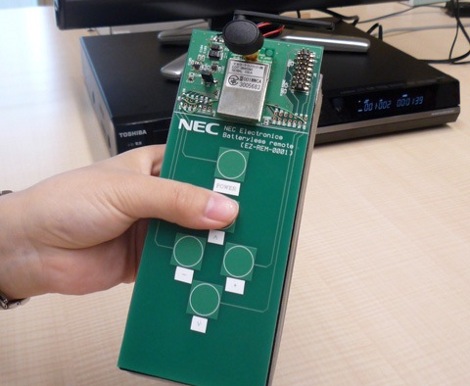
Remote Uses No Batteries

How often do you change the batteries in your television remote control?  Yeah, basically never. But that’s a tribute to how efficient the device is and not a reason to overlook this development. NEC is showing off a remote control that uses no batteries. Power is generated using the piezo effect that occurs when a button is pushed. That is to say, when a crystal is compressed it emits a tiny bit of electricity which is harnessed and used to power this device. This is the same principle that is used in the electricity producing sidewalks tested in Japan.

It’s pretty phenomenal that they can run the device using this method. Right now there’s only a handful of buttons but we’re sure there’ll be advances in the technology. There’s a ton of use for this if it can be miniaturized. It is using radio frequency instead of infrared, making it a useful development in wireless doorbells, garage door openers, key-less entry fobs for your car, and many more applications.

[Thanks das_coach]

Apple Remote Arduino Shield

arduino-apple-remote-shield

[Computergeek] made an Arduino Shield in order to use it as an Apple remote. We like the construction technique that he used; taking perf-board and soldering the circuit and using stripped wire to interface with the pin sockets on the Arduino. He’s written the code needed to function as an Apple Remote but this shield has a lot more potential. This is an excellent opportunity to delve into the different IR protocols out there and create a universal remote for all of your random devices. We’d also want to give it a try as a TV-B-Gone.

The parts are easy to find or salvage without putting in an order.  We’re not certain about his design, he should probably have invited a resistor to the party the two IR LEDs are having.

TV-B-Gone-zilla! Rawr!

tv-zilla

TV-B-Gone: antisocial nuisance or harmless prank? Whatever your feelings, there’s no denying this device has become a staple of the DIY hacking crowd, as evidenced by the countless derivatives since hatched. This latest mutation crushes them all.

[manekinen] from the Polish electronics blog Elektroda (“Electrode”) wasn’t satisfied with high-power TV-B-Gone designs using multiple 5mm infrared LEDs, so he created his own using a single one-Watt monster. The device is concealed in an ordinary flashlight casing, making it somewhat inconspicuous. A custom PCB containing an ultra-minimalist version of the TV-B-Gone circuitry sits just behind the reflector. The choice of reflectors determined maximum distance vs. coverage…they opted for distance. Specific figures aren’t given, but we estimate this thing could shut off televisions on Mars.

The original article (Polish or Google-ized English) includes construction photos and an archive (.rar) of project files including Eagle schematics and C source code.

Would it be totally irresponsible to mention there’s now a 3-Watt version of this LED? We’re just sayin’.

[thanks RicoElectrico]

Garage Door… Packet Sniffer

Some type of logger or sniffer exists for almost every form of electronic communication. Your keystrokes, phone conversations, and wireless networks could all be monitored. In this awesome proof-of-concept project, [James] expanded that array to include garage door openers. After receiving a piece of chain mail which stated that criminals have the technology to record any remote code and play it back, [James] wondered if he could build such a device that would work on at least his opener model. Continue reading “Garage Door… Packet Sniffer”

Add IR Control To Your WiFi Router

wrt54g_ir_receiver

[Craig] wanted to use Boxee on his TV but his computer was in a different room. He rigged up a rather dubious method of delivering the A/V signal (this is a hack in the most guttural sense). More interesting to us is his solution for a remote control interface. We’re familiar with building USB connected infrared receivers but [Craig] decided to patch one into the serial connection on his Linksys WRT54G router. Continue reading “Add IR Control To Your WiFi Router”

Homemade UAV

uav

[Terence Bordelon] sent in his impressive UAV (Unmanned Arial Vehicle). The hack is a culmination of his other projects. It can be turned to fully automatic at the flip of a switch. It will fly itself to gps way points, land, and take off. The UAV has a range of 100km thanks to his home built RF Unit which runs on ham bands. The brains of the setup is his custom IMU (Inertial Measurement Unit). The unit is controlled by his ground station which either allows him to fly it normally or toggle through the various modes.  [Terrence] is also a game developer and has worked on many popular titles such as Zoo Tycoon 2 and Ratchet and Clank.

Head Bangers Beware: Motion Sensing Headphones

tiltphones

The iPhone doesn’t have the market cornered on the use of accelerometers. The tiltphone project incorporates a three axis accelerometer into a set of headphones transforming them into a remote control for an iPod. A PIC16F690 reads in data from the analog sensor, translates specific movements into commands, and like the Arduino iPod Remote from last week, relays them to an iPod via the Apple Accessory Protocol. A quick nod left or right skips tracks, holding a sideways nod controls the volume, and setting the headphones down pauses.

This project is a bit older but we’re glad [anon] tipped us off as we hadn’t seen it before. There doesn’t seem to be any code or schematics available but because the Apple Accessory Protocol is known, it’s only a matter of working out how to interpret the sensor data. There is video after the break and if you pull off this hack yourself be sure to send in details for a followup.

Continue reading “Head Bangers Beware: Motion Sensing Headphones”