Displaying Video And Gifs On RGB LED Matrices

led_matrix

[Mathieu] was on holiday in China and picked up some fun toys while perusing the numerous electronics markets there. The most interesting things he discovered were a pair of RGB LED matrices. They came in two different flavors, one made for indoor and one for outdoor displays, sporting a 64×32 and 32×16 resolution, respectively.

If you’ve read his blog before you know he is a big fan of LED matrices, so it’s only natural that bought a whole bunch of them and started experimenting once he got home. Using the same Atmel FPSLIC LED matrix control board he showed off in this previous hack, he was able to get the LED matrices up and running in no time. He adapted his webcam project to utilize the new panels, and he added a whole new feature as well. Via MatLab, he can now display any sort of animated gif on the panels, as you can see in the video below. The panels look great, and if we had a few of these around, there’s no doubt we would probably play this video on infinite repeat.

He says that the despite their somewhat questionable origins, the panels are of top notch quality, and he is willing to organize some sort of group buy if others are interested.

Continue reading “Displaying Video And Gifs On RGB LED Matrices”

Awesome Custom Disco Basement

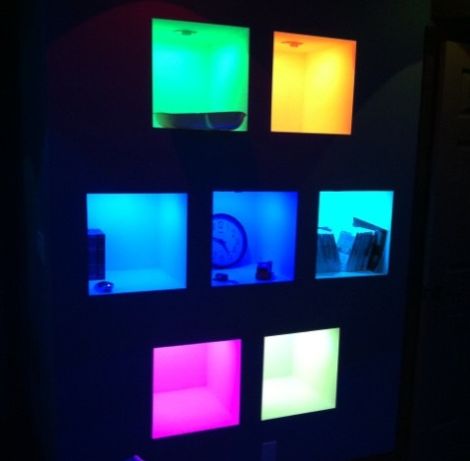
led_shelves

[Evan] is one of those neighbors you only wish you had.

His neighbors were renovating their basement for use as home theater, and he stopped by to check out how things were coming along. While there, he suggested they add some LED lighting to their shelving unit to make them pop. His neighbors were game, so he sourced some cheap RGB LEDs online and began working on the circuits and firmware needed to control the lights. His neighbors wrote some custom software that interfaces with iTunes to create a neat visualization in the shelving unit whenever music is played.

Once everything was complete, his neighbors informed him that they wanted an additional 20 overhead can lights and a set of 4 wall sconces wired up as well. Needless to say he was pretty excited, so he got busy wiring up the remainder of the basement.

He pushed the installation’s PIC microcontroller about as far as he possibly could, resulting in the awesome show seen in the video below.

Needless to say, it’s pretty impressive, though we wish we could have a peek at the code used to run everything. Wink, wink, nudge, nudge.

Continue reading “Awesome Custom Disco Basement”

Designing A Controllable RGB LED Driver Board

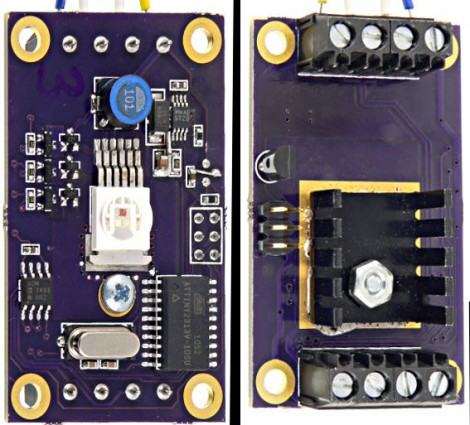
[Paul] wrote in to tell us about this LED driver board he’s been working on with a few friends. The collaborators had been unhappy with the Lumens per Watt ratings (or lack of a rating) on low powered LEDs and set out to find a better solution. They picked up the beefy ASMT-MT00 which houses all three diodes in one package, with all the pins on one side of the surface mount package, a heat dissipating tab on the other side, and pushed 30 Lumens per Watt. With that in hand they set out to design a host board for the blindingly bright light.

The board includes a heat sink on the underside. To drive the LEDs [Paul] sourced an LM3407 constant current driver. The manufacture recommends using one of these chips for each of the colors in the LED package. [Paul] built a circuit that allows him to route power around each LED, making the system work with just one low-side driver. From there, an ATtiny2313 provides addressable control via the RS485 protocol. Screw terminals on either end of the PCB allow this to be chained along with other modules, and they’ve already worked out a basic PureData program that will be able to address multiple boards once they finish manufacturing them.

Flower With PCB Pot And LED Blossoms

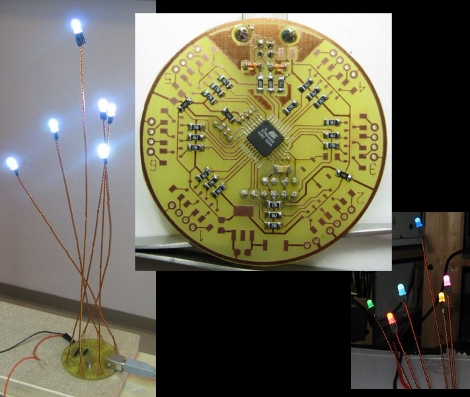
[Johannes Agricola] recently held a workshop at the Peace Mission in Goettingen, Germany where he shared his RGB LED flowers. The small round PCB hosts an ATmega88 microcontroller which is running the V-USB stack so that the unit can be controlled by a computer. Each flower blossom is an RGB LED connected with four enameled wires which, when twisted together, make up the stem of the flower. [Johannes] took tons of pictures during the assembly while offering soldering advice along side the illustrations. The PCB is single-sided helping make this a great project for someone trying out surface mount component soldering for the first time. Or if you want something a little more free-formed try out this lemon-juice powered LED flower.

Meter Clock With Pleasing Design Considerations

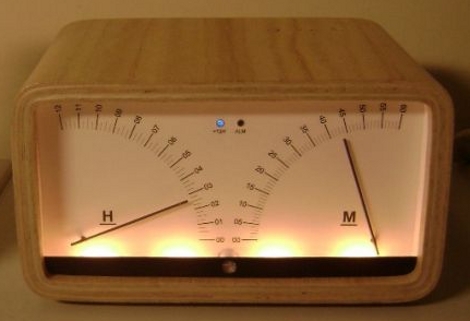
[AndyO] embraced his inner geek by building this meter clock. It exhibits a lot of features that you’d want to see in a home-built timepiece, include over-complexity, abundant features, and RGB LEDs. We’re fascinated by the design he put into this. For instance, the two indicator LEDs on the clock face are not poking through the surface, but use brass tubes as light pipes. Also, the three buttons on the top are almost indistinguishable, and have an RGB back light that places a halo around each. The case itself was built by first making a form, then laminating thin sheets of wood (a difficult task due to the tight curves). The needles themselves are not actually meters, like the clock the inspired the build, but are attached to servo motors. This all comes together into a fascinating build, and a great writeup.

[Thanks Graham]

Warm Tube Clock

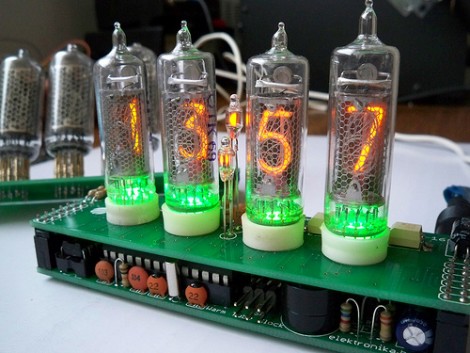
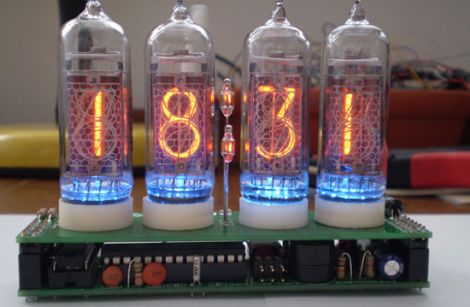
The Warm Tube Clock is the new kid on the block of Nixie Tube clocks. It takes inspiration from, and uses the same voltage driver circuit as the Ice Tube Clock. But this one uses four tubes instead of that hard-to-find single tube. It has a few other tricks up its sleeve. The shield that hosts the tubes has been designed for two different types. It also hosts an RGB LED for each tube, which adds the green glow seen above, and has a couple of small neon indicator bulbs which serve as the colon between hours and minutes.

The driver board centers around an ATmega328 running about three thousand lines of code. The firmware offers a lot of options including sound feedback, and a setting for every clock, calendar, alarm, and LED color toggle imaginable. See for yourself as the settings video, embedded after the break, walks you through each stage of the menu. We can’t help but think you need an instruction manual to set this thing up.

Continue reading “Warm Tube Clock”

Under-desk RGB Keyboard Lighting

[Jay Collett] was having trouble seeing his keyboard when the room was dim. But throwing a light under the desk just didn’t seem cool enough. Instead he built an RGB light board that is controlled by his desktop. The board is based around an ATmega328 with the Arduino booloader. He etched a single-sided PCB to connect it to a group of five RGB LEDs, with a programming header for an FTDI cable. The board communicates with a PC via serial connection, with a C# control application that [Jay] coded to control the color. We’ve embedded a couple of videos after the break but check his page for a package of code and hi-res pictures.

If you want something cool that’s a little bit less work to build check out the EL-wire keyboard from this links post.

Continue reading “Under-desk RGB Keyboard Lighting”