We Knew We Were Doomed When The T-shirt Cannon Bots Showed Up

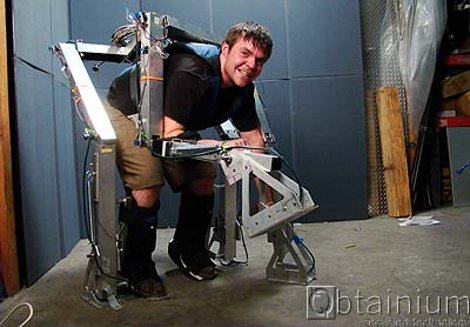
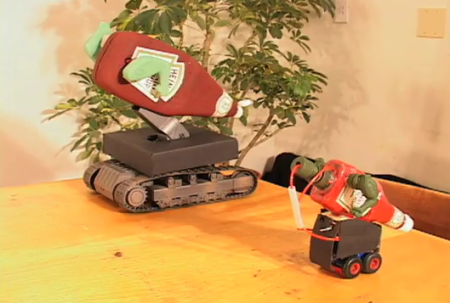
The newest addition to the Skynet armada is this 10-barrel t-shirt cannon. It’s capable of storming the battlements at over twelve feet per second with a firing rate of three T-shirts per second (ooh, is that cotton?).

The members of Team 254, which is hosted by Bellarmine College Preparatory School, built the robot over the summer. This involved a full production cycle; planning, 3D modelling, acquiring the materials, and finishing the build. All of this is well documented in their build blog and for video, check out their media page.

We already know how to customize the T-shirts for use as ammo, now what this needs is some tank treads.

Robot Gripper Uses Coffee To Pick Up Anything

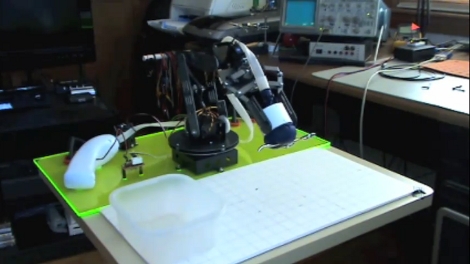
Picking up a raw egg is not something we’d think a robot gripper would be good at. But this model uses a bulbous tip instead of claw, which makes crushing the object less of a concern.

That tip is kind of like a balloon. It is stretched full with coffee grounds but air can also be pumped in and sucked out. When it comes time to grip an object, a bit of air is pumped in and the bulb is pressed down on its target. Once in place all of the air is sucked out, locking the coffee grounds around the object. Take a look after the break to see just how many things can be gripped with this technique.

Now the real question, can it bring me a beer?

Continue reading “Robot Gripper Uses Coffee To Pick Up Anything”

Fully Customized Robots

i.materialise, a custom 3D printing fabrication house are looking for talented robotics enthusiasts with the skills to design custom robotics parts such as functional frames, decorative shells, as well as unique parts required by robots to look and perform their best. The best part? They are offering free 3D printing of parts to the people they select with the most interesting or useful ideas. Make sure you check out their blog for details on what they are looking for and how to enter, as well as checking out some of the other cool things they do, such as a fully customizable 3D printed frisbee. Let us know what you design, we would love to show it off!

[via Robots-Dreams]

EvalBot: Arrival And Assembly

[Chris Muncy] just received his EvalBot from TI and took some pictures of the assembly process. He was one of the lucky folks that picked up the kit for just $25 using a short-lived coupon code. Seeing the kit makes us wish we had ordered one. There is some assembly required but as you can see, it’s pretty much just mechanical assembly of the wheels and the front bumper arms.

We think the wheel design is quite good. It consists of two small gearhead motors mounted on the rectangular PCB parts that you can see on the right portion of the image above. Those mount to the circular mainboard using metal L brackets. The wheels themselves are three circular pieces of PCB, one with a smaller diameter sandwiched in between its two larger cousins. This creates a channel that is perfect for a neoprene O-ring to give the wheel traction. The main board uses an optical sensors and a hole through all three parts to function as a rotation counter.

It’s a fancy piece of hardware and we can’t wait to see what you can do with it! If you’ve got one, we want to hear about your adventures.

Darbuka Band

This robotic band has just the right amount of drums. [Liat] and her colleagues fit a group of Darbuka drums with a pair of servo-driven mallets. We’re quite surprised that the servo motors achieve such a successful strike and rebound without dampening the vibrations of the drum head. This is more often accomplished with solenoids because of their quick response and relative strength.

You can listen to a performance of this work-in-progress in the video after the break or make plans to see it live. The installment was built for the Bat-Yam international biennale of landscape urbanism. It will be attached to, and powered by alternative energy producers like solar cells and wind turbines. Continue reading “Darbuka Band”

New Term For Art: Sculptural Robotics

[Dan Roe] has been working on Sculptural Robotics for quite some time, and most recently presented his newest creation: Solar Flowers 2010. Typically, Sculptural Robotics (coined by [Dan] himself) are stand alone, static art presentations made from electronic components and wire. [Dan] of course has taken it quite a bit further; giving all his sculptures life using solar panels, motors, engine circuits, and more. Making them zero emission, and beautiful at the same time. You can catch four videos after the jump of his moving sculptures. Not that we’re picking favorites, but the dragonfly is pretty amazing if we do say so ourselves.

Continue reading “New Term For Art: Sculptural Robotics”

As Promised: More Industrial Robot Goodness

Remember [Mattythorne]? He took a BMW industrial arm and re-purposed it to write twitter messages on a white board. You can read a small excerpt here.

Well [Matt] is back, and as promised includes an entire write up for how he got @scribblebot scribbling twitter messages.  It’s a little light on details and we wish there was some more in-depth how-to magic, but then we remembered with most of the population not having an industrial arm in the first place the extra time spent incorporating the extra info would be far from worth it. Regardless, it doesn’t surprise that the previous commentators were not far off the mark in how difficult programing one of these machines would be. While such arms do have a few built in libraries it looks like a very exhausting process to override the default axis of motion, incorporate a UI, build a pen holder, and more. And in the end, is it worth it? [Matt] tells us the arm is going to be going back to monotonous car building work soon, giving weeks of prep only a day in the limelight.