Mbed Robo-Rover

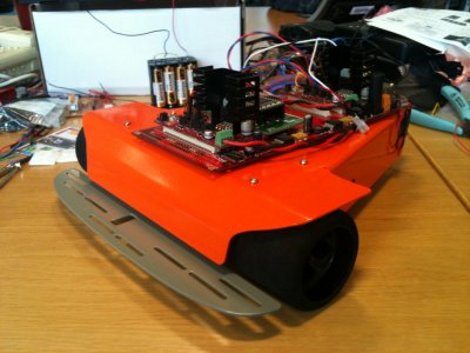
There are a ton of rapid prototyping available on the market these days which all cater to different niches. Todays project, a robotic rover on a 4 wheel chassis, is based on the NXP mbed. The mbed is a popular board for higher need applications, and is centered around an ARM Cortex core.

This multi-part writeup is a great place to start for people who are looking into making a robot of any kind. [Aaron] explains a lot of important concepts that are often overlooked by novices of robot building, including the importance of movement feedback such as quadrature encoders, as well as the usefulness of Inertial Measurement Units (IMUs) to maintain bearing and terrain awareness. This project is nearing completion, and promises to deliver essential material such as source code, a bill of materials, and the robot in action.

This could also be a valuable tool for any FIRST teams looking to understand some of the necessary ideas in creating a robot. Are there any Hackaday readers out there participating in or mentoring a FIRST (or any other robotic competition) team? We would love to hear from you!
Flipping Pancakes

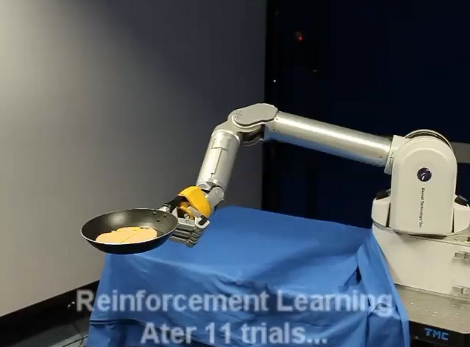
[Petar and Sylvain] are teaching this robot to flip pancakes. It starts with some kinesthetic learning; a human operator moves the robot arm to flip a pancake while the robot records the motion. Next, motion tracking is used so that the robot can improve during its learning process. It eventually gets the hang of it, as you can see after the break, but we wonder how this will work with real batter. This is a simulated pancake so the weight and amount at of force necessary to unstick it from the pan is always the same. Still, we loved the robotic pizza maker and if they get this to work it’ll earn a special place in our hearts.

Continue reading “Flipping Pancakes”

Break Out The Two-ply, Ecobot III Poops

[youtube http://www.youtube.com/watch?v=qU6zi1_aZiw&feature=player_embedded%5D

Imagine our surprise when this article on Ecobot III and the disgusting video above showed up in our feed. The robot can theoretically be self-sustaining forever, so long as it has a food source. Yes, you read correctly, food.

Typical robots relying on grub burn the biomass to produce heat/steam/energy, but Ecobot III actually digests using Microbial Fuel Cells and extracts energy in the form of hydrogen.

The process isn’t very efficient (yet), and of course waste must be excreted, but we’re inching closer and closer to the day our robot overlords are invincible. The project has come to a halt (we can’t imagine why), but you can still read up on the process, and meet Ecobot’s brothers: II and I.

Related: We’re all going to die, Carnivorous robots.

General Purpose Robot Remote

[youtube=http://www.youtube.com/watch?v=uuwb3fn51r4]

[theGrue] has posted his Robot remote control project for us to gawk at. This box o’ buttons is a parallax propeller brain with some Xbee units for communication. Though it was designed to work with TOBI, his tool carrying robot, he made it so that he could control a multitude of robots with it by flipping some switches on the front of the remote.

[via Hacked Gadgets]

Foam Board Servo Driven Arm

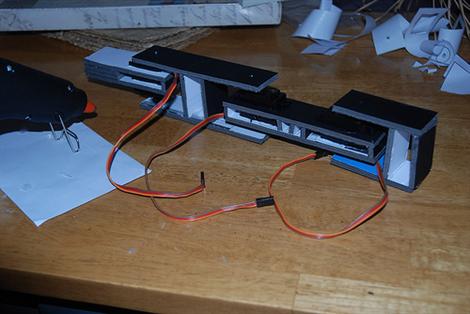
[Lucky Larry] posted some pictures to the Hack a Day flickr pool that caught our eye. He made a quick and cheap servo driven arm. Constructed from foam board and some hobby servos, he’s using an Arduino for the brains. You can download the pattern for the arm pieces as well as the code on his site.

He ultimately finds that he has positioning issues that he blames on the cheap servos. You can see in the video on his site that the circles it is drawing are drifting one direction.

Toddler Android

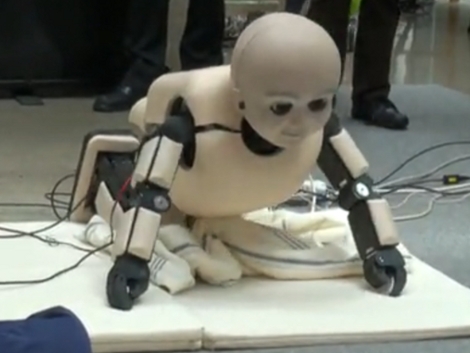
We came across a couple of videos of this toddler android. It sits up, rolls over, and responds to humans around it using visual, audio, and sensor inputs. After the break you will see that the movements are quite like that of a young child. The giveaway is the weight of the robot which is evident when its handlers trying to help it get untangled from that blanket. It seems to respond to individuals around with a smile and a twinkle of its… errr… camera eye. We wonder if it would find delight in knocking down some dominoes.

Continue reading “Toddler Android”

Distributed Flight Array

[youtube=http://www.youtube.com/watch?v=7iHZKMDvdNI&w=470]

Though it is in the beginning stages of development, the Distributed Flight Array is already looking very interesting. Each unit can scuttle across the ground using the down force from its prop, but when 4 or more join forces, they can take off and fly. The documentation shows that they should be smart enough to fly in random configurations, though in the video we only see the standard 4 prop layout. This is being worked on by the same people who produced the balancing cube.

[via BoingBoing]