Beer Kegs Make Excellent Resin Dispensers

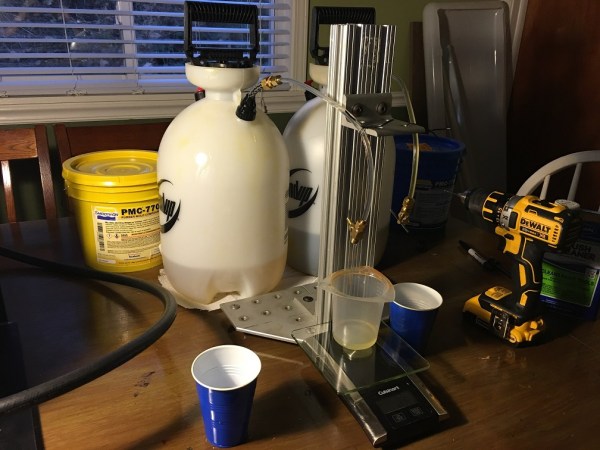
[Josh Updyke] woke up one morning and found himself in a sticky situation. The demand for his modular robotic track system was outgrowing his ability to produce. One of the bottlenecks was weighing out resin. It’s a slow, monotonous process that must be done with accuracy. The free market did not have any affordable solutions to the problem. So like any hacker worth his weight in 2N2222 transistors, he made his own by re-purposing some used beer kegs.

The resin comes in two parts – the resin itself and a hardener. Each must be weighted out on a scale before mixing to ensure proper proportions. It was a trial-by-error learning process before [Josh] was able to settle on a final solution. First he tried some garden sprayers, which worked OK at first. But the resin was taking too long to exit the sprayers, and he had to pressurize them by manually pumping them with air. He ended up with a much better method that used some Cornelius Kegs.

Be sure to check out his io page for more details.

3D Printed Hydraulics

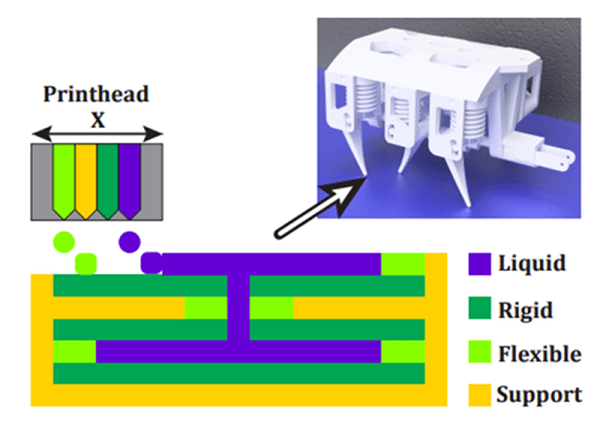
[Robert MacCurdy] at MIT wants to change how people think about hydraulics. Using fluid can be very useful in systems like robots, but it is often the case that the tubing that carries hydraulic fluid is not an integrated part of the overall design. [MacCurdy] and his colleagues have modified a 3D printer to allow it directly include hydraulic components as it prints.

The idea is simple. The team started with a printer that uses a liquid ink that is UV cured to produce solid layers. The printer has the ability to use multiple liquids, and [MacCurdy] uses hydraulic fluid (that does not UV cure) as one of the print materials. Just as you can use a 3D printer to build structures within other structures, printing the hydraulics allows for complex closed systems that use the UV-cured resin as mechanical parts that can transfer pressure to and from the hydraulic system.

Continue reading “3D Printed Hydraulics”

Robot Listens To Commands–Literally

Where you might see a can, [Adam Kumpf] sees a robot. [Adam’s] robot (named [Canny]) doesn’t move around, but it does have expressive eyebrows, multicolored eyes, and a speaker for a mouth. What makes it interesting, though, is the fact that it receives audio commands via the headphones it wears. You can see [Canny] in action in the video below.

The headphones couple audio tones to [Canny’s] microphone using AFSK (audio frequency shift keying). [Canny] uses an opamp to bring the microphone level up and then uses a 567 PLL IC to decode the audio tones. [Adam] selected two clever frequencies for the mark and space (12345 Hz and 9876 Hz). In addition to being numerically entertaining, the frequencies are far enough apart to be easy to detect, pass through the headphones with no problem, and are not harmonically related.

Continue reading “Robot Listens To Commands–Literally”

Creating Art In A Robot That Tastes With Its Feet

[Sarah Petkus] started off her career as a visual artist with traditional mediums. She has a webcomic called Gravity Road, but somewhere along the line she wanted her creations to come alive. These characters are robots – artistically designed robots – and turning this type of art into a real object isn’t something that happens very often.

Robots usually aren’t art. A Roomba is just a vacuum cleaner that’s meant to turn on a dime, thus the circular shape. The welding robots in a car factory aren’t art, they’re only tools to assemble cars. These are just devices built for a single purpose, and art is for any or every purpose. It’s not something you can really design, but you can engineer a few interesting solutions.

Continue reading “Creating Art In A Robot That Tastes With Its Feet”

Swallow The Doctor — The Present And Future Of Robots Inside Us

I recently finished the Silo series by Hugh Howey, a self-published collection of novellas that details life in a near-future, post-apocalyptic world where all that remains of humanity has been stuffed into subterranean silos. It has a great plot with some fun twists and plenty of details to keep the hacker and sci-fi fan entertained.

One such detail is nanorobots, used in later volumes of the series as both life-extending tools and viciously specific bio-weapons. Like all good reads, Silo is mainly character driven, so Howey doesn’t spend a lot of eInk on describing these microscopic machines – just enough detail to move the plot along. But it left me wondering about the potential for nanorobotics, and where we are today with the field that dates back to Richard Feynman’s suggestion that humans would some day “swallow the doctor” in a 1959 lecture and essay called There’s Plenty of Room at the Bottom.”

Continue reading “Swallow The Doctor — The Present And Future Of Robots Inside Us”

Who Is Responsible When Machines Kill?

This morning I want you to join me in thinking a few paces into the future. This mechanism let’s us discuss some hard questions about automation technology. I’m not talking about thermostats, porch lights, and coffee makers. The things that we really need to think about are the machines that can cause harm. Like self-driving cars. Recently we looked at the ethics behind decisions made by those cars, but this is really just the tip of the iceberg.

A large chunk of technology is driven by military research (the Internet, the space race, bipedal robotics, even autonomous vehicles through the DARPA Grand Challenge). It’s easy to imagine that some of the first sticky ethical questions will come from military autonomy and unfortunate accidents.

Continue reading “Who Is Responsible When Machines Kill?”

Hacklet 83 – Tiny Robot Projects

Hackers, makers, and engineers have been hacking on robot projects since the era of clockwork mechanics. Any robot is a cool project, but there is something particularly attractive about small ones. Maybe it’s the skill required to assemble them, or perhaps it’s the low-cost. Either way, there are lots of palm-sized robot projects on Hackaday.io. This week on the Hacklet, we’re going to highlight a few of them!

tinyrobot2We start with the granddaddy of them all, [shlonkin] and Tiny robot family. [Shlonkin] built line following robots that can hide under a US half-dollar coin. The robots are simple circuits – an ATtiny85 with an LED and pair of phototransistors. The code is provided both in Arduino’s wiring, and in straight C++. Two coreless motors, normally used in cell phones vibrators or quadcopters, provide the locomotion. These robots only know one thing – moving forward and following a line. They do it well though! We love this project so much that we hosted a tiny robot workshop at the 10th anniversary back in 2014.

toteWhen it comes to tiny walking robots, [Radomir Dopieralski] is the king. Many of his projects are small biped, quadruped, or even hexapod robots. He’s done things with 9 gram nano servos that we thought were impossible. Tote, an affordable spider robot, is his latest creation. Tote is a four-legged bot utilizing 12 9 gram servos. [Radomir] created a custom PCB for Tote, which acts as a carrier for its Arduino Pro Mini Brain. This robot is easily expandable – [Radomir] has experimented with the Teensy 3 series as well. Controlling the robot can be anything from an ESP8266 to an infrared remote control.

botbot[Alan Kilian] may well have the ultimate tease project with Hand-wound inductors for a tiny robot. [Alan] was using some tiny GM-10 motors on his micro-bot. The motors didn’t have inductance for the locked-antiphase drive controller. His solution was to wind some coils to provide a bit of added inductance. The mod worked, current consumption dropped from 116 ma to about 6 ma. We want to know more about that ‘bot though! It’s controlled by a Megabitty, [Monty Goodson’s] ATmega8 controller board from sometime around 2003. The lilliputian board has been very popular with the nano sumo crowd. Other than the controller, motors, and the plywood frame, [Alan] has left us guessing about his robot. If you see him, tell [Alan] to give us more info on his micro robot’s design and construction!


espbot[Ccates] jumped on the tiny robot bandwagon with Tiny wi-fi robot. Rather than go with an Arduino for control, [Ccates] grabbed the popular ESP-8266 WiFi module. The construction of the bot is inspired by [shlonkin’s] tiny robot family up above. This bot is controlled by the Xtensa processor embedded in the ESP-8266. Since it only drives forward, it only takes two GPIO pins to control the transistors driving the motors. Even the diminutive ESP-01 module has enough I/O for that. We’d love see some sensors and a full H-bridge on this micro beastie!


If you want to see more palm-sized robot projects, check out our new tiny robot projects list! These ‘bots are small, so I may have missed yours. If that’s the case, don’t be shy, just drop me a message on Hackaday.io. That’s it for this week’s Hacklet. As always, see you next week. Same hack time, same hack channel, bringing you the best of Hackaday.io!