Walking, jumping, rolling, flying, swimming – robotic locomotion is limited only by the imagination of the inventor. [Roger Rabbit] apparently has a pretty vivid imagination, because he’s building robots that move like worms.
Version 1 of [Roger]’s robot is only semi-vermiform and is more of tube climber. It has a pair of 3D-printed pantographs that expand and contract with servos and move along the robot’s axis on a stepper-driven lead screw. An Arduino reads sensors and coordinates the expansion of the pantographs to grip the internal diameter of a pipe and push the worm-bot along. It’s a slow but effective way to get around in the limited confines of a pipe.
The next iteration, dubbed [Wolly], is much more worm-like and not restricted to pipe-running. It has four expandable triangular frames connected to each other with rack-and-pinion backbones. The first frame contracts, the racks push it forward, it expands, the next contracts, and soon it’s doing the worm across the floor. Still slow, but pretty neat to watch, and you can see how it can be steered. It might even be able to roll around its long axis, and it’d make a decent tube climber as well.
This creepy autonomous worm-bot seems very similar to [Wolly], but aside from that we haven’t covered too many robots like these. There’s a lot of thought and effort in these worm-bots, and we’re keen to see where [Roger] takes this unique robot body plan.
Last weekend was Sparklecon, the premier meetup in Southern California of dorks dorking around, fire, electricity, welding, and general mischief. Just imagine a party of a hundred or so like-minded individuals at a hackerspace. Now imagine the entire party is the after party. That’s a pretty good idea of what happened.
The event was held at the 23b shop in Fullerton, a true hackerspace tucked away in a small industrial park. The people at 23b are using their location to their advantage: no one in the neighborhood really cares what happens after 5pm on a Friday. This allows for some very loud, very bright, and very dangerous hijinks.
There weren’t many pages missing from the Hackaday Omnibus donated to the 23b shop. Oddly, the only pages missing were the articles written by Benchoff.
There was something for everyone at Sparklecon, including:
Electric Pickle. Take a stick welder, and put a few hundred amps through a pickle. First, the pickle turns into a sodium light. Then, it turns into a carbon arc light. Best done after dark.
FPV drone racing. Flying around and crashing into trees in an abandoned lot. FPV from a few quads were projected onto the side of a building
Live music! Analog synths and Game Boys!
Tesla coils! This was a 300 amp monster, and completely analog. The spark gap was impressive by itself, but it gets really cool when you steal a fluorescent light from a fixture and stand 20 feet away from the Tesla coil.
Hammer Jenga! Cut some 2x4s up and make a tower of Jenga. Get a hammer, some colorful commentators, a dozen people, and make some competition brackets. Hackaday’s own [Jasmine] was the first champion of the night.
Sparklebot Death Battle! It’s like BattleBots, only things break more often and we don’t have [Bil Dwyer].
Hebocon! Battling robots, but much crappier than the Sparklebot Death Battle. These robots broke more often.
Analog synths provided the tunes
The Sparklebot Death Battle ring
Tesla Coils and Spark Gaps
A Hebocon bot, using a mouse trap as a weapon
A lady tribble, vibrating her way across the Hebocon ring
The basic premise of Hammer Jenga
Art was made out of the spare parts left over from the Hebocon build-off. This robot is named Art
The main event was, of course, Sparklecon’s own version of Battlebots. There were only four competitors the entire night, but the competition was fierce.
Three of the bots were wedge designs, in keeping with the ramp-ification of battling robots. The lone exception to this was [Charlie]’s Slow Bot, a cube design equipped with a spinning steel blade. The blade moves fast, but Slow Bot doesn’t. It’s a purely defensive design, meant to destroy bots trying for an easy kill. The test video of Slow Bot can be seen here:
The first fight of Slow Bot did not live up to the hype, unfortunately. After Slow Bot’s primary weapon got up to speed, the opposing bot moved in for the kill. The bolts on Slow Bot‘s blade sheared, ending the match, and leaving five or six people looking around the 23b shop for M5 bolts, or some larger bolts and a tap.
Is it all hilarously unsafe? Well, there were some plexiglas shields in front of the crowd, and most people viewed the fights on the projector beaming against the wall, anyway.
Is it worth it to go to Sparklecon? If you like dangerous experiments, soldering wires directly onto AA batteries, fire, electricity, electromagnetic fields, broken robots, and hanging out by a fire, yes. It’s a party at a proper hackerspace, making it the best kind of party ever. If history repeats itself, there will also be an afterparty at 23b following the LayerOne conference in May.
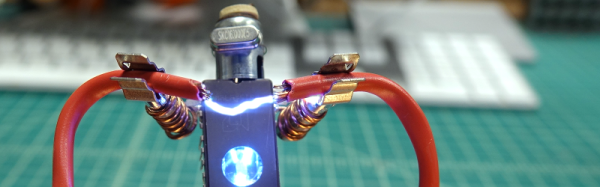
At Hackaday, we cover some pretty high-tech builds. Sometimes, though, you see something simple, but it still makes you feel happy to see it. That’s pretty much the case with [ProtoG’s] High Voltage EPROM Man.
The parts probably came out of a junk box, but the good news is that they don’t have to work, and you can freely substitute anything you have. According to [ProtoG], the “robot” head is a bulb socket with a crystal for the visor. The arms are fuses with fuse clips for the hands. The knees are adjustable caps, and the feet are TO-220 transistors.
If you watch science fiction movies, the robots of the future look like us. The truth is, though, many tasks go better when robots don’t look like us. Sometimes they are unique to a particular job or sometimes it is useful to draw inspiration from something other than a human being. One professor at Johns Hopkins along with some students decided to look at spider crickets as an inspiration for a new breed of jumping robots.
I have something that follows me around all the time: my dog Jasper. His cargo-carrying capability is limited, though, and he requires occasional treats. Not so this robotic suitcase. All it needs, the designers claim, is an occasional charge and a Bluetooth device to follow.
Designed by NUA Robotics, this suitcase is equipped with powered wheels and a certain amount of smarts: enough to figure out the direction of a Bluetooth signal such as your cell phone and follow it. This is also accompanied by proximity sensors so it doesn’t bump into you or other people. When the built-in battery runs out, just pop put the handle and pull it yourself, and the regenerative motors will recharge the battery. There’s no indication on price, battery life or how much space is left to actually carry stuff yet, but the designers claim it could be out within the year. As someone who uses a walking stick, this sounds like a great idea. And if they can work out how to get it to walk the dog for me, that would be even better.
Now, who will be the first to build a clone of this in their basement? Bonus points if it’s a two-wheeled self-balancer.
Robots and DIY electronics kits have a long history together. There probably isn’t anyone under the age of forty that hasn’t had some experience with kit-based robots like wall-hugging mouse robots, a weird walking robot on stilts, or something else from the 1987 American Science and Surplus catalog. DIY robot kits are still big business, and walking through the sales booths of any big Maker Faire will show the same ideas reinvented again and again.
[demux] got his hands on what is possibly the worst DIY electronics kit in existence. It’s so incredibly bad that it ends up being extremely educational; pick up one of these ‘introduction to electronics’ kits, and you’ll end up learning advanced concepts like PCB rework, reverse engineering, and Mandarin.
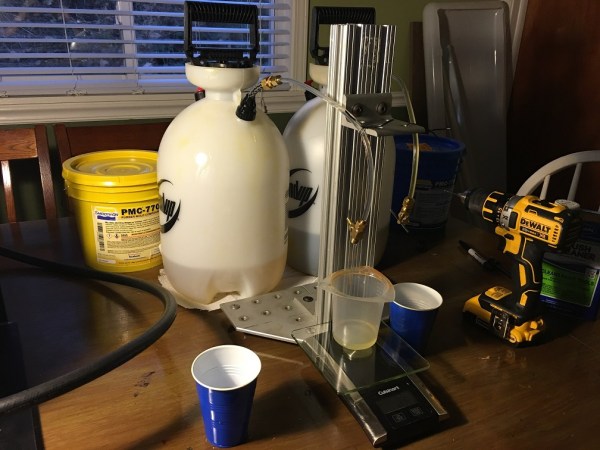
[Josh Updyke] woke up one morning and found himself in a sticky situation. The demand for his modular robotic track system was outgrowing his ability to produce. One of the bottlenecks was weighing out resin. It’s a slow, monotonous process that must be done with accuracy. The free market did not have any affordable solutions to the problem. So like any hacker worth his weight in 2N2222 transistors, he made his own by re-purposing some used beer kegs.
The resin comes in two parts – the resin itself and a hardener. Each must be weighted out on a scale before mixing to ensure proper proportions. It was a trial-by-error learning process before [Josh] was able to settle on a final solution. First he tried some garden sprayers, which worked OK at first. But the resin was taking too long to exit the sprayers, and he had to pressurize them by manually pumping them with air. He ended up with a much better method that used some Cornelius Kegs.
Be sure to check out his io page for more details.

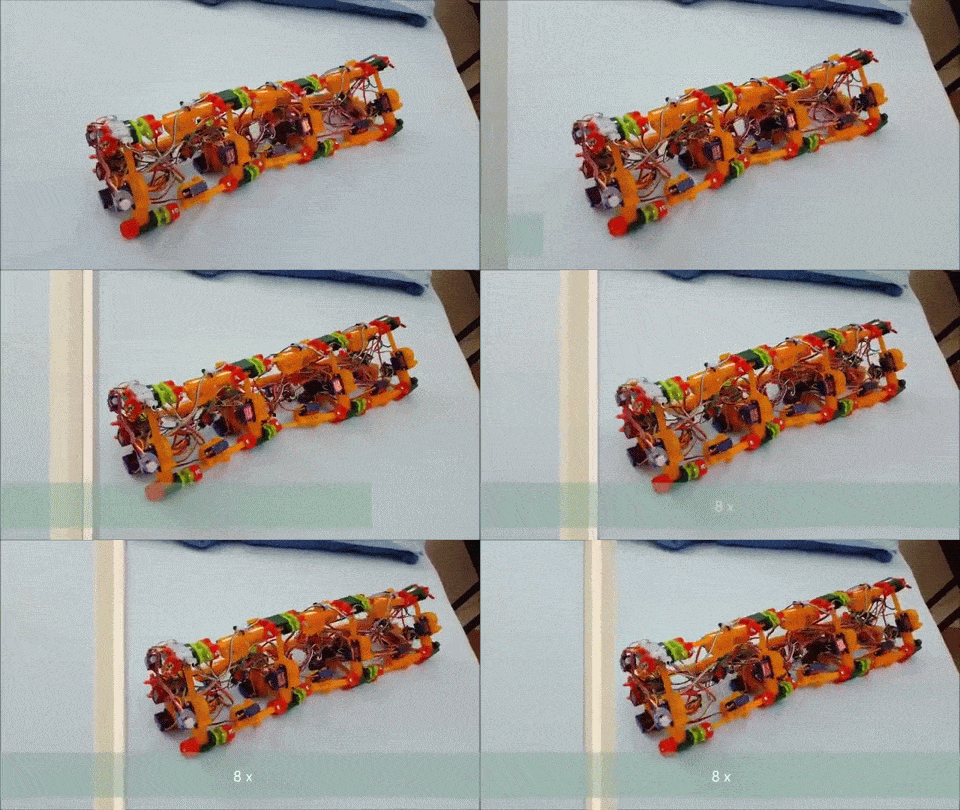
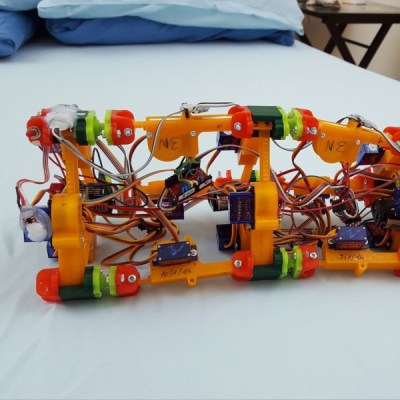
 Version 1 of [Roger]’s robot is only semi-vermiform and is more of tube climber. It has a pair of 3D-printed pantographs that expand and contract with servos and move along the robot’s axis on a stepper-driven lead screw. An Arduino reads sensors and coordinates the expansion of the pantographs to grip the internal diameter of a pipe and push the worm-bot along. It’s a slow but effective way to get around in the limited confines of a pipe.