Compliant Robot Gripper Won’t Scramble Your Eggs

[Chiprobot] has created an amazing compliant gripper.  Designing robot hands (or end effectors) can be a perilous task. It is easy to give robots big, good, strong hands. Strong grippers have to be controlled by sensors. However, sensors can’t always be relied upon to ensure those hands don’t crush anything they touch. Hardware fails, software has bugs. Sometimes the best solution is a clever mechanical design, one which ensures a gripper will conform to the object it is gripping. We’ve seen “jamming” grippers before. (so named for their use of a granular substance which jams around the object being gripped).

[Chiprobot’s] gripper is something entirely different. He designed his gripper in blender, and printed it out with his Ultimaker 3D printer. The material is flexible PLA. Three plastic “fingers” wrap around the object being gripped. The fingers are made up of two strips of printed plastic connected by wire linkages. The flexible plastic of the fingers create a leaf spring design. The fingers are attached to a linear actuator at the center point of the gripper. The linear actuator itself is another great hack. [Chiprobot] created it from a servo and an empty glue stick.  As the linear actuator is pulled in, the fingers pull around  any object in their grip. The end result is a grip strong enough to hold an egg while shaking it, but not strong enough to break the egg.

We would like to see the gripper gripping other objects, as eggs can be surprisingly strong. We’ve all seen the physics trick where squeezing an egg with bare hands doesn’t break it, yet squeezing an egg while wearing a ring causes it to crack much… like an egg.

Continue reading “Compliant Robot Gripper Won’t Scramble Your Eggs”

Build And Control Your Own Robot Army

deltas

[Sarah Petkus] has a simple dream. She wants to build and command her own delta robot army. It all began with an illustration she drew of a woman hovering over a field of flowers. The flowers in this case had incandescent light bulbs as blooms. [Sarah] decided to create her image in the real world as an interactive art installation. Her first attempts at moving light flowers were based on a pulley system, which was unreliable and not exactly the graceful movement she imagined. Eventually [Sarah] discovered inverted delta robots. She changed her flower design to a delta, and began building her own delta robots out of parts she had around the house.

A chance meeting with the folks at SYN Shop hackerspace in Las Vegas, NV kicked the project into high gear. [Sarah] switched from using R/C ball links as joints to a simple ball bearing joint. She created her entire design in CAD software and printed it on the hackerspace’s 3d printer. She now has six working prototypes. The robots are all controlled via I2C by an Arduino compatible Nymph board. Six robots doesn’t exactly constitute an army, so [Sarah] had to find a new way to fund her project. She’s currently setting up a project for Kickstarter. [Sarah] will be selling kits for her robots, with the proceeds going toward the realization of her dream of a field of robotic light bulb flowers – Assuming the deltas don’t become sentient and try to take over the world first. [Sarah] posts progress updates to her blog, and has a dedicated site (which we featured on Sunday as part of a Links post) for information about her upcoming Kickstarter campaign.

Continue reading “Build And Control Your Own Robot Army”

Robots Of BarBot 2013

barbot

Here’s an amazing conference we really wish we could have been at — Barbot 2013: a celebration of booze serving robotic masterpieces.

Lucky for us though, the folks over at Evil Mad Scientist did have the opportunity to attend — and they took lots of pictures. There is just so much awesome it is hard to pick our favorite barbot, but the one shown above is definitely a contender. It’s the Schrödinger’s Martini. While the box is closed, the amount of vermouth poured is indeterminate until observed. Classic.

Another one that popped out at us was the 500SW, which became more affectionately known as Dance Dance Intoxication, which apparently judged you based on your dancing skills and then poured you a drink — appropriate to your moves.

Click through and see for yourself, but here’s a couple other related posts from our past, remember the Cooler Master Advanced Beer Delivery System? How about the amazing conveyor belt driven, alcohol dispensing Inebriator? There are just so many ways to have fun with the concept it’s hard not to try your hand at building one at home.

Halloween Links: October 30th, 2013

hackaday-links-chain

Happy Halloween from everyone at Hackaday! To help you enjoy the holiday here are a few festive links:

[Mike Kohn] whipped up a set of motion tracking eyeballs to make his decor extra creepy.

There’s not much to this jet-pack costume but the results are pretty amusing.

The eyes on [Tim Butler’s] skeleton prop don’t follow you around the room, but they do use a PIR sensor to light up the skull.

Speaking of skulls, [Tom] is using some real skulls as decorations. He also added lights where the eyeballs should be, but he is using a photoresistor and comparator to turn on some LEDs.

[Clark] built a Mecha Robot Warrior costume for his son. With all of those LED strips we think he’ll be pretty safe when crossing the street!

And finally, [Jesse] added a lot to his prop in order to produce a Sinister Joker. That’s Joker-as-in-cards and not as in Batman. It’s got an IR distance sensor as a trigger, with a motor to move the wrist, lights for the eyes, and a sound shield to give it a disturbing voice.

Inexpensive Robot Tracking System Is Swarm Ready

RobotWebcam

[Ladvien] has figured an inexpensive way to control a robot from a remote PC with a static webcam. Inspired by swarming robot videos such as those from the UPENN Grasp lab, [Ladvien] wanted to build his own static camera based system. He’s also managed to create one of the more eclectic Instructables we’ve seen. You don’t often find pseudo code for robot suicide mixed in with the project instructions.

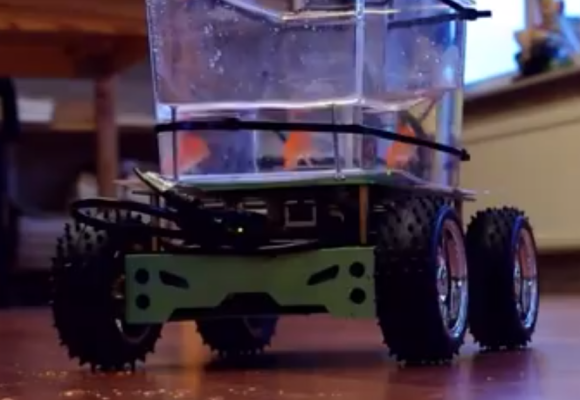
Fixed cameras are used in many motion capture systems, such as the Vicon system used by numerous film, game, and animation studios. Vicon and similar systems cost tens of thousands of dollars. This was a bit outside [Ladvien’s] budget. He set about building his own system from scratch. The first step was the hardest – obtaining permission from his wife to screw a webcam into the ceiling. With that problem overcome, [Ladvien] brought openCV and python to bear. He created Overlord, his webcam vision and control system. A vision system with nothing to control would be rather boring, so [Ladvien] created DotMuncher, Overlord’s radio controlled robot slave.

The basic processing system is rather simple. DotMuncher carries a magnetometer on board, which it uses to send heading information to Overlord. Overlord is pre-calibrated with an offset from magnetic north to “video game north” (toward the top of the screen). Overlord then uses openCV’s color detection to find DotMuncher in the current scene.
Overlord finally generates a virtual “Dot” on screen, and directs DotMuncher to drive over to it. When the robot gets to the dot, it is considered munched, and a new dot is generated.

Continue reading “Inexpensive Robot Tracking System Is Swarm Ready”

Walter Is A Robot Head Built From Scratch.

walter

[Chris] has put together a robot head that is impressive at first sight. [Chris’] robot, Walter II, becomes even more impressive when you realize that [Chris] built every single part from scratch. Many of Walter’s parts were created using machines [Chris] built himself. Walter is a robot neck and head. His upper neck joint is based upon three bevel gears.Two steppers drive the side gears. When the steppers are driven in the same direction, Walter’s head nods. When they are driven in opposite directions, the head turns. The end result allows Walter’s head to be panned and tilted into almost any position.

A second pair of motors raise and lower Walter’s neck via a chain drive. What isn’t immediately visible is the fact that a system of gears and belts maintains the tilt on Walter’s head as his lower neck joint is actuated. For example, if Walter’s head is facing directly forward with his neck raised, one would expect him to be facing the ground when the neck is lowered. The gear/belt system ensures that Walter will still be facing forward when the neck joint reaches its lower limit. All this happens without any movement of the neck motors. [Chris] definitely put a lot of thought into the mechanical design of this system.

Continue reading “Walter Is A Robot Head Built From Scratch.”

Quadruped Robot Thinks It’s A Puppy

puppybotBack at New York MakerFaire 2012, we noticed an amazing little steampunk quadruped robot walking around in the crowd outdoors. The robot was amazingly well executed, and had a unique ability to draw children over with it’s puppy like animations. It turns out this is [Drew’s] Little Walking Robot (AKA Puppy Bot).

Puppy Bot has actually been around for quite a while. He was born from the spare parts [Drew] had left over after competing in Robot Wars and Battlebots. The robots in these competitions were often controlled by Radio Control plane or car transmitters. Most of these systems are sold as packs for an RC car or plane. In addition to the transmitter and receiver, the pack usually included a battery and 3 or 4 servos. Standard RC servos were much too weak for use in battle robots, so they remained in his parts box.

On what [Drew] calls a slow weekend, he started putting the servos together, and ended up with a basic robot that could crawl around the room. After that the robot took on a life of its own. [Drew] improved the battery system, and added a microcontroller to automate the various gaits and animations. He brought the robot along with him to one of his battlebot competitions, and it took home the “Coolest Robot” award – even though it wasn’t actually competing!

Continue reading “Quadruped Robot Thinks It’s A Puppy”