Retrotechtacular: Restoring A 19th Century Automaton

eyes

Made sometime in the 1790s or 1800s London, the Maillardet Automaton has a long and storied history. It was exhibited around England for several decades, brought over the Atlantic by [P.T. Barnum], nearly destroyed in a fire, and donated to the Franklin Institute in Philadelphia in the 1920s. From there, this amazingly complex amalgam of cogs, cams, and linkages eventually became the inspiration for the book – and movie – Hugo. Time hasn’t exactly been kind to this marvel of the clockmaker’s art; it has been repaired four times before receiving a complete overhaul in 2007 by [Andrew Baron].

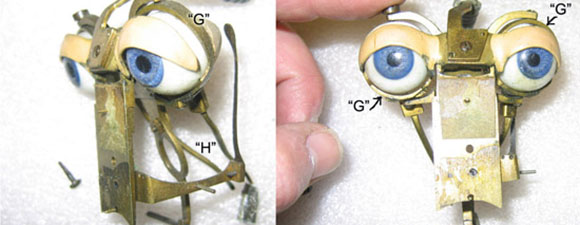
[Fran], one of Hackaday’s sources for awesome projects, recently visited the Franklin Institute and posted a series of videos on the reverse engineering of the Maillardet Automaton. Being nearly destroyed and repaired so many times didn’t make this an easy job; it’s extremely possible no one alive has ever seen the eyes of the Automaton move as originally designed.

Even though the Maillardet Automaton has one of the largest series of cams of any mechanical draftsman, that doesn’t mean it’s simply an enlargement of an earlier machine. The automaton’s pen is like no other writing device on Earth, with a stylus acting as a valve to dispense ink whenever the tip touches paper. The eyes have linkages to follow the pen as it traces a drawing. In 1800, this automaton would have been a singularity in the uncanny valley, and watching it put pen to paper is still a little creepy today.

Below you’ll find a video from [Fran] demonstrating all seven drawings the Maillardet Automaton can reproduce. You can also find a whole bunch of pics of the mechanisms along with the 2007 repair report on [Andrew Baron]’s site.

Retrotechtacular is a weekly column featuring hacks, technology, and kitsch from ages of yore. Help keep it fresh by sending in your ideas for future installments.

Continue reading “Retrotechtacular: Restoring A 19th Century Automaton” →
Yo Fish, We Pimped Your Tank

fishie

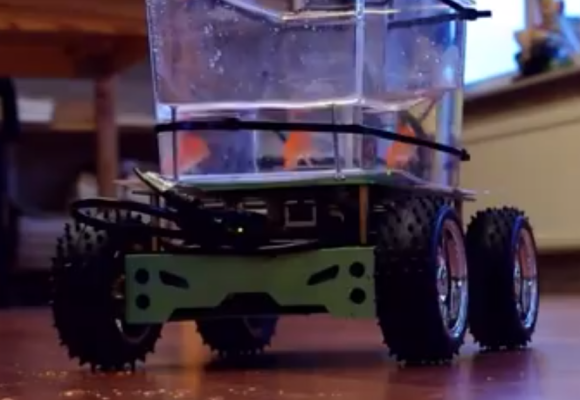
[Studio Diip] a machine vision company based in The Netherlands has created fish on wheels, a robotic car controlled by a goldfish. The idea of giving fish mobility on land is nothing new, but this definitely is a novel implementation. A Logitech 9X0 series camera captures overhead images of the fish tank. The images are then fed into a BeagleBoard XM, where they are processed. The image is thresholded, then a centroid of the fish-blob is determined. With the current and previous blob locations known, the BeagleBoard can determine the fish’s swim direction. It then and commands the chassis to drive accordingly.

The system appears to work pretty well on the video, however we’re not sure how much of the input is due to the fish swimming, and how much is due to the water sloshing and pushing the fish around. We definitely like the chrome rims and knobby tires on the fishes’ pimped out ride.  This could become a trend. Just make sure no animals or humans are hurt, and send your animal powered hacks to our tip line!

Continue reading “Yo Fish, We Pimped Your Tank” →

Gamecube Robot Is More Than Meets The Eye

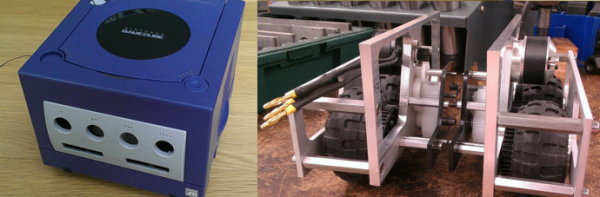
[Joshua] had his old Gamecube kicking around. Rather than let it gather dust, he took it into the machine shop at Harvey Mudd College and used its body as the shell of a mobile robot. With a bit of thought, it turns out that you can fit quite a lot inside the rather small Gamecube case. [Joshua] started with a couple of R/C plane style brushless outrunner motors. These motors generally give more torque and spin slower than their inrunner counterparts. Several thousand RPM was still too fast to directly drive the LEGO tires though. He needed a gear reduction.

Gears and tight spaces usually send people running for the SDP/SI website. We’ve used SDP/SI parts before, and have found that they make incredibly accurate gears and assemblies. Things can get pricey, however, when you’re buying two of everything. In search of a solution a bit more within his college-student-budget, [Joshua] looked at radio control servos. R/C servos have some rather strong output gears, especially the metal gear variety. Even with strong gears, parts do break in crashes, so replacement gear sets are available and cheap. [Joshua] settled on gears made for Hitec servos. His next problem was finding a pinion gear for his motors. That turned out to be easy, as 64 pitch gears commonly used in RC cars mesh with metric servo gears.  The final results are great. His robot has tons of torque and plenty of speed to zip around. The only thing it’s missing is a brain. Videos after the break.

Continue reading “Gamecube Robot Is More Than Meets The Eye” →

Happy Birthday, Son. Here’s Your Very Own Claw Machine

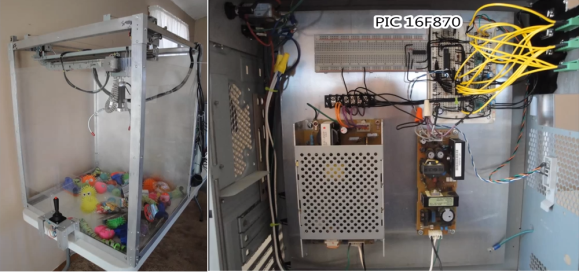
mrclawIf [Will Baden] is in the running for Father of the Year, he’s a shoe-in. His son requested a robot-themed birthday party, so [Will] did what any superhero father would do and built him a toy claw machine.
[Will] harvested many of the parts from copy machines: both the 5V and 24V power supplies, the limit switches, 2/3 of the motors, and the 24V solenoid coil in the claw. The carriage is from a commercial printer. He made many of the mounts, including the ones holding the 3 stepper motors from Pololu.

A PIC16F870 is running the show. [Will] programmed it in assembly using Timer2 for stepper pulsing and RB0 interrupt to drop the claw when the button is pushed. He also added a WDT to get out of code trouble if needed. The claw’s solenoid is driven by a ULN2001A Darlington array. [Will] put a kickback diode on the coil so the pulses don’t go farther than they need to. He formed the fingers of the claw by bending pieces of brake line.

Not your kind of claw? Check out these incredible Wolverine claws!

Continue reading “Happy Birthday, Son. Here’s Your Very Own Claw Machine” →

0.19 Leagues Under The Sea

ROV

[Doug] and [Kay] have been building a steel 70-foot sailboat for the last few years, and since it’s a little too cold to work outside their home/shop in Oklahoma, they’re bringing their projects inside for the winter. Until it warms up a bit, they’re working on an underwater ROV capable of diving to 3000 feet below the waves, maneuvering on the ocean floor, and sending video and side-scan sonar back to their homebuilt ship.

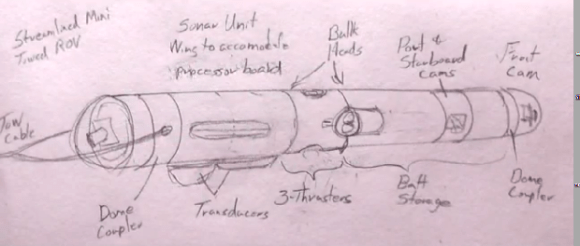
Like [Doug] and [Kay]’s adventures in shipbuilding, they’re documenting the entire build process of ROV construction via YouTube videos. The first video covers the construction of a pressure vessel out of a huge piece of 10″ ID, half inch wall steel pipe. The design of the ROV will look somewhat like a torpedo, towed by the ship with cameras pointing in all directions.

For communication with the surface everything is passing over a single Cat5 cable. They’re using an Ethernet extender that uses a twisted wire pair to bring Ethernet to the ocean bottom. With that, a few IP webcams relay video up to the ship and a simple Arduino setup allows for control of the ships thrusters.

The thrusters? Instead of an expensive custom solution they’re using off the shelf brushless motors for RC cars and planes. By potting the coils of a brushless outrunner motor, [Doug] and [Kay] found this solution makes an awful lot of sense; it’s cheap, fairly reliable, doesn’t require a whole lot of engineering, and most importantly cheap.

Bunch of videos below, or just check out [Doug] and [Kay]’s progress on their slightly out-of-date blog.

Continue reading “0.19 Leagues Under The Sea” →

[Ben Krasnow] Did It All For The (Perfect) Cookie

[Ben Krasnow] is on a mission. He’s looking for the perfect chocolate chip cookie. To aid him in this noble endeavor, he’s created the cookie perfection machine. From cleaning with plasma, to a DIY CT scanner, to ruby lasers, to LED contact lenses, [Ben] has to be one of the most prolific and versatile hackers out there today. What better way to relax after a hard day of hacking than to enjoy a glass of milk and a perfect chocolate chip cookie?

This is actually an update to the machine we first saw back in 2012. [Ben] has loaded his machine up with ingredients, and has everything under computer control. The machine will now dispense the exact amount of ingredients specified by the computer, measured by a scale. Everything happens one cookie at a time. The only downside is that the machine doesn’t have a mixer yet. [Ben] has to mix a single cookie’s worth of dough for every data point. His experiments have returned some surprising results. Too little flour actually results in a crisper cookie, as the wetter dough spreads out to a thinner layer. [Ben] also found that adding extra brown sugar also doesn’t result in a more chewy cookie. Even though he’s still in the early experimentation phases, [Ben] mentions that since it’s hard to make a bad chocolate cookie, even his failures taste pretty good.

Continue reading “[Ben Krasnow] Did It All For The (Perfect) Cookie” →

R/C Rock Crawler Prepped To Become Stair Climbing Robot

rc-robot-frame

[Starlino] is working on an autonomous mobile robot. Like many before him, he looked to the radio controlled car world for a base frame. He found a good candidate in a rock crawler model called “Mad Torque”. Crawlers have been around for years, but they’ve recently been getting more popular. As always, popularity leads to lower priced entry-level models, which puts this crawler at a reasonable price for a robot frame. As the name implies, rock crawlers are all about crawling. Relatively low speeds, locked differentials, four-wheel drive, and (optional) four-wheel steering.

Of course, [Starlino] had to test drive his frame out before tearing it down to install electronics. As long time R/C modelers ourselves, we can’t blame him. Testing uncovered one major problem. The Mad Torque wasn’t quite mad enough to climb the stairs in his house. The front tires would grab and pull over the first step, but the wheelbase wasn’t quite long enough for the rear wheels to grab hold.

[Starlino’s] solution was to extend the wheelbase. For most 4WD R/C cars or trucks this would be a major problem, as the motors are mounted amidships. An extended wheelbase would mean also extending the drive shafts or belts. This isn’t a problem with rock crawlers. Crawlers need to support huge amounts of suspension articulation. Rather than create complex drive linkages, the common design is to place an electric motor on each axle. This isn’t the greatest idea in terms of unsprung mass, but it does make for easy wheelbase changes. [Starlino] found that the design was so modular he could bolt a second chassis up to the original. The new rear chassis bolted to the front at the top shock mounts. An extra set of battery brackets formed a lower brace. The new extended truck was long enough to clear the steps, though it does still struggle a bit, as can be seen in the video. We think larger diameter tires might help a bit here. [Starlino’s] next step is to ditch the R/C unit and give this ‘bot a brain!

Continue reading “R/C Rock Crawler Prepped To Become Stair Climbing Robot” →