Satellite Snoopers Pick Up Surprising TV Broadcast

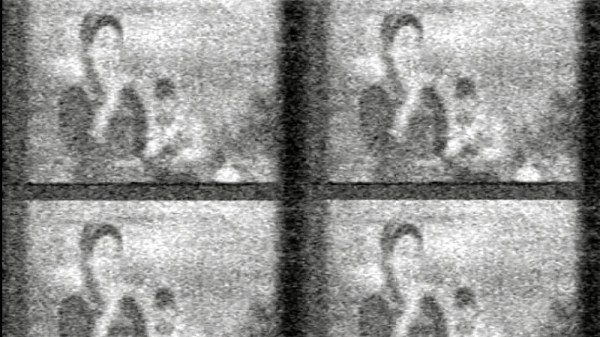
While Internet based streaming services appear to be the future of television, there are still plenty of places where it comes into the home via a cable, satellite, or antenna connection. For most satellite transmissions this now means a digital multiplex carrying a host of channels from a geostationary satellite, for which a set-top box or other decoder is required. Imagine the surprise of satellite-watchers than when the Russian polar communications satellite Meridian 9 which has a highly elliptical orbit was seen transmitting old-style terrestrial analogue TV (ThreadReader Link). What on earth was happening?

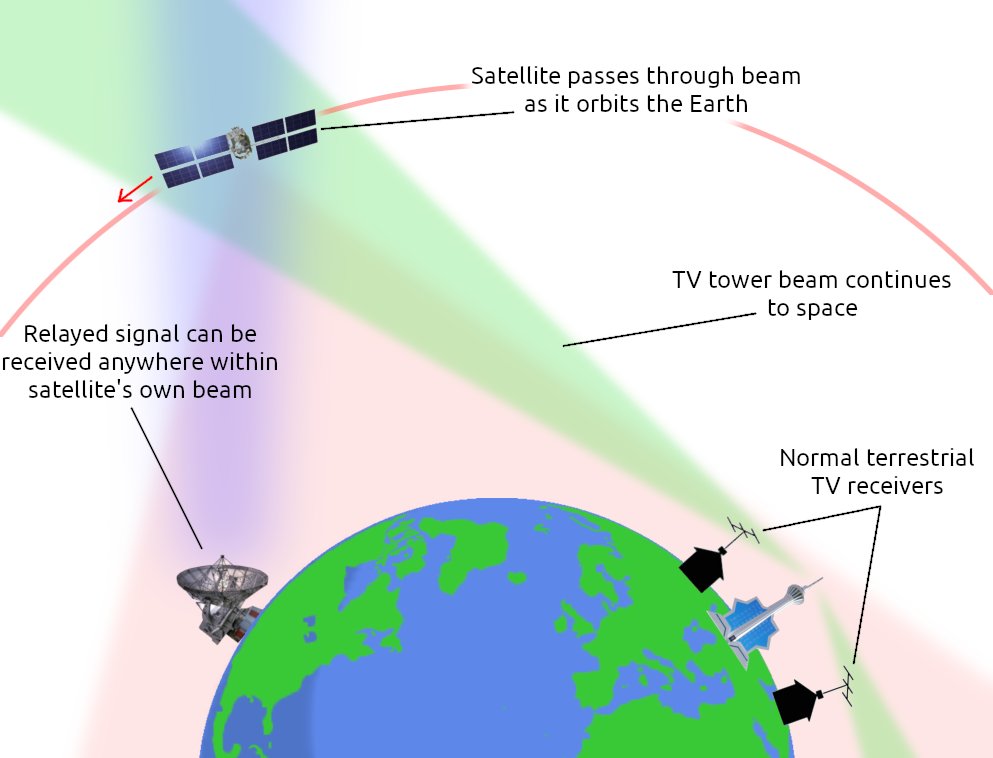
How a Russian polar comms satellite picked up a TV station.

The TV signal in question comes from Turkmenistan, so were some homesick Turkmenistanis in an Antarctic base being treated to a taste of their country? The truth is far more interesting than that, because the signal in question comes from a terrestrial transmitter serving domestic TV viewers in Turkmenistan.

We’ve all heard of the idea that somehow every TV show ever transmitted is somewhere out there still traveling as radio waves across space, and while perhaps we can’t fly far enough out to check for 1960s Doctor Who episodes it’s true that the horizontal transmissions from a TV tower pass out into space as the earth curves away from them.

Thus Meridian 9 passed through the beam from the Turkmenistan transmitter which happened to be on a UHF frequency that matched one of its transponders, and the result was an unexpected bit of satellite TV. We’re indebted to the work of [@dereksgc] and [Scott Tilley] for bringing us this fascinating observation. We’ve featured [Scott]’s work before, most notably when he relocated a lost NASA craft.

You Can Find Military Radars On Publicly-Available Satellite Data

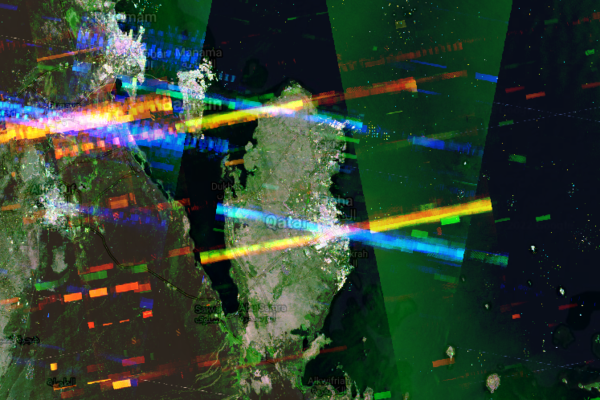
When it comes to hunting down military radar installations and associated hardware, we typically think of equipment that is firmly in the price bracket of nation states and their military forces. Whether it’s early warning radar, those used for air defence, or for naval purposes, you’d think it was relatively difficult to intercept or track these emissions.

However, a new tool built by geocomputation lecturer Ollie Ballinger shows this isn’t the case. In fact, openly-available data captured via satellite can be used to find all manner of military radar emitters. Let’s explore how!

Continue reading “You Can Find Military Radars On Publicly-Available Satellite Data”

Hackaday Links Column Banner

Hackaday Links: February 13, 2022

If you need evidence that our outwardly peaceful little neck of the solar system is actually a dangerous place, look no further than the 40 newly launched Starlink satellites that were just clobbered out of orbit. It seems that the SpaceX launch on February 3 was ill-timed, as it coincided with the arrival of energetic plasma from a solar storm that occurred a few days before. The coronal mass ejection followed an M-class flare on the Sun, which was aimed just right to hit just as the 49-satellite addition to the Starlink constellation was being released. This resulted in an expansion of the upper atmosphere sufficient to increase drag on the newborn satellites — up to 50% more drag than previous launches had encountered. Operators put the satellites into safe mode, but it appears that 40 of them have already met a fiery demise, or soon will. Space is a tough place to make a living.

Continue reading “Hackaday Links: February 13, 2022”

Detect Starlink Satellites Passing By

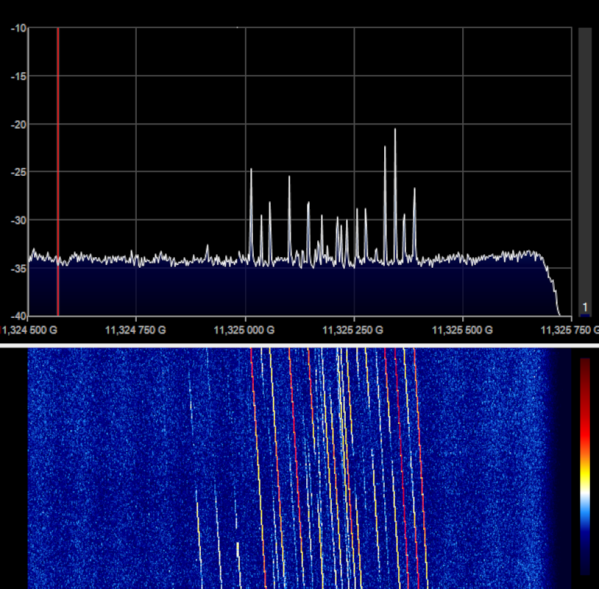
The Starlink beta has semi-officially ended, but it seems as though the global chip shortage is still limiting how many satellites are flying around the world for broadband internet access for those that might not be served by traditional ISPs. Not every location around the world has coverage even if you can get signed up, so to check that status the hard way you can always build a special antenna that tracks the Starlink beacons as they pass overhead.

[Derek] is using this project to show of some of his software-defined radio skills, so this will require an SDR that can receive in the 1600 MHz range. It also requires a power injector to power the satellite receiver, but these are common enough since they are used to power TV antennas. The signals coming from the Starlink satellites have a very high signal-to-noise ratio so [Derek] didn’t even need a dish to focus the signals. This also helped because the antenna he is using was able to see a much wider area as a result. Once everything was set up and the computer was monitoring the correct location in the spectrum, he was able to see very clearly how often a satellite passed him by.

Of course, [Derek] lives in an area with excellent coverage so this might be a little more difficult for those in rural areas, but possibly not for long as the goal of Starlink is to bring broadband to people who otherwise wouldn’t have access to it. There is some issue with how much these satellites might interfere with other astronomical activities though, so take that with a grain of salt.

Thanks to [Spritle] for the tip!

Russian Anti-Satellite Weapon Test Draws Widespread Condemnation

On the morning of November 15, a Russian missile destroyed a satellite in orbit above Earth.  The successful test of the anti-satellite weapon has infuriated many in the space industry, put astronauts and cosmonauts alike at risk, and caught the attention of virtually every public and private space organisation on the planet.

It’s yet another chapter in the controversial history of military anti-satellite operations, and one with important implications for future space missions. Let’s examine what happened, and explore the greater context of the operation.

Continue reading “Russian Anti-Satellite Weapon Test Draws Widespread Condemnation”

Space Age Road Rage: Right Of Way Above The Karman Line

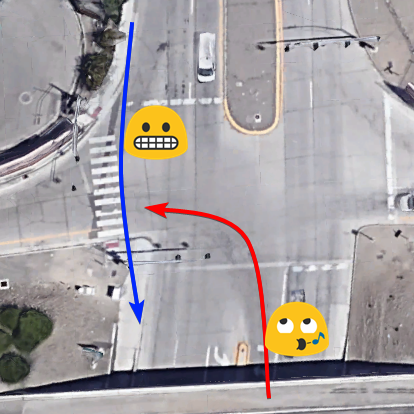
On a dark night in 2006 I was bicycle commuting to my office, oblivious to the countless man made objects orbiting in the sky above me at thousands of miles per hour. My attention was instead focused on a northbound car speeding through a freeway underpass at dozens of miles per hour, oblivious to my southbound headlamp. The car swerved into the left turn lane to get to the freeway on-ramp. The problem? I was only a few feet from crossing the entrance to that very on-ramp! As the car rushed through their left turn I was presented with a split second decision: slow, and possibly stop in the middle of the on-ramp, or just go for it and hope for the best.

A graphic depicting a dawdling bicycle rider about to be in the way of a speeding car driver
In Blue: Terrified cyclist. In Red: A speeding car careening around a corner without slowing down.

By law I had the right of way. But this was no time to start discussing right of way with the driver of the vehicle that threatened to turn me into a dark spot on the road. I followed my gut instinct, and my legs burned in compliance as I sped across that on-ramp entrance with all my might. The oncoming car missed my rear wheel by mere feet! What could have ended in disaster and possibly even death had resulted in a near miss.

Terrestrial vehicles generally have laws and regulations that specify and enforce proper behavior. I had every right to expect the oncoming car be observant of their surroundings or to at least slow to a normal speed before making that turn. In contrast, traffic control in Earth orbit conjures up thoughts of bargain-crazed shoppers packed into a big box store on Black Friday.

So is spacecraft traffic in orbit really a free-for-all? If there were stringent rules, how can they be enforced? Before we explore the answers to those questions, let’s examine the problem we’re here to discuss: stuff in space running into other stuff in space.

Continue reading “Space Age Road Rage: Right Of Way Above The Karman Line”

Things Are Looking Brighter! But Not The Stars

Growing up in Montana I remember looking out at night and seeing the Milky Way, reminding me of my insignificance in the universe. Now that I live in a city, such introspection is no longer easy, and like 1/2 of humanity that also lives in urban areas, I must rely on satellites to provide the imagery. Yet satellites are part of the problem. Light pollution has been getting worse for decades, and with the recent steady stream of satellite launches and billionaire joyrides we have a relatively new addition to the sources of interference. So how bad is it, and how much worse will it get?

Looking up at the night sky, you can usually tell the difference between various man-made objects. Planes go fairly slowly across the sky, and you can sometimes see them blinking green and red. Meteors are fast and difficult to see. Geostationary satellites don’t appear to move at all because they are orbiting at the same rate as earth’s rotation, while other orbit types will zip by.

SpaceX has committed to reducing satellite brightness, and some observations have confirmed that new models are a full magnitude darker, right at the threshold of naked-eye observation. Unfortunately, it’s only a step in the right direction, and not enough to satisfy astronomers, who aren’t looking up at the night sky with their naked eyes, naturally.

The satellites aren’t giving off the light themselves. They are merely reflecting the light from the sun back to the earth, exactly the same way the moon is. Thus something that is directly in the shadow of the Earth will not reflect any light, but near the horizon the reflection from the satellites can be significant. It’s not practical to only focus our observatories in the narrow area that is the Earth’s shadow during the night, so we must look closer to the horizon and capture the reflections of the satellites. Continue reading “Things Are Looking Brighter! But Not The Stars”