Taylorator Makes Mischief On The Airwaves

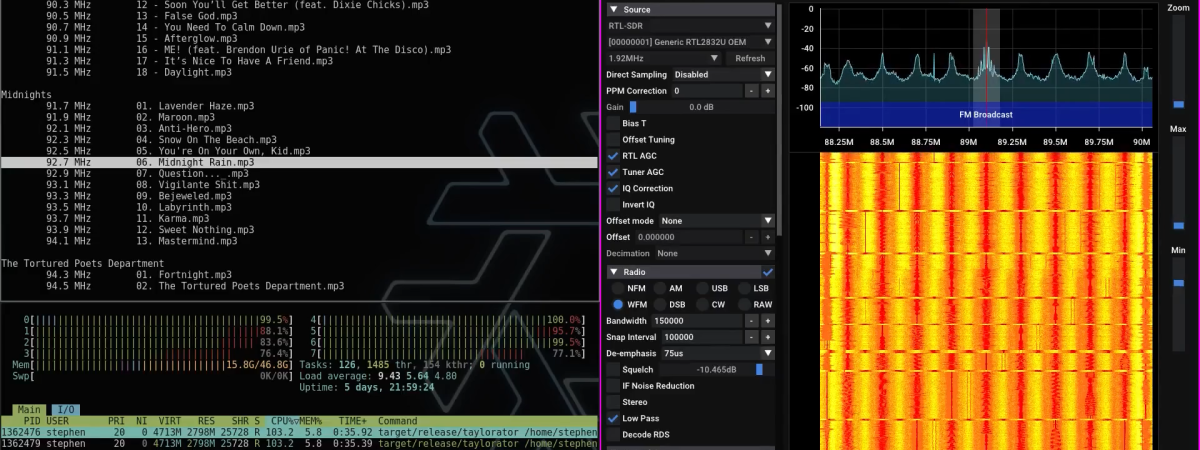
[Stephen] recently wrote in to share his experiments with using the LimeSDR mini to conduct a bit of piracy on the airwaves, and though we can’t immediately think of a legitimate application for spamming the full FM broadcast band simultaneously, we can’t help but be fascinated by the technique. Called the Taylorator, as it was originally intended to carpet bomb the dial with the collected works of Taylor Swift on every channel, the code makes for some interesting reading if you’re interested in the transmission-side of software defined radio (SDR).

The write-up talks about the logistics of FM modulation, and how quickly the computational demands stack up when you’re trying to push out 100 different audio streams at once. It takes a desktop-class CPU to pull it off in real-time, and eats up nearly 4 GB of RAM.

You could use this project to play a different episode of the Hackaday Podcast on every FM channel at once, but we wouldn’t recommend it. As [Stephen] touches on at the end of the post, this is almost certainly illegal no matter where you happen to live. That said, if you keep the power low enough so as not to broadcast anything beyond your home lab, it’s unlikely anyone will ever find out.

Continue reading “Taylorator Makes Mischief On The Airwaves”

Car Radio Chip Goes Into DIY Build

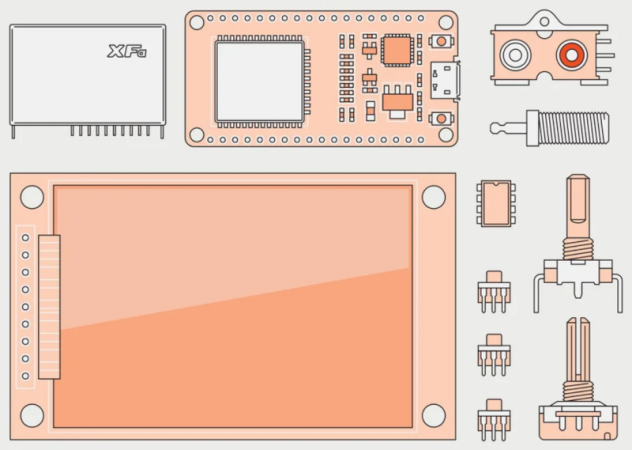
[Sjef Verhoeven] still loves radio and enjoys the challenge of listening to radio signals from far away. He wanted to build his own radio and turned to the TEF6686 chip, a device often found in car radios. It is known to be very sensitive and seemed perfect for pulling in weak signals. So [Sjef] built this DIY radio and shares the details in this recent Spectrum post.

Unlike older radio-on-chip devices, the TEF6686 is a DSP, which, according to the post, is part of the reason it is ultrasensitive. Even though it is made for car radios, the device is versatile and can pick up shortwave as well as the usual broadcast bands, with the right configuration.

Continue reading “Car Radio Chip Goes Into DIY Build”

Junk Box Build Helps Hams With SDR

SDRs have been a game changer for radio hobbyists, but for ham radio applications, they often need a little help. That’s especially true of SDR dongles, which don’t have a lot of selectivity in the HF bands. But they’re so darn cheap and fun to play with, what’s a ham to do?

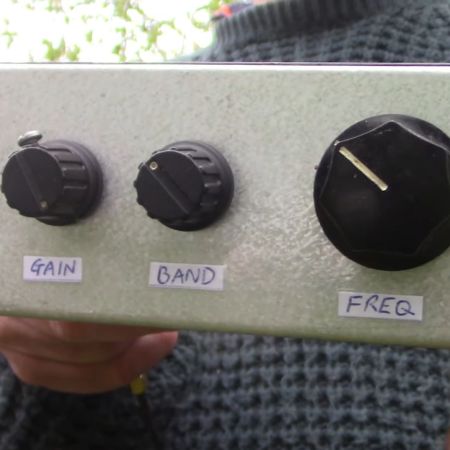
[VK3YE] has an answer, in the form of this homebrew software-defined radio (SDR) helper. It’s got a few features that make using a dongle like the RTL-SDR on the HF bands a little easier and a bit more pleasant. Construction is dead simple and based on what was in the junk bin and includes a potentiometer for attenuating stronger signals, a high-pass filter to tamp down stronger medium-wave broadcast stations, and a series-tuned LC circuit for each of the HF bands to provide some needed selectivity. Everything is wired together ugly-style in a metal enclosure, with a little jiggering needed to isolate the variable capacitor from ground.

The last two-thirds of the video below shows the helper in use on everything from the 11-meter (CB) band down to the AM bands. This would be a great addition to any ham’s SDR toolkit.

Continue reading “Junk Box Build Helps Hams With SDR”

GNSS Reception With Clone SDR Board

We love seeing the incredible work many RF enthusiasts manage to pull off — they make it look so easy! Though RF can be tricky, it’s not quite the voodoo black art that it’s often made out to be. Many radio protocols are relatively simple and with tools like gnuradio and PocketSDR you can quickly put together a small system to receive and decode just about anything.

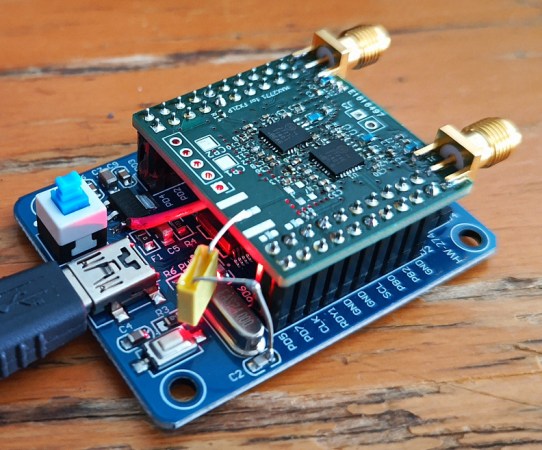
[Jean-Michel] wanted to learn more about GNSS and USB communication. Whenever you start a project like this, it’s a good idea to take a look around at existing projects for designs or code you can reuse, and in this case, the main RF front-end board is taken from the PocketSDR project. This is then paired with a Cypress FX2 development board, and he re-wrote almost all of the PocketSDR code so that it would compile using sdcc instead of the proprietary Keil compiler. Testing involved slowly porting the code while learning about using Python 3 to receive data over USB, and using other equipment to simulate antenna diversity (using multiple antennas to increase the signal-to-noise ratio): Continue reading “GNSS Reception With Clone SDR Board”

Cyberpack Puts All The Radios Right On Your Back

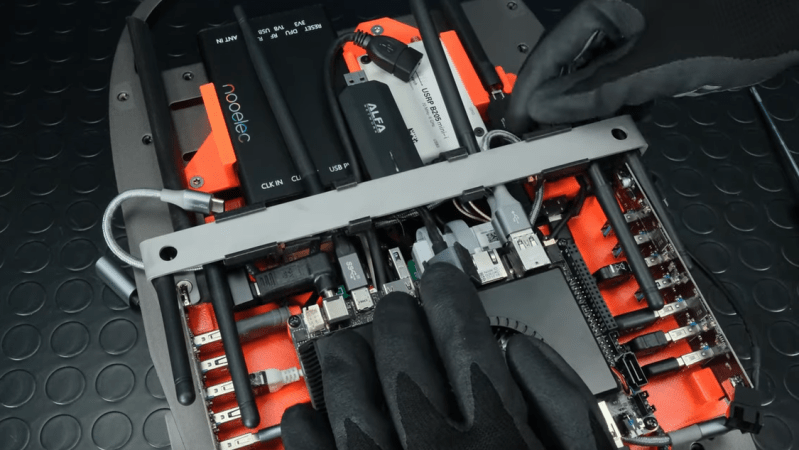
A disclaimer: Not a single cable tie was harmed in the making of this backpack cyberdeck, and considering that we lost count of the number of USB cables [Bag-Builds] used to connect everything in it, that’s a minor miracle.

The onboard hardware is substantial, starting with a Lattepanda Sigma SBC, a small WiFi travel router, a Samsung SSD, a pair of seven-port USB hubs, and a quartet of Anker USB battery banks. The software defined radio (SDR) gear includes a HackRF One, an Airspy Mini, a USRP B205mini, and a Nooelec NESDR with an active antenna. There are also three USB WiFi adapters, an AX210 WiFi/Bluetooth combo adapter, a uBlox GPS receiver, and a GPS-disciplined oscillator, both with QFH antennas. There’s also a CatSniffer multi-protocol IoT dongle and a Flipper Zero for good measure, and probably a bunch of other stuff we missed. Phew!

As for mounting all this stuff, [Bag-Builds] went the distance with a nicely designed internal frame system. Much of it is 3D printed, but the basic frame and a few rails are made from aluminum. The real hack here, though, is getting the proper USB cables for each connection. The cable lengths are just right so that nothing needs to get bundled up and cable-tied. The correct selection of adapters is a thing of beauty, too, with very little interference between the cables despite some pretty tightly packed gear.

What exactly you’d do with this cyberpack, other than stay the hell away from airports, police stations, and government buildings, isn’t exactly clear. But it sure seems like you’ve got plenty of options. And yes, we’re aware that this is a commercial product for which no build files are provided, but if you’re sufficiently inspired, we’re sure you could roll your own.

Continue reading “Cyberpack Puts All The Radios Right On Your Back”

Pi Pico SDR On A Breadboard

How hard is it to make a fully standalone SDR? [101 Things] shows you how to take a breadboard, a PI Pico, and two unremarkable chips to create a capable radio. You can see the whole thing in the video below.

The design uses a standard Tayloe demodulator. There’s also an encoder and an OLED display for a user interface. You might also want to include some PC speakers to get a bit more audio out of the device.

Continue reading “Pi Pico SDR On A Breadboard”

The Pi Pico, An SDR Receiver Front End

Making a software defined radio (SDR) receiver is a relatively straightforward process, given the right radio front end electronics and analogue-to-digital converters. Two separate data streams are generated using clocks at a 90 degree phase shift, and these are passed to the software signal processing for demodulation. But what happens if you lack a pair of radio front ends and a suitable clock generator? Along comes [Mordae] with an SDR using only the hardware on a Raspberry Pi Pico. The result is a fascinating piece of lateral thinking, extracting something from the hardware that it was never designed to do.

The onboard RP2040 ADC is of course far too slow for the task, so instead an input is used, with a negative feedback arrangement from another GPIO to form a crude 1-bit ADC. A PIO peripheral is then used to perform the quadrature mixing, resulting in the requisite pair of data streams. At this point these are sent over USB to GNU Radio for demodulating, mainly for convenience rather than necessarily because the microcontroller lacks the power.

The result is a working SDR front end, demonstrated pulling in an FM broadcast station. The Pico has to be overclocked to reach that frequency and it’s more than a little noisy, but we’re extremely impressed with how much has been done with so little. Oddly it isn’t the first Pico SDR we’ve seen, but the previous one was a much more conventional and lower-frequency affair for the European Long Wave band.