
Recycled Cat Feeder

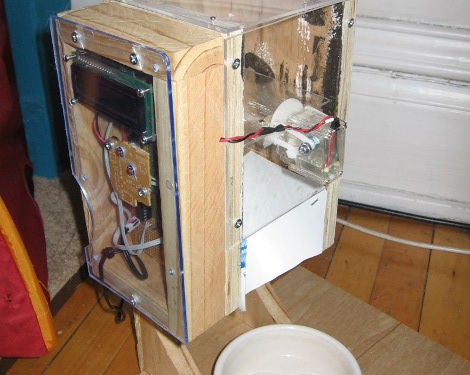
I find that I do a lot of fun projects but I’m very bad about documenting them when I’m done. Holidays are for hacking (in my mind) so I usually plan ahead and do something cool during my time off. This project, which I loving call the Autodine-2009, was a spontaneous event over Thanksgiving that I’m just getting around to writing about.

Our cat’s want to be fed at 6am and are very insistent about it. Like most folks, I’d rather be sleeping at that time of day so I built an automatic cat feeder. Now we sleep while the cats eat. We don’t want to rely on a hack to feed our cats when we’re away so I didn’t go the route of an Internet-enabled multiple-dose feeder. Instead, I used parts on hand to create a single-serving dispenser on a timer. A servo rotates a false bottom to gravity-feed the cat food. The servo doesn’t have control circuitry so it is controlled through an h-bridge (I did have to buy 2 transistors for that) by an AVR ATmega8 microcontroller. There are two salvaged tactile switches to set the time and timer, and a serial LCD display that I’ve had sitting around for years. Power comes from an old cell phone charger a friend had just given me that spawned the feeder idea when I asked myself “hmmm, what can I use this for”?

I’ll demonstrate this recycled device for you in a video after the break. This wasn’t as hardcore as my AVR Tetris build but I’m much happier now that I can sleep in a bit.

Continue reading “Recycled Cat Feeder”

Frustromantic Box, A Reverse Geocache

One of the best feelings in the world is when one of our posts inspires a fellow hacker to plan, create, and execute his or her own project.

[Russ] let us know about his Frustromantic Box which he gained inspiration from the original Reverse Geochache we posted about. For those out of the loop, the box is locked and will only open in a certain location. The current distance to the  location is displayed on the screen when a button is pressed, and usually there is a limited number of button presses (3 presses for those that know geometry, 50 for everyone else). As soon as the box is at location, it will open.

The Frustromantic Box uses an Arduino, classic HD44780 display, a servo, and the pièce de résistance EM406 GPS. All built in time to frustrate his wife for Christmas.

Servo Hacked Linear Actuator

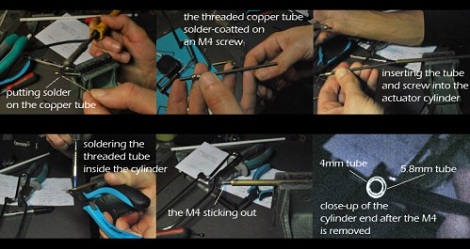
[AntonB] has modified a servo into a powerful linear actuator (think: changing rotational motion into linear motion). The process is simple enough, modify a servo for continuous rotation and then add the custom built actuating shaft. You do of course lose the precision of the servo, but a small price to pay to be able to lift ~20 pounds straight up. Inspiration for such a cheap solution came from his Planetary Surface Exploration Rover. Check out a video of both after the break.

[Thanks Eric]

Continue reading “Servo Hacked Linear Actuator”

Cubicle-dwellers Rewarded For Reflexes

[youtube=http://www.youtube.com/watch?v=kUqRcLjFOUc]

[StudioJooj] is trying to torture or test his colleagues in his office. A lot of folks leave a candy jar on their desks for all to enjoy but he’s making his friends work for their reward. Like cubicle-dwelling lab subjects, they must successfully navigate his maze to be rewarded with chocolate. The game piece is an amazingly orb-like peanut M&M candy. The maze is constructed from plywood and moves on two axis with the help of a couple of servos. The user interface includes a couple of NES console buttons to release the game piece and a PS2 joystick to control the maze. [StudioJooj] was nice enough to include a music video in his project clip.

We wonder the M&Ms will disappear faster or slower than they would from a candy jar.

[via SparkFun]

Double Clutch Transmission Model

[Alan] did an extraordinary job building a computer controlled model gearbox. His project from several years back is based on a dual-clutch Direct Shift Gearbox that was developed for VW and Audi vehicles. His design uses a gear head motor to provide the locomotion to this transmission. Shifting is computer controlled through serial cable, with servo motors providing the physical motion to change gears. Seeing all these moving parts in the clip after the break might make you a bit dizzy.

This is some extreme model building. It reminds us of the guy who built that aluminum aircraft model that was all over the Internets in December.

Continue reading “Double Clutch Transmission Model”

Simplest Most Useless Machine

[youtube=http://www.youtube.com/watch?v=Z86V_ICUCD4]

[Brett] posted about his most useless machine build. His project gives us a chance to massacre the language in the title because it uses the lowest parts count we’ve see with these machines. The logic is controlled by our friend, the 555 timer. Add to that just one servo motor, two switches, three resistors, two caps, a diode, and a battery pack and you’re in business. The hardest part to find locally is the servo but check at a hobby/RC store. If you don’t have to put in a parts order this can be your next impulse project.

Simple Liquid Dispenser For Auto-cocktails

[Qdot] came up with a simple way to dosing out liquids to use in his Bartris project. As you can see above, flexible tubing is connected to some inverted bottles that house the liquid. A chopstick is attached to a board on one end, and via string to a servo on the other. When the servo turns it pulls the chopstick tight against the board, cutting off the flow of liquid through the tubing. This isn’t as elegant as the system the Bar2D2 uses but it’s a heck of a lot less expensive.

You can check out some of the build pictures in his Flickr pool. He’s included this concept in a project he calls Adult Mario. Watch the video after the break but the quick and dirty is that the more coins you score in Super Mario Brothers, the more beverage is rationed out into your cup. Ah, human lab rats, is there nothing they won’t do for booze?

Continue reading “Simple Liquid Dispenser For Auto-cocktails”









