Things That Kill You, Hacked For Clean Energy

Tobacco and E coli can wreak havoc on your body causing serious damage if not death. Some researchers from the University of California at Berkeley have found a way to take these potentially dangerous organisms and make them do our bidding. By genetically engineering a virus they have shown that the two can be used to grow solar cells. Well, they grow some of the important bits that go into solar cells, reducing the environmental impact of the manufacturing process.

Once a tobacco plant is infected with the altered virus it begins producing artificial chromophores that turn sunlight into electricity. Fully grown plants are ground up, suspending the chromophores in a liquid which is sprayed onto glass panels to create the solar cells. This types of creative solar energy production make us wonder if Thunderdome and the apocalypse are further off than we thought.

[Thanks Jon]

Cold Climate Solar Water Heater

Here’s a solar water heater setup that augments your home’s water heater instead of replacing it. The system monitors a solar collector panel on the roof for temperature. If the temperature is warm enough, a photo voltaic cell powered pump circulates cold water through the system. The heated water returns to the top of the home’s water heater. Unlike the warm-climate solar heater we saw earlier, this one can withstand freezing because it uses silicone tubing in the collector.

[Thanks Marius]

Solar Water Heater

[Jake] built himself a solar water heater. The system has an 82 gallon insulated water tank and uses a solar collection grid made of PVC pipe. As the water heats, it rises to the top of the collector and runs into the tank while pulling colder water from the bottom of the tank back into the collector.

A sunny day yields temperatures around 130 degrees Fahrenheit. On a cloudy day the water can still be heated to about 90 Fahrenheit. This is about 19 degrees cooler that one might desire but the difference is made up by an electric shower head that heats as the water comes out. [Jake’s] system, seen in the video after the break, allows him to forgo the use of electricity on sunny days, and reduce its use by around half on cloudy days. Continue reading “Solar Water Heater”

Thermoelectric Solar Power

Thermo_Electric_Solar_Power

[Colin] has put together an instructable for a solar power generator that uses the thermoelectric effect instead of the photovoltaic (PV) effect. We have seen Peltier devices used in cooling cans, solder paste, backs, and hacked hard drives. This is the first hack we have seen where a Peltier device is used to generate electricity from heat, essentially running the device backwards. The thermoelectric effect is the same principle that is used to generate electricity in radioisotope thermoelectric generators used in deep space probes such as Cassini. What applications can you come up with to use the thermoelectric effect as a power source?

Solar Tracking, Without Overkill

[youtube=http://www.youtube.com/watch?v=ATnnMFO60y8]

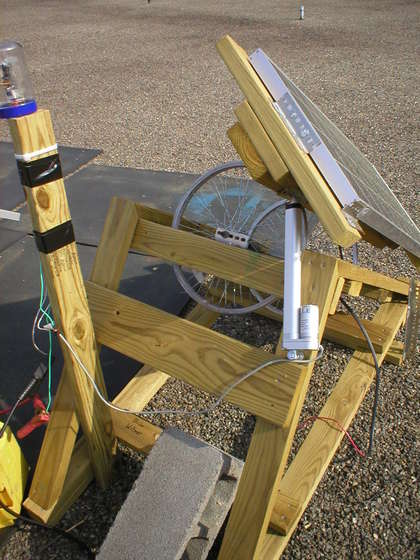
We saw this pretty smooth solar tracker run by an Arduino. There aren’t many details, but we can see that it works well, and is in fact, run by an Arduino. We knew if we posted this that people would be commenting that the Arduino is overkill. We agree.  So this post is to ask, how would you do it? Give us links to the more efficient designs you have come up with. It doesn’t have to be a fully documented project, a schematic will do. We would probably go with something like a phototropic suspended bicore for simplicity and low power consumption.

[via littlebirceo]

Vintage Video: Computing Across America

roberts

in 1983, [Steve Roberts] packed up a Tandy 100 laptop and a 5-watt solar panel, fleeing suburbia on his recumbent bicycle on what would become a 17,000 mile journey that forever cemented his place in the geek pantheon…not just as a technology hacker, but as one of the preeminent “life hackers,” pursuing his own dreams on his own terms and inspiring others to do the same.

In this 1989 video, recently unearthed by Hack a Day, [Roberts] reflects on the first 16,000 miles of his voyage, detailing some of the technology that went into his then-current ride, the Winnebiko II.

Continue reading “Vintage Video: Computing Across America”

12kW Solar Collector

[youtube=http://www.youtube.com/watch?v=jTvAL7ty53M]

Though not much info is readly available about it on the web, [Joe Carruth] is trying to build publicity (and venture capital) for his home-built solar electric generator. At its essence, it is a Stirling dish system with an adjustable composite mirror surface. This means that instead of having to rotate the entire contraption in order to follow the Sun, [Joe] only has to make  the mirror segments pivot. A Stirling steam engine at the tip converts the energy into the movement used to generate electricity. Solar power plants (or ‘farms’) that are emerging are beginning to consider the advantages of using more efficient Stirling dishes rather than less efficient solar panels. If anyone has an idea as to how [Joe] can automate sun tracking for the mirrors, please post it in the comments. A couple more videos on the topic (in general) are available below: Continue reading “12kW Solar Collector”