Building A High-Performance Shifter For Sim Racing

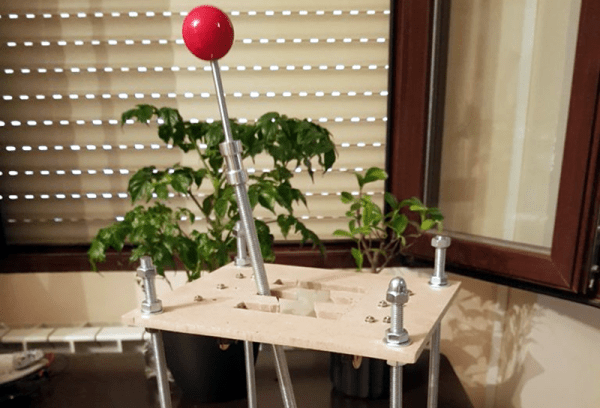
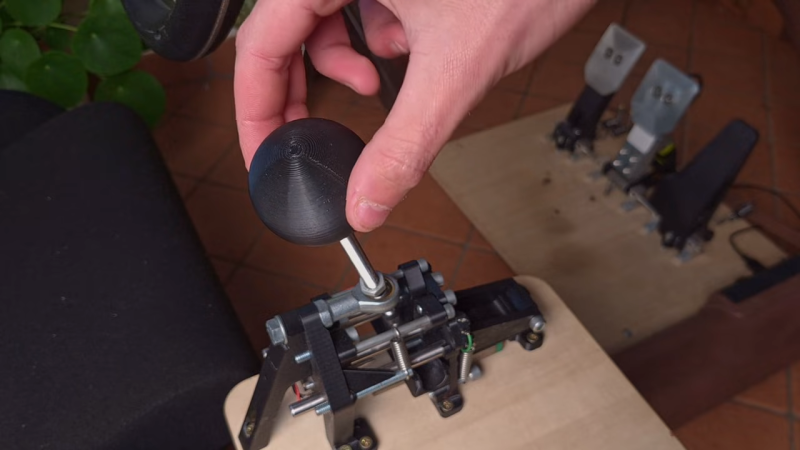
These days, sim racing is more realistic than ever. There are better screens, better headsets, and better steering wheels with better force-feedback, all of which help make you feel like you’re driving the real thing. If you’re looking for a stick shifter to complete such a setup, [DAZ Projects] might have just what you’re looking for. 

To create a robust shifter with great feel, the build relies on 3D printed parts as well as lots of quality metal hardware. At the heart of the build is a linear rail for the front-to-back movement, with a printed slider on top with a carefully-profiled indexer to ensure the stick properly ca-chunks into the right gear. A ball joint locates the shift lever itself, while allowing for smooth movement left-to-right. Centering is via simple extension springs. The H-pattern shift is enforced with machined steel rods. Detecting the position of the stick is handled via microswitches, with an Arduino Leonardo reading the switches and reporting itself as a USB device that should work with any modern sim.

It’s funny to think that such a mechanism would once have been a very serious machining job. These days, you can just squirt all this stuff out on a printer in a few hours. For the parts that can’t be extruded, [DAZ Projects] has provided a parts list on Google Docs.

We’ve featured some great racing sim builds over the years, from button pads to pedal boxes.

Continue reading “Building A High-Performance Shifter For Sim Racing”

The Physics Lesson I Keep Re-Learning

One of the most broadly applicable ideas I’ve ever encountered is the concept of impedance matching. If you’re into radio frequency electronics, you’re probably thinking that I mean getting all your circuit elements working to a common characteristic resistance for maximum power transfer. (If you’re not, you’re probably wondering what that jumble of words even means. Fear not!)

But I mean impedance matching in the larger sense. Think about driving a stick-shift automobile. In low gear, the engine has a lot of torque on the wheels, but it can’t spin them all that fast. In high, the wheels turn fastest, but there’s not enough torque to get you started from a standstill. Sometimes you need more force and less motion, other times more motion and less force. The gearbox lets you match the motor’s power to the resistance – the impedance – it’s trying to overcome.

Or think about a cello. The strings are tight, and vibrate with quite a bit of force, but they don’t move all that much. Air, which is destined to carry the sound to your ear, doesn’t take much force to move, and the cello would play louder if it moved more of it. So the bridge conveys the small, but strong, vibrations of the strings and pushes against the top of the resonant box that makes up the body of the instrument. This in turn pushes a lot of air, but not very hard. This is also why speakers have cones, and also why your ear has that crazy stirrup mechanism. Indeed, counting the number of impedance matches between Yo Yo Ma and your brain, I come up with four or five, including electrical matches in the pre-amp.

I mention this because I recently ran into a mismatch. Fans blow air either hard or in large volume. If you pick a fan that’s designed for volume, and put it in a pressure application, it’s like trying to start driving in fifth gear. It stalled, and almost no air got pushed up through the beans in my new “improved” coffee roaster, meaning I had to rebuild it with the old fan, and quick before the next cup was due.

I ran into this mismatch even though I knew there was a possible impedance issue there. I simply don’t have a good intuitive feel how much pressure I needed to push the beans around – the impedance in question – and I bought the wrong fan. But still, knowing that there is a trade-off is a good start. I hope this helps you avoid walking in my footsteps!

Four On The Floor For Your Virtual Race Car

There was a time when building realistic simulations of vehicles was the stuff of NASA and big corporations. Today, many people have sophisticated virtual cockpits or race cars that they use with high-resolution screens or even virtual reality gear. If you think about it, a virtual car isn’t that hard to pull off. All you really need is a steering wheel, a few pedals, and a gear shifter. Sure, you can build fans to simulate the wind and put haptics in your seat, but really the input devices alone get you most of the way there. [Oli] decided he wanted a quick and easy USB gear shifter so he took a trip to the hardware store, picked up an arcade joystick, and tied it all together with an Arduino Leonardo. The finished product that you can see in the video below cost about $30 and took less than six hours to build.

The Leonardo, of course, has the ability to act like a USB human interface device (HID) so it can emulate a mouse or a keyboard or a joystick. That comes in handy for this project, as you would expect. The computer simply has to read the four joystick buttons and then decide which gear matches which buttons. For example up and to the left is first gear, while 4th gear is only the down button depressed. A custom-cut wooden shifter plate gives you the typical H pattern you expect from a stick shift.

Continue reading “Four On The Floor For Your Virtual Race Car”

Hackaday Podcast 066: The Audio Overdub Episode; Tape Loop Scratcher, Typewriter Simulator, And Relay Adder

Hackaday editors Elliot Williams and Mike Szczys stomp through a forest full of highly evolved hardware hacks. This week seems particularly plump with audio-related projects, like the thwack-tackular soldenoid typewriter simulator. But it’s the tape-loop scratcher that steals our hearts; an instrument that’s kind of two-turntables-and-a-microphone meets melloman. We hear the clicks of 10-bit numbers falling into place in a delightful adder, and follow it up with the beeps and sweeps of a smartphone-based metal detector.

Take a look at the links below if you want to follow along, and as always, tell us what you think about this episode in the comments!

Direct download (60 MB or so.)

Continue reading “Hackaday Podcast 066: The Audio Overdub Episode; Tape Loop Scratcher, Typewriter Simulator, And Relay Adder”